One November day awhile ago, I was dispatched by Publishers Weekly to Washington, D.C. to interview the famous newsman Jim Lehrer, who just had a novel out. My editor insisted the interview take place at his home not far from the National Cathedral, not his office. This to create a feeling of intimacy, including details about all the bus memorabilia he collected in honor of his father, a bus driver, etc. Lehrer kindly complied, rushing from his office in Arlington, VA, where he was preparing to interview the Assistant Director of the FBI.
Tag: Waking Up
-
Take Off the Bubble Top
Sitting in his pretty, unwashed living room, Lehrer gave the impression of having stopped on a dime. Lehrer’s famous face, as ordinary and noble as a farmhouse on a Western plain, composed itself in a look of alert waiting. His way of being with me, forthright and decent, was a lesson in how to conduct interviews–and also in how we can be with one another.Lehrer was used to living in the present moment under intense scrutiny. He was used to asking questions designed to draw out the truth without shouting or intruding, without the questions screaming for attention themselves. He recalled driving his daughters to one presidential debate he was moderating: “I told my girls in the car, if people remember the questions, I haven’t done my job.”It was excruciating to watch the trampling of time limits, the ignoring of questions to “stay on message,” the blatant lying, in the last presidential debate Lehrer tried to moderate. I felt like I was watching a decent man witness the seeming loss of our ability to have a civilized (not to mention honest) exchange in this country.But this is beside the point today. The point is this singular memory that Lehrer shared. He worked as a young newspaper reporter in Dallas in the late 1950s and 60s. On November 22, 1963, he was dispatched to ask the Secret Service man in charge of security President Kennedy’s motorcade whether the President would be riding with the bullet-proof bubble-top on his limousine on or off. As fate would have it, it was a beautiful day.“Take off the bubble top!” Lehrer heard the man command. Later, inside the Dallas police station, the shattered agent whispered the same words to Lehrer again. Lehrer wondered how many times the poor man had thought of those words since. May he have found peace.Our lives are made of moments, some indelible, but each dependent on causes and conditions beyond fathoming. What happens to others and to ourselves, what arises in a moment, binds us to each other and to a greater whole.
-
In the Chapter Room
“The solitary life, being silent, clears away the smoke-screen of words that man has laid down between his mind and things,” writes Thomas Merton in Thoughts in Solitude. “In solitude we remain face to face with the naked being of things. And yet we find that the nakedness of reality which we have feared, is neither a matter of terror nor for shame. It is clothed in the friendly communion of silence, and this silence is related to love. The world our words have attempted to classify, to control and even to despise (because they could not contain it) comes close to us, for silence teaches us to know reality by respecting it where words have defiled it.”
When you are thinking of bicycles, you see bicycles everywhere. Contemplating Parabola’s latest theme, “Alone and Together,” I find fresh evidence of the interplay between solitude and community everywhere. I visited The Cloisters with my daughter Alex and her boyfriend Anthony. Set on a hilltop with sweeping views of the Hudson River, The Cloisters is not just a museum of medieval art, it actually is a medieval cloister transported here from France.
Merton writes of it in The Seven Storey Mountain, the iconic memoir of his spiritual journey. Merton opens the book by saying that he was born in the shadow of some French mountains. “There were many ruined monasteries in those mountains,” he writes “My mind goes back with great reverence to the thought of those clean, ancient stone cloisters, those low and mighty rounded arches hewn and set in place by monks who have perhaps prayed me where I now am…”
And many momentous years later, after he lost his father and mother, after he went to private school and Cambridge University, and then on to Columbia University in New York, Merton encountered one of those ancient cloisters again…in the upper reaches of Manhattan. Can you imagine? He found himself at Columbia, in what I’ve heard called upstate Manhattan. Under his friendliness and activity, he was lonely and searching. And as he began to turn towards the contemplative path, as he began to turn towards the inner path—he found a monastery from the innermost layers of memory—literally relocated in time and place. Can you imagine the proverbial mountain coming for you?
“One of [the cloisters], stone by stone, followed me across the Atlantic a score of years later, and got itself set up within convenient reach of me when I most needed to see what a cloister looked like, and what kind of place a man might live in, to live according to his rational nature, and not like a stray dog. St. Michel-de-Cuxa is all fixed up in a special and considerably tidy little museum in an uptown park in New York, overlooking the Hudson River, in such a way that you don’t recall what kind of city you are in. It is called The Cloisters. Synthetic as it is, it still preserves enough of its own reality to be a reproach to everything else around it, except the trees and the Palisades (the lofty steep cliffs along the Hudson).”
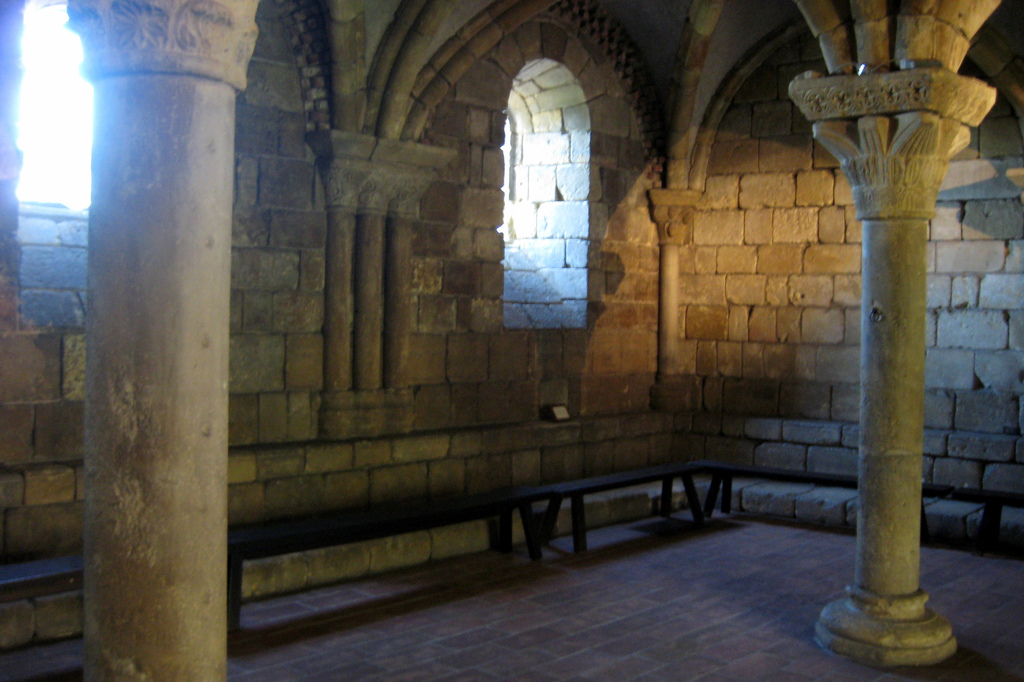
I sat in the cool depths of the Chapter House. With Alex’s firm encouragement (understandably, she and Anthony wanted to drift through the garden and among the treasures without Mom on their heels), I sat for a long while in a twelfth-century enclosure where monks gathered for daily readings of the Rule of St. Bendict, the rules of their order—the most famous of which is about welcoming guests as if they were a manifesting divine. I felt welcomed, and more. The stones communicated something to me on a “preverbal”—possibly even a “post-verbal” level.
“True communication on the deepest level is more than a simple sharing of ideas, of conceptual knowledge, or formulated truth,” writes Merton in a talk he once planned. “The kind of communication that is necessary on this level must also be ‘communion’ beyond the level of words….”
For a little while, sitting in the Chapter Room, I experienced The Cloisters not as a tourist but as a pilgrim. I felt a presence or vibration in the stones around me. It felt like I was being helped by the efforts of others in the past who tried to cultivate an awareness beyond ordinary words and knowledge—who tried to open to what is new, to welcome whomever and whatever arrives as a manifestation of the divine.
Eventually, Alex and Anthony arrived. I described my sense that the stones communicated something. Alex is used to this sort statement from me. But Anthony, who studies theoretical physics and math in graduate school at Princeton, looked doubtful. No matter. I know that he understands that nothing is solid and separate in his own way. I know that we are made up of energies that too quick and subtle to perceive.
Except, I find that we can sense this great mystery with these very bodies, hearts, and minds. Sometimes when we are very still, there can be a subtle movement of availability and we can receive something extraordinary that is being offered, radiated. Sitting at The Cloisters the other day, I glimpsed that reality—a finer level reality—is not something chilly and abstract. It really does come “clothed in the friendly communion of silence.”
-
Car Crash Sutra
The accident happened at the worst possible moment, although there is probably never a really good moment for a car accident. I was driving home through the rain, thinking about how much I had to do before I left for my daughter’s college graduation that week. I was thinking about what a difficult week it had been and feeling triumphant. I accomplished so much! Good for me! And then…crash! I was driving through an intersection, almost home, when an elderly man turned left and smashed into me, demolishing the front of my car.Time slows down during accidents and emergencies. A crystalline clarity comes. I was aware of my thoughts. Wasn’t I driving straight through a green light? Was the driver impaired? He turned on red! But the thoughts seemed slow and overly simple, like a headline news stream, compared to the full feeling the impact. There was the sensation of the collision and the sound of crunching metal and breaking glass. And there was a deeper seeing. I watched myself try to refuse to take in what was happening. My mind tried to push it away with objections: It wasn’t right! Why did it have to be happening on the week of Alex’s graduation? Why did I have to be in that place at that time? And at the same time, a deeper awareness watched all this and more: I saw that every cell of my being was bracing itself, contracting, scooting away, DID NOT WANT THIS TO BE HAPPENING.
But all my thinking and objecting could not undo it. I sat stunned in the rain in my crushed little hybrid car. It got worse. The other driver, an elderly man who did seem a bit disoriented, got out of the big van he was driving and yelled at me to call the police because he did not have a phone. He hit crushed my car and then he yelled at me! His bullying manner was so unexpected and so wrong that I burst into tears. A volunteer fireman appeared out of nowhere and slipped into the seat beside me. He asked me if I was hurt. I told him that I was not although my feelings were very hurt. He nodded, this witnessing angel. I told him that my daughter was graduating from college that week. I told him that I loved my little Prius, and that I just bought it a few months ago. I told him it had been a very difficult week. These things happen, he told me kindly. This seemed incredibly true and profound. A very similar thing happened to him not long ago, he told me. Someone was texting and ran into him. Accidents happen. We both nodded. The important thing is that no one is hurt.
People should pay attention, I told him, realizing in my shocked state that this was also deeply true. Paying attention is the key to not being hurt. We waited together in the rain for a long time until the lcal police came. The press of errands and tasks just stopped, the flow of traffic proceeded around us, and I realized I would never be able to control life with my thoughts. Accidents would happen. It struck me as very strange then, that I would choose to live my taking the counsel of these ordinary thoughts, driven as they seemed to be by this pervasive fear, this grasping need to keep a grip on things, to keep unpleasant experiences out. I didn’t want to refuse life, drowning it out with our re, every shutting it out. Even as the tears flowed, I realized there is another way to live—not to like or dislike but to be receptive, to be interested and willing, open to receiving the truth that is always being offered. What inner conditions or qualities can help us meet life as it is?
“Don’t turn away,” counseled Rumi. “Keep your gaze on the bandaged place. That’s where the light enters you.”
We can practice being present with difficult feelings moment by moment, little ripples of fear or embarrassment or sadness that arise. As we see that we can be with these feelings for a moment with kindness and curiosity, seeing without fixing or fleeing, we may notice something else. We are not just what happens to us. We are also the compassionate light that sees.
-
Playing At Meditation
“Your vision will become clear only when you look into your heart. Who looks outside, dreams. Who looks inside, awakens,” wrote Carl Jung.
To look into the heart means to remember how we perceived and felt about the world when we were children. On this first day of spring, it seems especially fitting to remember that. In the course of my last silent retreat, it became clear to me that right effort towards awakening is like blooming–a gentle movement of allowing ourselves to open up and be exactly as we are. It is a movement of stilling the pool of the mind so that what is in the depths of us can be seen.
On the third day, I woke up utterly tired of maintaining my separation, tired of the stories about myself that I carry around like Marley’s chains. Children can be selfish, but they aren’t haunted by self like adults are. It’s as if a crust of protective stories form over our molten experience of life over the years. On retreat it is easy to see how thinking protects us from direct experience, lifting us above it, extracting us by abstracting us. But as we see how thin and repetitive the thoughts are, we inevitably drift back and become like children again.
It’s not a grand shift, like penetrating to the meaning of emptiness, just that my thinking and my fearful reactivity becomes less dense, a mist I can see through rather than a thick fog that blinds. The attention becomes free to investigate life rather than being an indentured servant of the self, constantly called back to think about what the self thinks about this or that. One morning, I tasted a local egg from a local farm that tasted so wild—I swear I could taste the chicken in the egg. This doesn’t sound like much in this super exciting world, but it was really something to notice—the life inside life. This is the kind of impression that kids take in all the time–the impressions that come with stillness. Here is a fragment of a letter Rilke wrote to a young poet:
“And when you realize that their [the adults around you] activities are shabby, that their vocations are petrified and no longer connected with life, why not then continue to look upon it all as a child would, as if you were looking at something unfamiliar, out of the depths of your own solitude, which is itself work and status and vocation? Why should you want to give up a child’s wise not-understanding in exchange for defensiveness and scorn, since not-understanding is, after all, a way of being alone, whereas defensiveness and scorn are participation in precisely what, by these means, you want to separate yourself from.
Think, dear Sir, of the world that you carry inside you, and call this thinking whatever you want to: a remembering of your own childhood or a yearning toward a future of your own — only be attentive to what is arising within you, and place that above everything you perceive around you. What is happening on your innermost self is worthy of your entire love; somehow you must find a way to work at it….”
During the retreat, we rose before dawn to bow and chant to Guan Yin, the female Buddha of Compassion. Head to the floor, arms extended with hands up in a gesture of surrender and supplication, I practiced sacrificing my separate self to a greater consciousness and force of compassion. Raised as a white Anglo Saxon Protestant in America, I found this gesture exotic, a trip to a remote part of my own humanity. But there was also a sense of homecoming in it. I remembered being a child engaged in a kind of serious play. I remembered playing outside and creeping over the living room furniture pretending to move carefully through the jungle, entering a hidden kingdom, practicing being awake and aware in my whole body and mind. I remembered how delicious it was to be alone and unseen, sensing that I was capable of more than the adults around me guessed as I climbed trees and couches, that I was capable of courage and grace. I go on retreat to remember what it is like to be a child. It is not that children are unselfish, they can be fiercely selfish. But they are not haunted by all kinds of ideas about the self, all kinds of limits about who we are and who we are not.
The teachers who led the retreat urged us to see that our understanding of “sati” really didn’t need to be limited to “mindfulness.” It could also be called “heartfulness” or “bodyfulness” because it points towards a collected state where mind, heart, and body touch. As I was able to drop from the head into that place, I began to perceive the impulses under the thoughts. I began to perceive energies, not just objects. This is not an abstract realm. Children perceive this way and so do animals, sensing the emotional weather around them and all manner of changes, sensing trouble and danger approaching like a storm.
In Pali, the language of the earliest Buddhist texts, the word for effort is “viriya.” It comes from a Sanskrit word called “vīrya,“ which literally means “state of a strong man.” In Vedic literature the term is often associated with heroism and virility. The Buddha expanded the definition to refer to a practitioner’s energy or vigor or persistence or exertion–necessary qualities for liberation. But the effort required isn’t necessarily the outwardly effortful striving way we usually think of it—that’s often a way to run away from our experience, to purge ourselves of what we don’t want to see. The effort we need to make to awaken is a gentle effort of allowing—and a child’s willingness to be alone. Can you think of meditation that way? As a form of serious play?
Here is Rilke again: “What is necessary, after all, is only this: solitude, vast inner solitude. To walk inside yourself and meet no one for hours — that is what you must be able to attain. To be solitary as you were when you were a child, when the grown-ups walked around involved with matters that seemed large and important because they looked so busy and because you didn’t understand a thing about what they were doing. “
Happy spring.
If you live in the area, please consider coming to sit with me on Sunday evenings from 7-9, at Yoga Shivaya in Tarrytown, New York: yogashivaya.com.
-
Remembering
When the first bell sounded, I reached for the mug of Starbucks coffee chilling on the window sill, prepared the night before to fortify me against the cold and darkness of Massachusetts in February, but also the piercing sadness that can come with solitude. The coffee tasted bitter. My mind hunted for something important to think about, a shard to keep me from sinking into nothingness, which is what the teachers of this silent meditation retreat seemed to want to happen to us all when they told us not to pay attention to our thoughts and “just breathe.”
In my little cell of a room, I felt like Edmund, the innocent man falsely imprisoned on an island in The Count of Monte Cristo. “These fragments I have shored against my ruins”—this line from T.S. Eliot’s “The Waste Land” repeated in a hollow way, along with the recognition that I didn’t actually read the lines in that great poem but in another book that I happened to leaf through one day. It was painfully clear there was nothing essential to think about and possibly nothing substantial to me, except this persistent grasping. There was a vow of silence, an intention to withdraw from the world of striving for a week, to receive what is given instead of insisting on what I want. And there was this counterforce that vowed to defy it.
Several times a year, I go on silent meditation retreats to remember. Smirti in Sanskrit, sati in Pali, and drenpa in Tibetan. All these words for mindfulness literally mean to remember. Christians speak of the “recollected heart.” They all point towards that state of “re-membering” or “re-collecting” — gathering together the usually distant parts of ourselves, letting the head, heart, and body all touch. I go on retreat to remember there is more to life than I think. As strange as it may sound, what is remembered is what it is like to be a child.
To be continued….
-
Being No Thing
“Love says ‘I am everything.’ Wisdom says ‘I am nothing.‘ Between the two, my life flows,” taught Sri Nisargadatta Maharaj. I am not a thing, and this is good news. And although I am limited I have a capacity to feel unlimited, to feel compassionate connection with everything. This is also good news. The bad news is that feeling like nothing in the ordinary sense of feeling like nobody is the usual gateway to letting go of a sense of specialness, of separateness from everything else. But that is a very wobbly, stressful state to maintain.
The Buddha called this state “dukkha,” which is usually translated as “suffering” but which is closer to “unreliable” or “stressful.” The root of the word means something akin to “dirty wheel,” referring to the gunky oil that builds up in the hub of a wheel making the turning wobbly. Dukkha has also been compared to the pain that comes from rubbing naked skin on a brick wall. It may not hurt much at first, but after a time it is a torment. This is the way things it goes, taught the Buddha. Things are not stable and reliable, not really solid. Nothing goes as smoothly as it does in our thoughts and dreams. Reality is rough. Head knowledge of this is not the same as living knowledge, human being knowledge. But life has a way of getting around our thinking and showing us our true nature. Here is one example of how the lesson of truth and possibilities of nothingness came to me:
The Metro North train pulled into a station, the doors slid open and a pretty young woman got on and sat down next to my then 11-year-old daughter Alex and me. As soon as we started rolling, she turned to us and asked if we would mind watching her lunch box while she went to the restroom. Alexandra looked at me for a clue about how to respond. After hesitating for a moment, I smiled back at the young woman and nodded yes. She seemed so nice, so open. After the young woman trotted up the aisle and through the heavy doors at the end of the car, Alex asked me in a whisper how I could know for sure if this person and her lunch box were safe?
We sat facing a shiny new poster with a picture of an ominous-looking black bag sitting unattended on a seat. It read” “If you see something, say something,” meaning that passengers should alert conductors to any suspicious objects or activities because they might be bombs or bombers. It was the winter after the attacks on 9/11, and fear and sadness and a terrible doubt seeped into everything like cold fog. Just after the attacks things had been different. There had been what one journalist called a “suspension of distraction.” Strangers made eye contact and held doors for one another. There was the feeling that we were all together in the midst was a mystery, and the best we could do was to be helpful and kind.
But things changed as the months passed. Yet I utterly fogged in by fear doubt.
Pundits in the media told us we were in the midst of a great war that sounded like The Lord of the Rings, in which merciless forces of darkness were out to extinguish the light of civilization. The major difference was that in our contemporary dark age the agents of evil might strike might they might look just like us. The most effective terrorists we were told might look like ordinary businessmen or mothers or students, like the young woman.
We had been hearing speculation that there might be bigger and more horrible attacks at any moment, and Grand Central Station and the trains going in were always included as possible targets. Periodically, State troopers patrolled the train cars with gas masks clipped to their gun belts. “I wonder about the etiquette of that, ” commented a commuter friend. I suggested they could hand out gas masks and have a collection box on the platform at the end of the ride, the way they collect 3D glasses in movie theaters.
I told Alex I thought we would have noticed if there was anything amiss. It would have been ticking or looked strangely heavy or something. But it looked like an ordinary insulated lunch bag. And the young woman was so pleasant and open, not nervous or fixated on a goal. But the technology of the terrorists could be subtle, Alex cautioned. It could look like an ordinary lunch box and be a bomb. And terrorists themselves could look perfectly nice and normal. We couldn’t trust our ordinary senses. We just didn’t know.
We were all fogged in by fear. I thought of the way that even single-celled organisms reflexively grasp at bits of food while contracting and scooting away from other cells. That’s what we were like then and for years to come, doubting our own senses and intuition, reflexively grasping or contracting to protect ourselves. What had become of that sense of openness and sharing, that recognition that we were all in this together?
A new stream of psychological research is exposing how it is that sights, sounds, or gestures can “prime” the unconscious, spurring us off in pursuit of goals that may or may not line up with the intentions of the conscious mind. Handing test subjects hop coffee warmed their opinion of a hypothetical person while iced coffee elicited chilly opinions. In what one scientist calls a “bottom-up” decision making process, ancient instinctive areas of the brain act on such subtle cues to make decisions about our survival without waiting for input from the much slower conscious mind. Being driven by fear is not life, I decided. I would make a stand.
I suggested to Alex that we could open the lunch box and have a look inside. She looked at me like I was crazy. Hadn’t I seen any movies or TV shows in my whole long life? If it was a bomb, opening it will make it explode. She told me she had a better idea. She snapped open her CD player, took out the stormy dramatic Fellowship of the Rings disk she’d been listening to, and clicked in a CD of upbeat pop music. She explained that she was creating a sound track to go along with a happy ending.
Believing that changing a soundtrack can change reality is magical thinking, I told her. She asked me if I had a better idea. I did not. At that moment, it seemed painfully clear that none of my ideas were good. What I took to be my life was actually a stream of shallow and repetitive thoughts, images, memories, all in the past and all of it driven by a primitive tendency to grasp and contract like an ameba, like pond scum. I felt like Dorothy, throwing back the curtain on the Wizard of Oz. The nice young woman came back and thanked us, and Alex turned to me and smiled.
The impressions of being nothing—of having no solid being—kept on coming. I walked through Grand Central Station on Christmas Eve. I watched heavily armed National Guard troops and police officers surround a deranged old homeless woman who had pushed her shopping cart into the terminal to take shelter from a freezing winter rain. She’d stood clutching a broken doll, looking bewildered as the officers poked through the possessions that were spread out on the ground around her. I noticed one young officer in particular. His stance was stern but he had a horrified, questioning look in his eyes, as if he were having one of those nightmares where you can’t move. Life is just like that, I thought, watching him. We are carried along passively by forces we do not understand. We need to face ourselves and try to understand.
Years later, some of our most distinguished journalists would write columns in our leading newspapers musing about why they had been so paralyzed during that period, confessing that what passed for investigative journalism too often had been reduced to gaining access to high-ranking officials and printing their quotes. When had they stopped digging for the truth? What could I expect of myself? In those days, I mostly wrote book reviews and interviewed famous authors for the weekly magazine. Sometimes I wrote for glossy monthly magazines. I worked hard to engage authors. I pounced any bit of live insight that might break out during these brief and contrived encounters. Still, I often saw the very same comments and anecdotes printed elsewhere or heard them repeated on National Public Radio.
I didn’t want to dig for more facts but for more awareness, I realized. Where was the questioning and generosity that we had all shared right after the attacks? I thought of a memory the Buddha just before his enlightenment, a memory which guided him. He remembered being a child, sitting alone under a tree, watching a plowing festival. He was withdrawn from the busy world of the adults, delighting in his solitude yet receptive to the impressions that came in. He was being nothing, and all children are very good at this. Yet, as the legend goes, he watched some insects struggling as their home in the earth was plowed up, and his heart went out to them. He was very limited yet he didn’t feel limited. He was nothing yet he felt everything.
A few days before the attacks in New York, I had interviewed neurologist and author Oliver Sacks in his office in the West Village. The very day of the attacks, I had boarded the train to New York, awash in anxiety and self-pity because I had a deadline and because I was tired of doing these interviews with celebrity authors for a living. After the lunch box incident, one story Sacks told me came back.
Sacks spent part of his boyhood in London during the Blitz. He would come out of his house in the morning and often find that something familiar had disappeared over night. A distant landmark would be gone, next the iron railings along the steps of his house, taken for the war effort. This daily loss (and during the same period he lost his brother to psychosis) made him resolve to be a keen observer of life, which is what is he became as a neurologist and writer. Suddenly what had just been an anecdote became a vital and practical bit information. It was like having a plastic fork and disparaging it as a plastic fork and suddenly needing one and realizing the true value of it, the function over the form.
I told Alex about meeting Oliver Sacks, and about how he built a career around noticing what was missing. The Blitz was actually much harder than what happened in New York, Alex and I agreed. The bombs dropped in London for 76 consecutive nights. Over a million homes were damaged and destroyed, and 40,000 civilian lives lost in the U.K., half in London. Yet it didn’t break their spirit. And at least one kid learned that a life didn’t have to be based on things and places being solid never changing. A person could observe, digging below the surface for deeper truths. A person could be with change.