The Buddha had no plans to teach after he became enlightened. Isn’t that interesting? He planned to abide peacefully and at ease. Undoubtedly he beyond pleasant when someone happened to cross paths with him. But he had no plans to try to convey the great shift that had taken place inside him. And who could blame him? Have you ever tried to convey fully your state of mind?
Undoubtedly, the Buddha was radiant. In one famous story, someone crossed paths with Buddha just after he achieved awakening, and asked him about this radiance. Are you a god? I am awake, answered the Buddha. That was all he said and the man was like, whatever, and walked on. How are we to understand this awakening, this enlightenment, this lighting up and lightening up of all burdens?
We have all seen radiance in the face of babies and those newly in love and sometimes in the face of those who have been spared. One day, as I was walking down a road near my home, intermittently listening to the birds and feeling the air on my skin and sinking back into the dense cloud cover of my own problems and concerns, when a woman rushed out of her house. “My husband is alive!” she exclaimed. “He just had a liver transplant and he is going to be okay!” Her face and eyes were shining. “I just had to tell someone!” She smiled at me and smiled back and agreed that this was wonderful news, stranger to stranger, human to human.
The woman’s face was shining with relief, with wonderment at being alive and out of pain and danger. One definition of “nirvana” I once heard is the breaking of a fever. Sweet cool relief. And yet as we stood there smiling, I wondered if it would last. There was unalloyed happiness at her release from suffering, yet this little edge of anxiety. Can it last?
Sometimes the Buddha is called the Tathagata, which roughly translates as one who has gone beyond, or one who has come and gone. One who has attained a state beyond words, a peace beyond all conditioning, all fretting about can I hold on to this state. This can mean something cosmic. But it can also mean something very human and down to earth.
After his awakening, the Buddha became the designated driver at the wild and sweaty party of life. He went beyond by becoming extremely calm and collected. Recollected, to be exact. The ancient word for mindfulness means to remember, literally re-membering or re-collecting all the different parts of ourselves, body, heart, and mind. This state of recollection, of bringing head, heart, and body all together brings a rootedness and a freedom and a presence that people who are carried away by one part just can’t know.
Have you ever tried to reason with someone who was drunk on alcohol or their own political views or swept by some other raging passion? Suddenly, or not so suddenly, you see that that it is just futile to try to talk with them and just stop. “Never argue with a fool,” writes Mark Twain. “Onlookers may not be able to tell the difference.”
After his awakening, the Buddha was still physically present in the world. In fact, he was radiantly present. He wasn’t blinded by his own desire or aversion or delusion. He was sober and relaxed and how can you transmit that to another? And yet according to legend, Brahma, the god of creation, came to the Awakened One and implored him to teach, asking him to see that there were at least some beings without too much dust in their eyes.
What are we to make of this story? Did a divine apparition really appear and have this exchange with the Buddha? Or did the whole event happen inside the Buddha? In a sense, the question is irrelevant. All great myths convey living truths. They are organic and accessible to us, and always changing as we change. The god of creation may not touch down before us but at one point or another life itself will challenge us to make a stand for our deepest truth. Situations will come along that cause us to remember who we really are. At certain times and in certain places, we will remember our deepest wishes and intentions. We remember that what we really, really, really want is not to be self contained and away from it all but to participate in life freely and without fear. In our sanest most awake moments, we don’t want huge conquests. We don’t want to take at all. We want to share our moments of lightening, of light.
“In three words I can sum up everything I’ve learned about life. It goes on,” wrote Robert Frost
In three words I can sum up the aim of mindfulness meditation. Being with change.
“See that sign for the David Barton Gym?” asked the woman walking ahead of me on Sixth Avenue in Manhattan. “What a sacrilege.” She addressed this to the teenage children walking on each side of her. A group of us stopped together for a moment, waiting for the light to change. She gestured to an old stone church on the corner of West 20th Street.“ This was The Limelight. It was a famous nightclub. I used to come here all the time.” The light turned green and the children surged ahead without giving the church a glance. I guessed they were her children, attractive, well cared for, benignly indifferent. Her nightclub days were clearly behind her. I turned left to go the Parabola office and they walked on.
What seemed a sacrilege to her, I thought, was the passing of a place of memories that were vivid and deep. Once I had the chance to ask the great Zen Master Thich Nhat Hahn why people seem to cling to their suffering, defining themselves by it. People cling to their strongest impressions, he told me. Slowly I have come to realize that the art of life and aim of spiritual practice has to do with making good impressions, moments of feeling peaceful and open to life, as alluring and powerful as painful impressions. I pictured the woman on the street 20 years ago, dancing at The Limelight, feeling as if anything was possible. Maybe she was in love or hoped to be. The trick is that the more sublime something is, the more painful it can be when it goes.
Today, the church that was formerly a nightclub called The Limelight is not just a gym but also Grimaldi’s pizza, a warren of expensive little shops, and the upscale Chinese restaurant Jue Lan. The Limelight nightclub shut down for drug selling in 1995. What a sacrilege it seemed to people then, turning a house of prayer into a gigantic den of drugs and debauchery. Once I went to a lavish party there, thrown by the publisher of a magazine I once wrote for. I remember wandering through dark and cavernous rooms, marveling that a place of stillness and the sacred was now full of music and bars and hipster children. The publisher host wore a tuxedo and a smug smile. Dark and gleaming, surrounded by dry ice fog, he looked like a New York Caligula. I wondered if being invited to the party meant that I was getting somewhere, but it felt like I was a little speck swirling in a storm. Now he and the magazine and the club and its air of hellish glamour and my reactions to it are all gone, given way to new life. Nothing stays the same.
The Buddha taught that the existence of all ordinary sentient beings is marked by impermanence. Change is constant everywhere, but New York City is a particularly easy place to observe it. The night of the party at The Limelight, I lived in an artsy neighborhood in the East Village. After I married and my daughter was born, I moved to a big apartment with soaring ceilings in a mostly Italian neighborhood that was beginning to see an influx of artsy young people from Manhattan. In the blink of an eye, that neighborhood was fashionable and very expensive. Two members of the Gambino Family who owned the building we rented came and told us that it was time to move, that it was nothing personal but the building was being sold to a Wall Street man and his young wife. The Gambino brothers spoke the truth. Change is not personal but universal.
Now, I commute down to New York on a Metro North train from leafy Northern Westchester. The streets of New York are what I imagine the Ganges to be, a holy river. Walking there I see every state of human life pass, joy, sorrow, love, hate, wealth, homelessness, fame, misfortune. I remember that no state or feeling is final. Blocks away from The Limelight stood Barney’s, a downtown department store that sold party clothes, maybe even to the woman I walked behind on the street the other day. And now it is the Rubin Museum of Art, offering sacred art and places for people to sit and be still in the midst of change.
“Love says ‘I am everything.’ Wisdom says ‘I am nothing.‘ Between the two, my life flows,” taught the great spiritual teacher Sri Nisargadatta Maharaji “My life flows” is the key statement. Science and reason tell us we are limited, yet we don’t feel limited. In spite of all the seeming facts, we feel as if we are connected to a larger life. There is a vibrating energy inside us that extends beyond our own skin. There is an awareness in us that embrace the world world beyond–that resonates with daffodils and mountain ranges and stars. How can this be?
“The force that through the green fuse drives the flower,” to quote the poet Dylan The life force is in us. The cosmic force that creates and creates. We tend to remember this great power in the spring, when everything begins to bloom. How amazing it seems! How unstoppable! In the plants and trees and the forward rushing life of the city, bouncing back after years of pandemic, there is a reminder that we must, as the saying goes, let go or be dragged. The life force is in us. An awareness that is part of a cosmic awareness is in us. Our practice is to open to receive what is constantly being given. And to let it go.
The Buddha described the state called “dukkha,” which is usually translated as “suffering” but which is closer to “unreliable” and “stressful.” I once heard this pervasive state compared to the pain that comes from rubbing naked skin on a brick wall. It may not hurt much at first, but after a time it is a torment. This is the way things go, taught the Buddha. Nothing goes as smoothly as it does in our thoughts and dreams. Reality is rough, and we have a way of making it rougher. We brood about ourselves because nothing is exactly the way we want it to be, nothing goes smoothly or stays fixed. We cling to memories and ideas about ourselves even when they are painful because we want something to stay. Little rough patches begin to bleed.
Yet we can find peace and equanimity. In places like the Rubin and on our own (or even walking down the street in New York) we can learn to be with the endless ebb and flow of life. Mindfulness meditation is self-observation with compassion. It is the practice of returning home to the moment-by-moment sensory experience of being in a body, breathing in and out, open to all that arises. It is a simple practice, if not easy. It goes against the stream of life, and it is always an act of devotion.
“The heart can think of no devotion/Greater than being shore to the ocean./Holding the curve of one position,/Counting an endless repetition.” –Robert Frost
“After great pain, a formal feeling comes,” writes Emily Dickinson. “The Nerves sit ceremonious, like Tombs.”
After a great shock or loss or change, a stillness comes. We sit still and receive life without leaning forward to grasp at it or commenting on it—think of the way a king or queen receives visitors. We have moments of this noble repose when we sit down to meditate, leaving the bustling little kingdom our thoughts to attend to our own breathing. This may the smallest action we can take to return to nature, following the breath, remembering that we live in a body that is open to vast forces outside itself.
“You are held within the web of life, within flows of energy far exceeding your own,” writes Joanna Macy in the current “Intelligence” issue of Parabola. When we first learn about mindfulness meditation, the practice can seem a little, well, mindless. We’re instructed to just sit there and observe what arises moment after moment without attaching the usual commentary—how is this not idiotic and artificial, a kind of willful amnesia.
Yet it turns out that observing with acceptance and without the usual commentary can lead sometimes to making deeper connections. These deeper connections are not just thoughts but fresh observations, moments of seeing a deeper truth or lawfulness overlooked before. Often these impressions (they do literally impress or mark us in a deeper way) give rise to a deeper feeling–not more passionate and dramatic than our ordinary emotions. What appears is a wish and a willingness to be still and know more—to know something beyond the kingdom of self, to know a greater web, to be part of it and serve it.
This deeper feeling for something greater than ourselves is always here like the breathing, just overlooked in ordinary times, the way candlelight and firelight seem like no big deal with the lights on. We notice their power in the dark—not just how far the light can be seen but how it warms us and reminds us of that web of life. After great pain, the emotions we usually have can seem not to have been true feelings at all but dust kicked up over nothing, reactions flowing from thoughts inside the head and fueling them in turn, endless drama, liking and not liking people, places, and events, all in relation to the self. Yet sometimes we discover that under all that thinking and striving and emotional reacting, there is good will, gentleness–a willingness to let go of all that thinking and emoting to receive what is constantly being offered.
“Intelligence communicates simultaneously with intelligence,” writes Anthony Blake in the “Intelligence” issue. We can discover this also in small moments in ordinary life, walking in nature, seeing ducks glide across a lake, hearing bird song. At those moments, it can be easy to let life in. At other times, not so easy, yet those are the times that reveal the true power of seemingly soft actions and feelings, love, acceptance, the wish to be part of something greater.
Consider times of pain or shock or loss. Once, for example, I learned that a loved one betrayed me. I was plunged into disbelief. Every cell in my body wanted to shut out this unwelcome news. It was like being in a car crash—the body and mind shut down instantly, as if we are conditioned not to take in too much reality. I watched every cell in my body wordlessly scream “I do not want this experience, close the gates!” Yet the experience rushed in, overcoming all my defenses. There came a feeling of immense vulnerability, and as much as I was conditioned to defend against this, I knew on some level that this was a moment of extraordinary opportunity, of opening of the body and mind. It’s important to note here that the thinking mind and the emotional reactions that come it will try to come back.
The thinking mind can be as relentless as Seal Team Six, tracking and taking aim, ready to kill or be killed in the effort to protect us from our true vulnerability. At first after I the shock of betrayal, after I went cold, I started thinking and thinking and talking and talking about this news, as if words and theories could shoot before I was pierced through by the true wildness of reality. A great teacher of mine once said the ego can never be killed because it was never really alive—meaning it is a constellation of habits and conditioning, especially the habit of being a particular self.
Yet there are deeper ways of knowing and feeling and sometimes—often when reality is so strong it overcomes all our defensive efforts—we remember this. Finally, the pain of betrayal and loss settled in. In the middle of the night, I had the sensation of being pulled from sleep by a strange new (or maybe very old) sensation in my body. I felt very still inside. There were no thoughts, just the physical sensation of being alive and the sense that I was radiating an energy. I thought of Mary Oliver’s beautiful phrase about “the soft animal of the body.” It was clear that the only thing to be done was to be still and allow my body to feel this energy—a more pure, direct form of attention than the thinking part of the mind can know. I grew more and more quiet, allowing the shy animal of the body to open more and more. I kept holding this energy that wasn’t separate from wisdom and compassion until the thoughts slowly came back.
It was clear to me that night that spiritual practices are meant to cultivate such an energy—that faith, love, understanding are not concepts to be learned but actions to be performed. Prayer and meditation and contemplation is a way of opening the heart and mind to hold these energies—to literally behold the life in us and offered to us. I realized that if I grew quiet enough, my heart–shut tight against hurt–might also open.
I thought of the Buddha touching the earth when he was confronted with the terrifying armies of the demon Mara. By connecting with the earth of the body, we can keep from being swept away by thoughts and emotional reactions, we can be still and allow the shy animals to appear. With a very quiet shock, I realized that I was not just comprised of my outer thinking mind and reacting heart and body, that there are also subtle energies, bodies–that this is not a mystical or poetic metaphor but real.
There are initiations you can’t sign up for (and who would want to?) Yet from time to time, we must dare to go beyond thought. We must be still and open to the darkness of the unknown. We must sit ceremonious, like Tombs, allowing new kinds of feelings to come.
“Therefore, Ananda, Be Islands unto yourselves, refuges unto yourselves. . . .” As he lay dying, the Buddha gave this advice to his beloved cousin and disciple Ananda. I thought of it as I stood in a security line in the Indira Gandhi International Airport in New Delhi, just after a male security guard gestured for me to move to the line marked “Ladies.”
I knew there were different translations that encouraged people to be “lamps” or “lights” unto themselves. Yet somehow I failed to notice there were separate security lines for “Ladies” and “Gents.” I knew that both “island” and “lamp” were signified by the word dipa in Pali, the language of the Buddhist scriptures, a Sanskrit-derived language that is probably close to what the Buddha spoke. But I didn’t actually speak Pali—or Hindi or Gujurati, the Sanskrit-derived languages spoken in this airport and in the northern Indian city of Ahmedabad, where I was headed.
I was an American woman travelling alone and it suddenly seemed clear that this was what I knew about India—bits of teachings of the Buddha, a bit of history about Gandhi, a few novels and films. Some this material was great, even sacred, but as I passed through a second round of security only to make the same mistake about “Ladies” and “Gents” it seemed to be nothing but a cloud of disembodied facts floating through my head like space junk.
The contrast between this kind of knowledge (a collection of facts and images and dreams) and real knowing, real embodied awareness, felt crucial. I had read the invitation to the Gandhi 3.0 retreat in my living room north of New York City, while sitting in a pool of lamp light, watching snow fill up the pines outside my window. In that snowbound hush, in a house as cocooned from the outside world as a ship at night, I felt sure that I should go. “You will not find these heroes on TV,” the invitation read, referring to the sixty businessmen, spiritual cultivators, social activists, and entrepreneurs who were to take part. “They don’t seek glory, nor do they wear any uniforms. Sometimes they do normal jobs but they are often doing the real work in subtle and invisible ways.”
I was being invited to be a secret agent of change by Nipun Mehta, founder of a community called ServiceSpace and leader of a gentle revolution of values called Gift Economy or “giftivism.” The Indian group hosting the retreat was Moved By Love, connected to Mehta and the California-based ServiceSpace, the way aspen trees can be outcroppings of the same interconnected root system.
I had dreamed of being in India since I was a little girl. I remembered climbing over the furniture of our brick ranch house in northern New York, pretending I was padding through a jungle in India, my black panther consort by my side. Were there black panthers in India? I had no idea. It was as if I had been practicing tracking something—practicing going towards something important. In the hugely self-centered, elaborately daydream-y yet completely innocent way that children have, I had sensed that I could be part of a greater life, a life that involved my whole body, not just my head in school. I had sensed that my small life might be capable of a nobility my parents didn’t suspect.
I typed “yes” to the invitation to the retreat almost as soon as I received it. The phrasing of the invitation touched my childhood sense that there was another way to live. Yet now here I was in the real India, exposed. Faced with the unknown, it seemed clear that my mind’s strong tendency was to seek the known, to plan and picture and think about familiar things rather than to engage in fresh seeing and experiencing. My wish to be here, to experience another, larger way to be in this world, was real. But it seemed such a small soft light inside, like a night light, easy to miss in the glare. It was real, just much weaker than the habit of fear.
Outside the airport in Ahmedabad, Neerad, a volunteer from the retreat, held up a sign with my name on it. He took my bag and ushered me to a car with a quiet dignity that contrasted with a sign that read “We Love You.” As we made our way through the streets of the city—through the indescribable in-rush of Indian traffic and colors and contrasts and cows—I realized how tense I had been, checking and re-checking for my passport and letter with contact information.
At every turn on the trip, people warned me to be careful, to be safe. In the car it dawned on me that help also kept appearing. “Just so you know,” said an Indian woman waiting to board the plane at JFK. “Indian people don’t have the same need for personal space. There will be crowding.” The young Indian woman sitting next to me offered travel tips. In New Delhi, another Indian woman bought me a bottle of water and offered me a mobile phone to call home, and her phone number just in case. I came to India braced for darkness. But in all my planning, I hadn’t anticipated the light. It dawned on me that those women and Neerad were islands, not self-sufficient as my conditioning led me to be, but refuges, offering a bit of shelter.
WE DROVE UP a long road to the retreat center that is part of the Environmental Sanitation Institute. This creation by Ishwar Patel, a beloved man who dedicated his life to bringing sanitation and dignity to the people of India, especially women, is an oasis, a beautiful gated compound with gardens and a pond ringed by palm trees. A posse of smiling people holding smiley-face signs, including Nipun Mehta, met me at the gate. I was surrounded, hugged, sung to. Weeks later, I was told had I looked so ashen with shock that they had decided to tone down the greeting. It had stung like a blast of heat after great cold, and I couldn’t help wondering if it had been sincere.
After accepting the invitation to the retreat, I had received the beguiling response, “Great! We’ll be here to welcome you home.” Over the next few weeks, I learned that this practice of welcoming home (as if they knew about my childhood jungle-girl fantasy games), this giving without restraint or expectation of return, was an aim of the retreat and of Moved By Love. The greeting party at the gate was made up of volunteers from all over India and California, people who had come to practice service, to weave a net of maitrî or lovingkindness, to carry the spirit of Mahatma Gandhi into a new age.
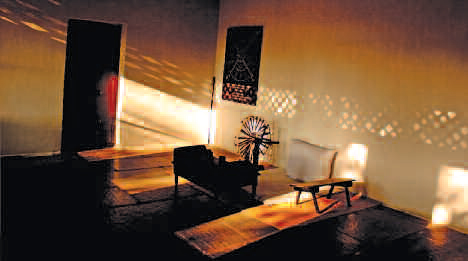
Gandhi’s room at the Sevagram Ashram
I was given dinner and shown to a dorm-like compound and a room that featured narrow little beds with hand-sewn coverings and a single blanket. There were slatted wooden blinds without glass in the windows, a simple bathroom with a bucket and pitcher for a shower. The austerity created a feeling of elegant simplicity, peace, order, of living without wasting, of being mindful of the many without clean water.
Like everything else in the retreat center, my room was simple but beautiful, showing signs of great care, immediately exposing my sprawling American style, suitcase top flipped open, possessions taken out and arranged rather than folded and stowed, taking up space.
Told I would be alone for a few nights, I felt a wave of relief. I wanted to bolt the door, to be alone, to think about all I had been through—all of this in such stark contrast to the river of hospitality I was carried in on, to the little hand-made gifts and offerings on the bed and tables, to the paper flower saying “Be the Change” on the mirror in the bathroom. It was never so clear how much of my life, including my spiritual life, involved isolation— stepping out yes, but always retreating, seeking privacy, locked doors.
I went to sleep to sounds of the music from a riotous Indian wedding blasting over scratchy speakers in a park somewhere, and awoke to the sound of chanted prayers and bells and dogs barking, to the smell of spice and woodsmoke, strange new bird cries, new light.
From the depths of my body, a strange, barely verbal insight dawned, that I had come all this way because we are meant to live in our bodies, not just in our minds. We are meant to give ourselves to life, to take in impressions and receive energies too fine for words. Briefly, it was clear that a single choice exists, moment after moment. We can turn away from life, or be open to receive. I vowed to try to be open.
Yet after my first bucket shower and a strong cup of chai, my head was back to wondering what the heart and aim of this big diffuse movement or organization really were. In the dining hall at breakfast, I confessed this to Guri Mehta, the wife of Nipun, who suggested I try just feeling with my heart instead of thinking. Guri said this with a California warmth and friendly intimacy that made me trust what she said.
After Guri left, I was invited to sit at a table with a smiling man dressed in immaculate white. I was told he was born and raised on the Gandhi Ashram. From his equanimity and quiet presence, I assumed he was a kind of monk, a modern satyagrahi, a renunciate love warrior, dedicated to Truth. Deep in conversation with a group of young men who listened to him closely, like acolytes, he looked at me kindly and said in Hindi (which was translated for me), “Only things that can open can blossom.” I knew this was a conclusion to a long exchange, but it felt uncanny, as if he knew about my waking insight and fleeting vow about opening.
Later I would learn that he was Jayesh Patel, the son of Ishwar Patel, the founder of the Sanitation Institute and the retreat center, and my host. In the coming weeks, I learned that Jayeshbhai (bhai means brother in Hindi and Gujurati, the local language of the district of Gujurat) is incredibly engaged. The founder of Manav Sadhna, an organization that works with ten thousand children, he is the managing trustee of the Sabarmati (Gandhi) Ashram, and the president of the Gujurat Harijan Sevak Sangh, a vast organization founded by Gandhi.
But I experienced him the way a child might, just noticing that his eyes were kind and didn’t look away. He gave his attention in a way that few people ever do, without distraction or calculation. It was a warm embrace of a gaze, a granting of unconditional acceptance. Strangest and rarest of all, there was the feeling that all of this giving was effortless, that we were all on the same level and this love was like sunlight, as much mine as his.
“When we see our role in society as servants, we will light up the sky together like countless stars on a dark night,” read a young woman named Kushmita in the opening circle, quoting Vinoba Bhave, a scholar and close spiritual friend and associate of Gandhi. He is little known today in the West but he is revered in India, not just for his participation in the Indian Independence Movement or his many books on the world’s great religious traditions but for the Bhoodan or Land Gift Movement. Vinoba spent years walking across India on foot, surrounded by friends and followers, persuading land owners to donate a portion of their holdings to the landless. In this extraordinary effort, walking from village to village, talking face to face, Vinoba showed what could follow Gandhi.
“Don’t think of society as the sky on a full moon night. The moon’s harsh light blinds us to the true and humble work of the stars,” he taught. “But on a moonless night, the true servants shine forth, as though they are connected invisibly in this vast and infinite cosmos.”
The intention of the retreat was to explore modern manifestations of Gandhi’s values, but the roots went deep into the past, in Vinoba’s famous walk and long before. The mostly young participants understood that real change must start with inner transformation, that we must be the change we wish to see in the world. It was accepted that real change today cannot be top down, focussed on great leaders or established institutions. It must be “many-to-many,” flowing from small acts of kindness, building on existing relationships and resources, emergent, not forcing pre-determined results. This is the principle–the seeing–that allowed Gandhi to lead India to freedom from the British Empire. Slowly and carefully, this group at the Gandhi Ashram intended to weave a net of maitrî to transform their world.
Lacking Hindi or much else in the way of real knowledge, I had no choice but to keep on observing and living like a child, being cared for, helpless to do much more than be present in the body in the most basic way. At every turn, I was met by small acts of kindness and generosity. I hadn’t brought a towel, and a folded towel appeared on the end of my bed. I lamented that I didn’t have the right clothes, only purple sneakers and Western items, and sandals appeared and a loose, cotton shirt or kurti.
MUCH THAT WAS VALUABLE was said and done during the retreat, but for me it was a teaching in surrender, in receiving gifts as they came, and life as it came. In conditions that gave me almost no control and no opportunity to give back, I had no choice but to receive, and to see that receiving is not separate from giving.
On the anniversary of Gandhi’s death, the whole retreat transferred to his Sabarmati Ashram in the suburbs of Ahmedabad. From this austere place, Gandhi led the Salt March, led the Independence Movement. I sat in Gandhi’s room, not normally open to the public, surrounded by his few possessions, his desk, walking stick, the iconic spinning wheel (or charkha), marveling at what was accomplished here.
The author at the Sevagram Ashram
Days later, some of us returned to the ashram for morning prayers, then went out into the slums to visit schools and a women’s center, to see how Gandhi’s work is being carried on today. Through it all, I watched Jayeshbhai. Often, he moved slowly or sat still, seeming to be empty of agenda or obvious care, yet meeting an endless stream of people, greeting everyone from slum kids to business leaders with the unwavering warmth and attention I experienced on the first day. I began to understand what Buddha meant by being an island. He meant to land, to come down out of the head and enter the body and the present moment, to be in a peaceful, grounded state, non-grasping and non-afraid.
Jayesh Patel
Jayeshbhai reminded me through a translator that Gandhi took his inspiration from the people in the villages he served. One day, a few of us were taken to visit a village where people live as most people have always lived, cooking over fires, working very hard for food and water, dependent on the help of oxen and camels and other animals, dependent on the help of God and of each other. I rode on an ox cart, had tea with a saintly village elder.
After many hours I began to feel weak from the heat and hunger and also from an uneasy sense of being a tourist, as if my Western, thought-filled self trapped me outside the experience, as if my mind was a pesky fly buzzing behind glass. Just then, a woman waved us over, inviting us to sit down and share the bread she was baking over a fire. It was a slow gesture, in the natural order of things, and it reached through the glass.
Give us this day our daily bread. I wondered why it had never dawned on me before that this seemingly ordinary thing, this basic experience of the body, was also an act of faith. It struck me that the people I met in India, Ivy-League educated volunteers and Fulbright scholars and villagers alike, lived as if God were watching, as if everything mattered, and as if their smallest actions were a way of expressing their faith in this Truth.
It touched me to remember that this understanding is in the Western tradition also. In THE COMPLETE MYSTICALWORKS OFMEISTER ECKHART, it is explained that one of the last things the great German mystic said to his students was: “I will give you a rule, which is the keystone of all that I have ever said, which comprises all truth that can be spoken of or lived. It often happens that what seems trivial to us is greater in God’s sight than what looms large in our eyes. Therefore we should accept all things equally from God….”
In the days to come, I travelled more, flying to the heart of India, to stay briefly at an ashram established by Vinoba in Maharastra for the spiritual development of women, rare in India, and also at Gandhi’s Sevagram Ashram. I kept on travelling as a child would, clueless about where I was going, handed a ticket to “Spice Jet” to Nagpur, driven in a car arranged by Jayeshbhai, stopping to walk out into a field of organic cotton to watch the sunset, then stopping again for chai and to visit one of the countless temples we passed in the dark.
Preparing breakfast at the Vinoba Ashram
Along the way, Nipun told me that a Buddhist monk he knows said that probably every inch of India has witnessed a prayer or a bow. Before the New York editor in me could say that I doubted every inch, I realized that in my case this was literally true. Every inch of my trip, I had been carried on a kind of collective prayer, a collective intention to manifest maitrî.
At the Vinoba Ashram, we joined nuns for evening prayers among relics fifteen-hundred years old. Conditions were very austere—my bed was basically a board. Yet there was a feeling of extraordinary safety. As elsewhere, there was very little privacy or private property, but people were eager to share food and prayer and stories.
Everyone was expected to share in the work. In pre-dawn darkness, I slowly chopped vegetables. After the sun rose, I helped harvest turmeric. I was handed big roots to break apart, the easy work, just so I could play a part. At times, I felt as if a door in my heart was beginning to open. I saw that what mattered wasn’t my rather shaky outer performance. The crucial point was opening to receive life and learning to become a vehicle for an energy or light of truth, just as I was.
As we dug turmeric, a nun with an incredible face approached. It was the kind of face that makes you not fear getting old, a safe face, not wanting, not hiding. She told us that she was eighty-five years old. We learned that she had spent twelve years on a walking pilgrimage across India, inspired by her teacher Vinoba, who walked the length and breadth of India over twenty years, persuading wealthy landlords to give their landless neighbors a portion of their land. Ultimately more than four million acres of land were donated, one conversation at a time. The nun told us that while her body wasn’t as strong now, she received energy from us.
Nun in garden at Vinoba Ashram
THE NEXT DAY, we visited Gandhi’s Sevagram Ashram. Gandhi deliberately founded this “village for service” in the heart of India even though it was (and is) very out of the way. After the Salt March, he vowed not to return to Ahmedabad and not to leave the heart of the country until independence was achieved. The atmosphere in Sevagram was quiet and reverent. Signs ask for “Silence.” It was clear that something great happened here.
It also felt strangely modern. Electricity was generated by biofuel from the cows, the dish water funneled into the compost that helped grow the organic vegetables we ate for lunch. Sitting on the ground where Gandhi sat to think and write and serve, physically in touch with the radical simplicity of the conditions of his life, it was easy to see that he was a visionary. Once swaraj or self-rule for India was attained, he knew it was important to continue to evolve (he often said “my quest continues”). That goal was “sarvodaya: the advancement of all.” This meant sustainability–responsibility in every way. Gandhi knew there can be no peace unless we learn to live in a shared world.
After we left Sevagram, four of us headed to the airport in Nagpur: Nipun; Nimesh (or Nimo) Patel, a former rap star and Wharton school graduate who has created a service-based music venture called “Empty Hands Music”; Anne Veh, an artist and curator from California, and myself, all but Anne bound for Mumbai. We hit a massive traffic jam. After nearly an hour, we decided to walk it. “Prepare to be stared at,” said Nipun.
Off we went, two American women and two Indian men trudging down a highway against traffic, carrying luggage. Soon, a policeman stopped us and asked us what we thought we were doing, contributing a drop more disorder to this hopeless-seeming mess. Nipun explained with a smile that we
were late for our flight. He spoke in Hindi so I didn’t understand what was being said, but I saw that he spoke in such a way that the policeman started flagging down vehicles to find us a ride. A bus full of civil servants in uniform stopped and opened their doors, even insisting that Anne and I put down our bags and take seats up front.
As it unfolded, it felt like being in an Indian version of ALICE IN WONDERLAND. But as I sat smiling at a bus full of smiling people in uniform, all of them enjoying this unexpected adventure in generosity, this adventure that started by stopping and opening their doors to the unexpected, it struck me that I hadn’t down a rabbit hole so much as fallen into life, into the dense, complex, in-rushing life of India, life as it can feel without fear.
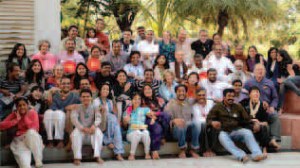
Gandhi 3.0 retreatants
“Nipun” means “master.” Watching the scene unfold in the traffic jam, I glimpsed a new (although I knew it was also ancient) kind of life mastery, a way of being unguarded and on intimate terms with life. I didn’t think this realization so much as feel the living, embodied truth behind things I had read and heard. I once heard Mozart’s music described as innocent, heedless of the world and heedless of shame. I thought of the Buddha walking through India, teaching people to be islands in the stream of life, to abide, “ardent, clearly knowing, mindful, free from desires and discontent in regard to the world.” I thought of Jayeshbhai, quoting his father Ishwar Patel, telling him to “Create heaven wherever you are.”
As I left to fly home to New York, Jayeshbhai, Nipun, Guri, and others came out to the gates of the retreat center to hug me goodbye. Jayeshbhai presented me with a beautiful scarf woven from organic cotton by women in the slum. “Tell them we are meant to live in a shared world,” he said.
The good news is my voice is back. The bad news is my voice is back. As I reported last week, I have been without a voice of late, just whisper, sometimes soft, sometimes rasping. I had my hair cut last week and the din of the hair dryers and music and conversation was too much for my whisper. Usually I love to tell stories and talk with my kind hair cutter, but I just couldn’t participate.
Sitting back, it dawned on me that I could go beyond being silent. I could practice the stillness I try to practice on the cushion. A new world opened. I saw more. I heard more. I felt more. I felt that I was part of a greater whole. Right there in a haircutting salon.
When you become still, you become attentive. Life opens up and becomes larger. You discover moments inside moments inside moments. On top of which, one of my noble friends in our Sunday sitting group commented that it was an uncommonly good haircut. “Whenever a contractor comes to the house, my wife tells me to be quiet and let them do their work. Maybe you should always be quiet when you get a hair cut.”
Last Sunday, we spoke about the difference between silence and stillness. Silence is a special external condition that can lead to an internal absence of noise. On silent retreats, people can reach sublime states of concentration. Yet stillness is not just an auditory but a physical state and it doesn’t depend on perfect external conditions. The paradox is that we can practice stillness in the midst of all kinds of conditions, even traumatic conditions. Stillness can descend like grace. We can be still in the midst of an argument, in the thick of exacting demands. This is not easy but it is possible. Stillness is finding a vertical axis inside, upright and noble and attentive, finding an inner alignment in a turning world. Stillness is not climbing up out of the mess and sometimes chaos of our life. It is a state of being grounded, touching the earth of our real, humble, moment-by-moment experience.
Stillness is stopping running towards or away from any experience. It is the state of no spin, no cover up. For years now I’ve believed that awakening is not a bolt out of the blue many small moments many times. It is the fruit of the slow process of learning to see without judgment, extending compassionate awareness without identification to all the orphans and strays and pushy, needy beings that appear inside and outside. A Zen master once said that there are no enlightened people, just enlightened moments.
The ancient teachings of the Buddhism teach that there is an ordinary and extraordinary (or “mundane” and “superior”) level of understanding for each step on the Eightfold Path. An ordinary understanding of the first step, “wise view,” is seeing karma—seeing that our conscious actions lead to lawful effects (“vipaka” or ripenings). The clouds clear and you realize that what you do and say has consequence and nothing is too small to count: certain actions lead to ease and happiness, other actions to tension, contraction, unhappiness. “Superior” wise view means glimpsing that there is a life beyond aiming to maximize our personal happiness, as wholesome and reasonable as that is. We can live as if we are part of a greater whole…even while we’re getting a hair cut.
On Saturday, I raced from a Buddhist monastery to see Meryl Streep in her landmark portrayal of the former British prime minister Margaret Thatcher. How could I have guessed that these wildly disparate activities would go so well together? I presented the scholar monk Bhikkhu Bodhi with copies of Parabola’s gorgeous new “Burning World” issue, which opens with a fresh translation of the Buddha’s Fire Sermon and a contemporary commentary by Ven. Bodhi. I also stayed to hear his weekly lecture on the earliest Buddhist teachings. This particular Saturday, he spoke about the traditional teachings on renunciation or letting go.
What does this have to do with Meryl Streep in The Iron Lady? Far more than I planned. In the Fire Sermon, the Buddha taught that all is impermanent, that all will be consumed by the fire of aging, sickness, and death. Streep portrays the prime minister out of power and in old age, suffering the early stages of dementia. She is beyond brilliant. Indeed, her portrayal has been compared to the greatest portrayals of King Lear. God is in the details, and Streep seems to empty herself completely. Her eyes, hands, face, body are filled with the experience of this once iron leader in decline.
Still, the Fire Sermon describes the unnecessary burning of greed, hatred, and aversion. Not surprisingly for a monk, Ven. Bodhi describes the attitudes and actions necessary to put out the fires consuming our world in ways that would definitely be described in modern terms as liberal. Margaret Thatcher, on the other hand, is a conservative icon more than two decades after leaving office. Despite the flaws in the story and no matter what your political leaning happens to be (Streep herself is liberal), this great perfomanence reminds viewers what leadership can be—flowing from inner conviction, not outer calculation. Streep portrays Thatcher as courageous and unshakable—a woman who learned to speak and move and in all ways manifest authority in a man’s world, and a very dangerous and imbalanced world.
It was a performance that has everything to do with an ancient Buddhist sutta about renunciation or letting go. It shows how the very greatest acts originate in emptying, in relinquishing our own ideas and identifications. After her recent Golden Globe win, Streep was asked by a reporter if she had a principle or something else that guided her when she took a role. Streep said: “I’ve never gotten to the bottom of me, all the conundrums and contradictions….” She allowed that she gravitated towards characters that helped her explore different aspects of her own character. In other words, she doesn’t come from a fixed sense of who she was or who a character is supposed to be; she is open to the unknown. As for Thatcher herself, although I disagree with her politics I came away from the film understanding something new about the power of commitment.
There is a kind of commitment does not consist in clinging to a fixed beliefs or ideas (which Lady Thatcher undoubtedly did in later years). This special kind of commitment consists in being willing to open to be part of something greater than our own thoughts, our own story. “Must make vacuum,” Gurdjieff urged his students, only then can reality enter. This requires an ability to be still, to sink below the din of thought. As I’ve been sharing in this space, we can’t find freedom by straining towards it seeking to transcend ourselves. We must see and accept what we are, the endless dance of the ego to identify with everything so that it can go on being. Yet at moments, conditions conspire to help us let go of all that, so that life can rush in and remind us that we are each in fact part of a greater whole.
After a meeting of Parabola editors in Manhattan recently, a fellow Parabola editor and I slowly made our way uptown through heavy traffic, talking about those times when it seems as if the universe is with you. Getting around in New York offers many wonderful teachings on this. Sometime the subway is there waiting for you with doors wide open just when you need it, and you sometimes you stand and wait. Sometimes you hit all green lights all the way up Park Avenue, and sometimes when you are late ad there is someplace you urgently have to be, traffic grinds to a halt. Even when you remember that you too are part of the traffic, you can feel like life is against you. You can decide that a golden few get to have great destinies—Meryl Streep, Margaret Thatcher, Gurdjieff, that certain someone who always has wonderful things happen to them—while the rest of us muddle along, Muggles among the magical.
Yet there can be moments when a door swings open and the light pours in, revealing magic in the most ordinary life. My fellow editor told me a marvelous true story about a woman who arrived somewhere late after encountering all kinds of obstacles, only to rush into a room just as the light was hitting at an angle just right to glint off her lost engagement ring. It occurred to her that the universe might have been trying to help her by putting all those obstacles in her path. If the great law of accident came to her aid, the underlying truth is just as magical. Let go and let life enter.
Remember what life feels like when you fall in love? It can feel as if a veil is pulled aside, as if we were never really isolated and alone but part of something vast and wonderful and alive. It can seem as if the universe was leading us towards this encounter. We are grateful for everything, even the disappointments and hard times, because it led to this. Years later, we remember the taste of waking up from our usual trance of anxious and embattled isolation to find we are part of a greater whole. How can we open more often? We need to see and accept what is—our freedom lay in knowing the details as well as Streep knew how Thatcher walked or washed a tea cup.
“In order to be present, I must understand the working of my thinking mind, that it’s function is to situation and explain, but not to experience,” writes Madame de Salzmann. “Thought is made up of accumulated knowledge in the form of images and associations, and it seizes an experience only to make it fit into categories of the known.” And yet we come to know the mind in loving detail, we can open to something beyond the world of our known thought. I’ve come to think of it more and more as softening—a softening towards what we are that deepens into the quiet acceptance, the real letting go that comes when you know you won’t get to the bottom of things.
Decades ago when I was just out of college, I was caught up in the story of being small, lacking the talent or luck or whatever other quality it would take to enable me to ever do more than witness the greatness of others (in those days I thought witnessing was a small thing). I was working as an underling in the movie business. I had a job that included sometimes greeting big producers who had come into the office for meetings and hearing not hello but “Diet Pepsi or Diet Coke.” I was to get things and bring things. One day, into the office came Meryl Streep. She smiled at me asked if she might come into my tiny office and sit down with her baby. Yes, I said. Her manner was very soft and present. She looked at me and smiled. It was a memorable feeling in those surroundings, being treated as if I really existed beyond my limited functions. She admired a painting hanging on the wall behind my desk, asking me if it was by a certain someone, an art star. I said no, but I thought this young artist was very influenced by the art star Streep mentioned. Streep laughed and told me that she never worried about being influenced or borrowing or stealing from other artists. She said something to the effect that everything she good had ever done (and by then she had done Sophie’s Choice and many other great roles) she had stolen. I got what she meant immediately, that it all starts with imitation, with borrowing, stealing. It all starts with something that has come before, an thought, an image, and then comes the work of opening to something real.
It took me many years to begin to understand about what it means to be open, to create a vacuum. Soon on long ago day, Streep was ushered out to meet with some big lawyers and executives. Instantly her demeanor changed as she stepped forward to greet them. I was left with an impression of fluidity, of changing to meet changing circumstances. There was also an impression of generosity and kind of radiance. She glowed. Gurdjieff once said that the highest role we can aspire to is actor in a very special sense–to play a role consciously without becoming identified. Streep was recently asked how she felt about being called possibly the greatest actor who ever lived. She smiled and said she just doesn’t take in such statements the way she takes in other facts. Of course this is a polite and politic thing to say (what a question!) But I have an indelible impression of the kindness and generosity she expressed towards an underling. I saw for myself she understands a few real facts about letting go, about not clinging to who you think you are, old limiting thoughts and feelings, about going beyond.
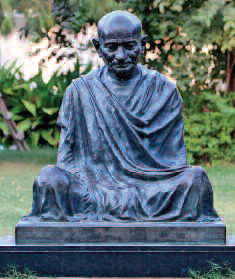
 “When we see our role in society as servants, we will light up the sky together like countless stars on a dark night,” read a young woman named Kushmita in the opening circle, quoting Vinoba Bhave, a scholar and close spiritual friend and associate of Gandhi. He is little known today in the West but he is revered in India, not just for his participation in the Indian Independence Movement or his many books on the world’s great religious traditions but for the Bhoodan or Land Gift Movement. Vinoba spent years walking across India on foot, surrounded by friends and followers, persuading land owners to donate a portion of their holdings to the landless. In this extraordinary effort, walking from village to village, talking face to face, Vinoba showed what could follow Gandhi.


 Tracy Cochran