“My guru told me ‘Be like Gandhi,’” Ram Dass told me once during an interview. “Gandhi said, ‘My life is my message.’” The words came haltingly, short phrases followed by long pauses. The former Dr. Richard Alpert, the once eloquent spiritual seeker and psychedelic rebel, sat in a wheelchair, hunting for words, often coming up with nothing except a soft “yea.” “Before the stroke it was words, words, words,” he told me. “After the stroke it was silence, silence, silence.”
Ram Dass spoke of before the stroke and after, about how things go in this world, often suddenly and unexpectedly. What stays, really? That meeting stays with me, so much silence, but full and warm, a sharing of presence. A real meeting. His assistant wrote me a note on his behalf afterwards that said he felt the same. Impossible to forget that generous gesture.
Ram Dass and I sat together near a window of a room in a hotel that was then called “the New York Marriott Financial Center,” a grand edifice of glass and steel that was a short and impressive stroll from the World Trade Center. The hotel itself turned out to be a lesson in before and after. About a year and a half after our meeting, much of that glass would be shattered, and when the hotel finally re-opened years later it was renamed the “New York Marriot Downtown.” No more references to financial or trade centers. Those were different times. The day I visited Ram Dass, there was a big bustling conference going on. There were signs in the lobby saying something about “Asset-backed Commercial Paper.”
“Acid-backed paper?” said Ram Dass, when I described the scene. “What are we waiting for? Let’s go!” He laughed, banging his hand on the arm of his wheelchair. Just for a moment, if I squinted my eyes, he looked a little bit like the psychedelic crusader who had ingested at least three hundred bits of acid-backed paper over the years, before he went off to India to find a guru and learn to meditate. He and the classic story of his journey Be Here Now had been iconic to me when I was young—proof that there was another way. The formerly ambitious young assistant professor of psychology at Harvard took psilocybin mushrooms with Timothy Leary and glimpsed an abiding awareness, a witnessing “I.” And from that time he sought not just know things but to “Know.” And now here we were.
The formerly irrepressible, unstoppably eloquent Ram Dass sat and waited patiently for words to float up to the surface (or not) and this inspired patience in me. There was nothing else to be done but just hang out and be. We sat together and watched ferries and tugboats criss-cross New York Harbor. The famous seeker was there to attend a conference on dying organized by Buddhist scholar Robert Thurman, and I was there to interview him about his latest book. But I couldn’t do my job the way it is usually done. I had to let go of my questions and just sit back and wait. I remember the two of us watching the tugboats riding low in the choppy grey water. And how comfortable it was being with him.
Once I thought of Ram Dass as a glamorous psychedelic outlaw turned spiritual seeker. I told him about reading Be Here Now as a youngster and how I wanted to emulate him, traveling the India, meeting an amazing guru who could read innermost suffering and love, all of it. He told me in his halting way that he wished he had a nickel for everyone who said something similar, but kind of chuckling gently, as if we were in this together. We all have to learn that concepts are different from reality.
Sitting with him that day, I began to realize that what I was really seeking was a way to contact what he spoke and wrote about so often, a deeper awareness that sees and knows. we don’t have to go to great extremes because life will bring us extremes, and the awareness that knows may find us anywhere because it is already in us, waiting patiently.
Ram Dass told me a little about the stroke that hit one evening in 1997, as he lay in bed wondering how to improve a book he was writing about the wisdom potential of aging. Over the months and years of his rehabilitation, wisdom came: “We think life is like one of these buildings, big and solid,” said, gesturing at the hotel around us and out the window towards the towers. “But age is like an earthquake. Everything goes.”
But years later, those mighty skyscrapers are gone or vastly altered, and Ram Dass himself is still here. The real irony was this, and it was wonderful. He was still here. More here. I shared with this famous seeker, this disciple of the Indian guru Neem Karoli Baba, some wisdom from my mother who suffered a stroke and recovered her vocabulary and other faculties, well beyond predictions: “You tell Ram Dass not to listen to anybody tell him what he can’t do. Tell him to just keep going because nobody knows what can happen.”
Ram Dass listened closely. He knew she knew something real. My mother never tripped or went to India. She never lost her Nebraska accent, just added a layer of Northern New York, so that his name came out like Dodge Ram (and Dass like Ass). But she understood the impermanent nature of life because she had lived through it. She was a mother (and a daughter) and she knew that forces like love and compassion are stronger and more enduring than buildings. She had lived through enough to know what matters, what is real–she had faced death and the loss that comes with age. Without ever putting it into words, she understood that reality is always different our thoughts and words about it, and that nobody can nail it down. She probably would have agreed with Ram Dass that about the best we can do is accompany each other in this mystery, give each other the gift of our presence and attention. I think she would have agreed with Ram Dass who said: “We’re all just walking each other home.”
“Therefore, Ananda, Be Islands unto yourselves, refuges unto yourselves. . . .” As he lay dying, the Buddha gave this advice to his beloved cousin and disciple Ananda. I thought of it as I stood in a security line in the Indira Gandhi International Airport in New Delhi, just after a male security guard gestured for me to move to the line marked “Ladies.”
I knew there were different translations that encouraged people to be “lamps” or “lights” unto themselves. Yet somehow I failed to notice there were separate security lines for “Ladies” and “Gents.” I knew that both “island” and “lamp” were signified by the word dipa in Pali, the language of the Buddhist scriptures, a Sanskrit-derived language that is probably close to what the Buddha spoke. But I didn’t actually speak Pali—or Hindi or Gujurati, the Sanskrit-derived languages spoken in this airport and in the northern Indian city of Ahmedabad, where I was headed.
I was an American woman travelling alone and it suddenly seemed clear that this was what I knew about India—bits of teachings of the Buddha, a bit of history about Gandhi, a few novels and films. Some this material was great, even sacred, but as I passed through a second round of security only to make the same mistake about “Ladies” and “Gents” it seemed to be nothing but a cloud of disembodied facts floating through my head like space junk.
The contrast between this kind of knowledge (a collection of facts and images and dreams) and real knowing, real embodied awareness, felt crucial. I had read the invitation to the Gandhi 3.0 retreat in my living room north of New York City, while sitting in a pool of lamp light, watching snow fill up the pines outside my window. In that snowbound hush, in a house as cocooned from the outside world as a ship at night, I felt sure that I should go. “You will not find these heroes on TV,” the invitation read, referring to the sixty businessmen, spiritual cultivators, social activists, and entrepreneurs who were to take part. “They don’t seek glory, nor do they wear any uniforms. Sometimes they do normal jobs but they are often doing the real work in subtle and invisible ways.”
I was being invited to be a secret agent of change by Nipun Mehta, founder of a community called ServiceSpace and leader of a gentle revolution of values called Gift Economy or “giftivism.” The Indian group hosting the retreat was Moved By Love, connected to Mehta and the California-based ServiceSpace, the way aspen trees can be outcroppings of the same interconnected root system.
I had dreamed of being in India since I was a little girl. I remembered climbing over the furniture of our brick ranch house in northern New York, pretending I was padding through a jungle in India, my black panther consort by my side. Were there black panthers in India? I had no idea. It was as if I had been practicing tracking something—practicing going towards something important. In the hugely self-centered, elaborately daydream-y yet completely innocent way that children have, I had sensed that I could be part of a greater life, a life that involved my whole body, not just my head in school. I had sensed that my small life might be capable of a nobility my parents didn’t suspect.
I typed “yes” to the invitation to the retreat almost as soon as I received it. The phrasing of the invitation touched my childhood sense that there was another way to live. Yet now here I was in the real India, exposed. Faced with the unknown, it seemed clear that my mind’s strong tendency was to seek the known, to plan and picture and think about familiar things rather than to engage in fresh seeing and experiencing. My wish to be here, to experience another, larger way to be in this world, was real. But it seemed such a small soft light inside, like a night light, easy to miss in the glare. It was real, just much weaker than the habit of fear.
Outside the airport in Ahmedabad, Neerad, a volunteer from the retreat, held up a sign with my name on it. He took my bag and ushered me to a car with a quiet dignity that contrasted with a sign that read “We Love You.” As we made our way through the streets of the city—through the indescribable in-rush of Indian traffic and colors and contrasts and cows—I realized how tense I had been, checking and re-checking for my passport and letter with contact information.
At every turn on the trip, people warned me to be careful, to be safe. In the car it dawned on me that help also kept appearing. “Just so you know,” said an Indian woman waiting to board the plane at JFK. “Indian people don’t have the same need for personal space. There will be crowding.” The young Indian woman sitting next to me offered travel tips. In New Delhi, another Indian woman bought me a bottle of water and offered me a mobile phone to call home, and her phone number just in case. I came to India braced for darkness. But in all my planning, I hadn’t anticipated the light. It dawned on me that those women and Neerad were islands, not self-sufficient as my conditioning led me to be, but refuges, offering a bit of shelter.
WE DROVE UP a long road to the retreat center that is part of the Environmental Sanitation Institute. This creation by Ishwar Patel, a beloved man who dedicated his life to bringing sanitation and dignity to the people of India, especially women, is an oasis, a beautiful gated compound with gardens and a pond ringed by palm trees. A posse of smiling people holding smiley-face signs, including Nipun Mehta, met me at the gate. I was surrounded, hugged, sung to. Weeks later, I was told had I looked so ashen with shock that they had decided to tone down the greeting. It had stung like a blast of heat after great cold, and I couldn’t help wondering if it had been sincere.
After accepting the invitation to the retreat, I had received the beguiling response, “Great! We’ll be here to welcome you home.” Over the next few weeks, I learned that this practice of welcoming home (as if they knew about my childhood jungle-girl fantasy games), this giving without restraint or expectation of return, was an aim of the retreat and of Moved By Love. The greeting party at the gate was made up of volunteers from all over India and California, people who had come to practice service, to weave a net of maitrî or lovingkindness, to carry the spirit of Mahatma Gandhi into a new age.
Gandhi’s room at the Sevagram Ashram
I was given dinner and shown to a dorm-like compound and a room that featured narrow little beds with hand-sewn coverings and a single blanket. There were slatted wooden blinds without glass in the windows, a simple bathroom with a bucket and pitcher for a shower. The austerity created a feeling of elegant simplicity, peace, order, of living without wasting, of being mindful of the many without clean water.
Like everything else in the retreat center, my room was simple but beautiful, showing signs of great care, immediately exposing my sprawling American style, suitcase top flipped open, possessions taken out and arranged rather than folded and stowed, taking up space.
Told I would be alone for a few nights, I felt a wave of relief. I wanted to bolt the door, to be alone, to think about all I had been through—all of this in such stark contrast to the river of hospitality I was carried in on, to the little hand-made gifts and offerings on the bed and tables, to the paper flower saying “Be the Change” on the mirror in the bathroom. It was never so clear how much of my life, including my spiritual life, involved isolation— stepping out yes, but always retreating, seeking privacy, locked doors.
I went to sleep to sounds of the music from a riotous Indian wedding blasting over scratchy speakers in a park somewhere, and awoke to the sound of chanted prayers and bells and dogs barking, to the smell of spice and woodsmoke, strange new bird cries, new light.
From the depths of my body, a strange, barely verbal insight dawned, that I had come all this way because we are meant to live in our bodies, not just in our minds. We are meant to give ourselves to life, to take in impressions and receive energies too fine for words. Briefly, it was clear that a single choice exists, moment after moment. We can turn away from life, or be open to receive. I vowed to try to be open.
Yet after my first bucket shower and a strong cup of chai, my head was back to wondering what the heart and aim of this big diffuse movement or organization really were. In the dining hall at breakfast, I confessed this to Guri Mehta, the wife of Nipun, who suggested I try just feeling with my heart instead of thinking. Guri said this with a California warmth and friendly intimacy that made me trust what she said.
After Guri left, I was invited to sit at a table with a smiling man dressed in immaculate white. I was told he was born and raised on the Gandhi Ashram. From his equanimity and quiet presence, I assumed he was a kind of monk, a modern satyagrahi, a renunciate love warrior, dedicated to Truth. Deep in conversation with a group of young men who listened to him closely, like acolytes, he looked at me kindly and said in Hindi (which was translated for me), “Only things that can open can blossom.” I knew this was a conclusion to a long exchange, but it felt uncanny, as if he knew about my waking insight and fleeting vow about opening.
Later I would learn that he was Jayesh Patel, the son of Ishwar Patel, the founder of the Sanitation Institute and the retreat center, and my host. In the coming weeks, I learned that Jayeshbhai (bhai means brother in Hindi and Gujurati, the local language of the district of Gujurat) is incredibly engaged. The founder of Manav Sadhna, an organization that works with ten thousand children, he is the managing trustee of the Sabarmati (Gandhi) Ashram, and the president of the Gujurat Harijan Sevak Sangh, a vast organization founded by Gandhi.
But I experienced him the way a child might, just noticing that his eyes were kind and didn’t look away. He gave his attention in a way that few people ever do, without distraction or calculation. It was a warm embrace of a gaze, a granting of unconditional acceptance. Strangest and rarest of all, there was the feeling that all of this giving was effortless, that we were all on the same level and this love was like sunlight, as much mine as his.
“When we see our role in society as servants, we will light up the sky together like countless stars on a dark night,” read a young woman named Kushmita in the opening circle, quoting Vinoba Bhave, a scholar and close spiritual friend and associate of Gandhi. He is little known today in the West but he is revered in India, not just for his participation in the Indian Independence Movement or his many books on the world’s great religious traditions but for the Bhoodan or Land Gift Movement. Vinoba spent years walking across India on foot, surrounded by friends and followers, persuading land owners to donate a portion of their holdings to the landless. In this extraordinary effort, walking from village to village, talking face to face, Vinoba showed what could follow Gandhi.
“Don’t think of society as the sky on a full moon night. The moon’s harsh light blinds us to the true and humble work of the stars,” he taught. “But on a moonless night, the true servants shine forth, as though they are connected invisibly in this vast and infinite cosmos.”
The intention of the retreat was to explore modern manifestations of Gandhi’s values, but the roots went deep into the past, in Vinoba’s famous walk and long before. The mostly young participants understood that real change must start with inner transformation, that we must be the change we wish to see in the world. It was accepted that real change today cannot be top down, focussed on great leaders or established institutions. It must be “many-to-many,” flowing from small acts of kindness, building on existing relationships and resources, emergent, not forcing pre-determined results. This is the principle–the seeing–that allowed Gandhi to lead India to freedom from the British Empire. Slowly and carefully, this group at the Gandhi Ashram intended to weave a net of maitrî to transform their world.
Lacking Hindi or much else in the way of real knowledge, I had no choice but to keep on observing and living like a child, being cared for, helpless to do much more than be present in the body in the most basic way. At every turn, I was met by small acts of kindness and generosity. I hadn’t brought a towel, and a folded towel appeared on the end of my bed. I lamented that I didn’t have the right clothes, only purple sneakers and Western items, and sandals appeared and a loose, cotton shirt or kurti.
MUCH THAT WAS VALUABLE was said and done during the retreat, but for me it was a teaching in surrender, in receiving gifts as they came, and life as it came. In conditions that gave me almost no control and no opportunity to give back, I had no choice but to receive, and to see that receiving is not separate from giving.
On the anniversary of Gandhi’s death, the whole retreat transferred to his Sabarmati Ashram in the suburbs of Ahmedabad. From this austere place, Gandhi led the Salt March, led the Independence Movement. I sat in Gandhi’s room, not normally open to the public, surrounded by his few possessions, his desk, walking stick, the iconic spinning wheel (or charkha), marveling at what was accomplished here.
The author at the Sevagram Ashram
Days later, some of us returned to the ashram for morning prayers, then went out into the slums to visit schools and a women’s center, to see how Gandhi’s work is being carried on today. Through it all, I watched Jayeshbhai. Often, he moved slowly or sat still, seeming to be empty of agenda or obvious care, yet meeting an endless stream of people, greeting everyone from slum kids to business leaders with the unwavering warmth and attention I experienced on the first day. I began to understand what Buddha meant by being an island. He meant to land, to come down out of the head and enter the body and the present moment, to be in a peaceful, grounded state, non-grasping and non-afraid.
Jayesh Patel
Jayeshbhai reminded me through a translator that Gandhi took his inspiration from the people in the villages he served. One day, a few of us were taken to visit a village where people live as most people have always lived, cooking over fires, working very hard for food and water, dependent on the help of oxen and camels and other animals, dependent on the help of God and of each other. I rode on an ox cart, had tea with a saintly village elder.
After many hours I began to feel weak from the heat and hunger and also from an uneasy sense of being a tourist, as if my Western, thought-filled self trapped me outside the experience, as if my mind was a pesky fly buzzing behind glass. Just then, a woman waved us over, inviting us to sit down and share the bread she was baking over a fire. It was a slow gesture, in the natural order of things, and it reached through the glass.
Give us this day our daily bread. I wondered why it had never dawned on me before that this seemingly ordinary thing, this basic experience of the body, was also an act of faith. It struck me that the people I met in India, Ivy-League educated volunteers and Fulbright scholars and villagers alike, lived as if God were watching, as if everything mattered, and as if their smallest actions were a way of expressing their faith in this Truth.
It touched me to remember that this understanding is in the Western tradition also. In THE COMPLETE MYSTICALWORKS OFMEISTER ECKHART, it is explained that one of the last things the great German mystic said to his students was: “I will give you a rule, which is the keystone of all that I have ever said, which comprises all truth that can be spoken of or lived. It often happens that what seems trivial to us is greater in God’s sight than what looms large in our eyes. Therefore we should accept all things equally from God….”
In the days to come, I travelled more, flying to the heart of India, to stay briefly at an ashram established by Vinoba in Maharastra for the spiritual development of women, rare in India, and also at Gandhi’s Sevagram Ashram. I kept on travelling as a child would, clueless about where I was going, handed a ticket to “Spice Jet” to Nagpur, driven in a car arranged by Jayeshbhai, stopping to walk out into a field of organic cotton to watch the sunset, then stopping again for chai and to visit one of the countless temples we passed in the dark.
Preparing breakfast at the Vinoba Ashram
Along the way, Nipun told me that a Buddhist monk he knows said that probably every inch of India has witnessed a prayer or a bow. Before the New York editor in me could say that I doubted every inch, I realized that in my case this was literally true. Every inch of my trip, I had been carried on a kind of collective prayer, a collective intention to manifest maitrî.
At the Vinoba Ashram, we joined nuns for evening prayers among relics fifteen-hundred years old. Conditions were very austere—my bed was basically a board. Yet there was a feeling of extraordinary safety. As elsewhere, there was very little privacy or private property, but people were eager to share food and prayer and stories.
Everyone was expected to share in the work. In pre-dawn darkness, I slowly chopped vegetables. After the sun rose, I helped harvest turmeric. I was handed big roots to break apart, the easy work, just so I could play a part. At times, I felt as if a door in my heart was beginning to open. I saw that what mattered wasn’t my rather shaky outer performance. The crucial point was opening to receive life and learning to become a vehicle for an energy or light of truth, just as I was.
As we dug turmeric, a nun with an incredible face approached. It was the kind of face that makes you not fear getting old, a safe face, not wanting, not hiding. She told us that she was eighty-five years old. We learned that she had spent twelve years on a walking pilgrimage across India, inspired by her teacher Vinoba, who walked the length and breadth of India over twenty years, persuading wealthy landlords to give their landless neighbors a portion of their land. Ultimately more than four million acres of land were donated, one conversation at a time. The nun told us that while her body wasn’t as strong now, she received energy from us.
Nun in garden at Vinoba Ashram
THE NEXT DAY, we visited Gandhi’s Sevagram Ashram. Gandhi deliberately founded this “village for service” in the heart of India even though it was (and is) very out of the way. After the Salt March, he vowed not to return to Ahmedabad and not to leave the heart of the country until independence was achieved. The atmosphere in Sevagram was quiet and reverent. Signs ask for “Silence.” It was clear that something great happened here.
It also felt strangely modern. Electricity was generated by biofuel from the cows, the dish water funneled into the compost that helped grow the organic vegetables we ate for lunch. Sitting on the ground where Gandhi sat to think and write and serve, physically in touch with the radical simplicity of the conditions of his life, it was easy to see that he was a visionary. Once swaraj or self-rule for India was attained, he knew it was important to continue to evolve (he often said “my quest continues”). That goal was “sarvodaya: the advancement of all.” This meant sustainability–responsibility in every way. Gandhi knew there can be no peace unless we learn to live in a shared world.
After we left Sevagram, four of us headed to the airport in Nagpur: Nipun; Nimesh (or Nimo) Patel, a former rap star and Wharton school graduate who has created a service-based music venture called “Empty Hands Music”; Anne Veh, an artist and curator from California, and myself, all but Anne bound for Mumbai. We hit a massive traffic jam. After nearly an hour, we decided to walk it. “Prepare to be stared at,” said Nipun.
Off we went, two American women and two Indian men trudging down a highway against traffic, carrying luggage. Soon, a policeman stopped us and asked us what we thought we were doing, contributing a drop more disorder to this hopeless-seeming mess. Nipun explained with a smile that we
were late for our flight. He spoke in Hindi so I didn’t understand what was being said, but I saw that he spoke in such a way that the policeman started flagging down vehicles to find us a ride. A bus full of civil servants in uniform stopped and opened their doors, even insisting that Anne and I put down our bags and take seats up front.
As it unfolded, it felt like being in an Indian version of ALICE IN WONDERLAND. But as I sat smiling at a bus full of smiling people in uniform, all of them enjoying this unexpected adventure in generosity, this adventure that started by stopping and opening their doors to the unexpected, it struck me that I hadn’t down a rabbit hole so much as fallen into life, into the dense, complex, in-rushing life of India, life as it can feel without fear.
Gandhi 3.0 retreatants
“Nipun” means “master.” Watching the scene unfold in the traffic jam, I glimpsed a new (although I knew it was also ancient) kind of life mastery, a way of being unguarded and on intimate terms with life. I didn’t think this realization so much as feel the living, embodied truth behind things I had read and heard. I once heard Mozart’s music described as innocent, heedless of the world and heedless of shame. I thought of the Buddha walking through India, teaching people to be islands in the stream of life, to abide, “ardent, clearly knowing, mindful, free from desires and discontent in regard to the world.” I thought of Jayeshbhai, quoting his father Ishwar Patel, telling him to “Create heaven wherever you are.”
As I left to fly home to New York, Jayeshbhai, Nipun, Guri, and others came out to the gates of the retreat center to hug me goodbye. Jayeshbhai presented me with a beautiful scarf woven from organic cotton by women in the slum. “Tell them we are meant to live in a shared world,” he said.
As I write this, I am sitting in a pool of lamp light, watching snow fall, watching the pines and cars and the road outside fill up with white, contrasting the snowbound hush, the cocooned feel of the house, like a ship at night, with the sights and sounds and the sometimes spicy and delicate, sometimes acrid smoky smells and most of all the feeling of being in India. Contrast is a key to understanding–and not just in the senses but in the heart, in the shift from thinking in the mind to feeling in the heart. Think of what it is like to be outside in the cold and then to come in and be warm, how it can sting and burn at first. Think of what it is like to go off alone to an unknown place–now make it a place vast and complex and famous for beautiful and dangerous extremes. “Be safe,” everyone said, even in line at the gate at JFK and in the airport in New Delhi. “Be careful…Don’t drink the water.”
So off I went to India, completely divided, heart curious and mind braced for difficulties small and large. Off I went, repeating a mantra I once heard attributed to Dorothy Parker: “Adventure is just discomfort in retrospect.” I coaxed myself out the door picturing how delicious it would be to be home again two plus weeks later, cozy under a pile of blankets, reflecting on the grand adventure I had just had. As if I could go to India and not have it really touch me.
Still, my heart said “yes!” the moment I received the invitation to Gandhi 3.0, a retreat conceived of by a group of wonderful people including Nipun Mehta, founder of Service Space and fomenter of the gentle revolution of values called Gift Economy. The retreat was to take place at a beautiful retreat center near Gandhi’s ashram in Ahmedabad, and around the anniversary of his death. And after there was the promise of a pilgrimage. I emailed “yes!” to the invitation before my mind could come up with a list of good reasons why it was just too hard. Almost immediately there came this beguiling reply: “We’ll be here to welcome you home.”
This extraordinary welcome didn’t mean that I personally gave off some kind of a reincarnation vibration (although I admit I entertained this ego-licious notion for a second when it hit my in box). It turned out that Moved By Love, the extraordinary Indian group hosting the retreat (connected to the California-based Service Space, the way Aspen trees are out-croppings of the same interconnected root system) practiced welcoming and giving and creating a feeling of home as a way of service, a way serving God. And in their service, they convey the spirit of Gandhi, a spirit that is itself a distillation of deeply rooted traditional values that pervade India.
Even before the crowded Air India flight took off from JFK, a young Indian woman began to prepare me for what was to come. “Just so you know, people don’t mind touching like they do here,” she said. “They don’t have the same sense of personal space.” She meant they don’t mind crowding into the aisles, but she also foreshadowed something marvelous. Even before I landed in Ahmnebad, kindness kept appearing, a bottle of water, a mobile phone to call home, contact numbers just in case. At the retreat center, the welcome was so warm (including signs and a song!) that the organizers told me weeks later that were worried that they terrified me.
I went to India braced for darkness, but I wasn’t prepared for the light. It will take a few posts to convey my adventure in India. For now I will say that I travelled there like a child, ignorant, utterly dependent on others, so I got to take in the kinds of impressions children take in. At every turn I was met by kindness and generosity. I felt like I had all the wrong things, stupid purple sneakers because I was afraid of snakes, no towel, no cool Indian clothes (why does travel make us, or me, feel so vulnerable?)–and sandals appeared, a towel, a kurti. But it wasn’t the offering of things but the field of “maitri,” of loving friendliness, the feeling of being held and carried forward by friends with a noble, even sacred intention, that was so extraordinary.
After the warm welcome at what felt like a beautiful jungle compound, I was offered an Indian dinner and shown to a room that featured narrow little beds with hand-sewn coverings and a single blanket, slatted blinds without glass, a simple bathroom with a bucket and pitcher for a shower–somehow the austerity created a feeling of elegant simplicity, of living without wasting, mindful of the millions (billions?) without clean water. I went to sleep to sounds of a riotous Indian wedding somewhere far away, and awoke to the sound of chanted prayers and bells. I wish I could convey the warmth after cold, the smell of spice and wood-smoke in the air, the strange new bird cries, the light.
A gentle knock and smiling face, indicating breakfast and chai, and suddenly I realized how isolated I had been–ready for forays into the world, but equally ready to retreat into my enclosed little space. Suddenly, in surroundings where not much privacy is provided for, it became very clear that a choice exists, moment by moment. I could try to turn away from life, isolating at least mentally, or I could be open to receive. I would try to be open. I would see that receiving consciously is not unrelated to giving.
At breakfast, a man I would come to know by his equanimity and presence rather than through words said in Hindi (translated for me), “Only things that can open can blossom.”

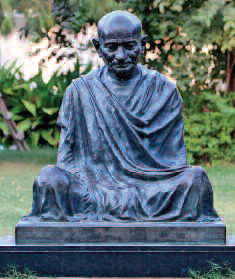
 “When we see our role in society as servants, we will light up the sky together like countless stars on a dark night,” read a young woman named Kushmita in the opening circle, quoting Vinoba Bhave, a scholar and close spiritual friend and associate of Gandhi. He is little known today in the West but he is revered in India, not just for his participation in the Indian Independence Movement or his many books on the world’s great religious traditions but for the Bhoodan or Land Gift Movement. Vinoba spent years walking across India on foot, surrounded by friends and followers, persuading land owners to donate a portion of their holdings to the landless. In this extraordinary effort, walking from village to village, talking face to face, Vinoba showed what could follow Gandhi.



 Tracy Cochran