One November day awhile ago, I was dispatched by Publishers Weekly to Washington, D.C. to interview the famous newsman Jim Lehrer, who just had a novel out. My editor insisted the interview take place at his home not far from the National Cathedral, not his office. This to create a feeling of intimacy, including details about all the bus memorabilia he collected in honor of his father, a bus driver, etc. Lehrer kindly complied, rushing from his office in Arlington, VA, where he was preparing to interview the Assistant Director of the FBI.
Tag: Awareness
-
Take Off the Bubble Top
Sitting in his pretty, unwashed living room, Lehrer gave the impression of having stopped on a dime. Lehrer’s famous face, as ordinary and noble as a farmhouse on a Western plain, composed itself in a look of alert waiting. His way of being with me, forthright and decent, was a lesson in how to conduct interviews–and also in how we can be with one another.Lehrer was used to living in the present moment under intense scrutiny. He was used to asking questions designed to draw out the truth without shouting or intruding, without the questions screaming for attention themselves. He recalled driving his daughters to one presidential debate he was moderating: “I told my girls in the car, if people remember the questions, I haven’t done my job.”It was excruciating to watch the trampling of time limits, the ignoring of questions to “stay on message,” the blatant lying, in the last presidential debate Lehrer tried to moderate. I felt like I was watching a decent man witness the seeming loss of our ability to have a civilized (not to mention honest) exchange in this country.But this is beside the point today. The point is this singular memory that Lehrer shared. He worked as a young newspaper reporter in Dallas in the late 1950s and 60s. On November 22, 1963, he was dispatched to ask the Secret Service man in charge of security President Kennedy’s motorcade whether the President would be riding with the bullet-proof bubble-top on his limousine on or off. As fate would have it, it was a beautiful day.“Take off the bubble top!” Lehrer heard the man command. Later, inside the Dallas police station, the shattered agent whispered the same words to Lehrer again. Lehrer wondered how many times the poor man had thought of those words since. May he have found peace.Our lives are made of moments, some indelible, but each dependent on causes and conditions beyond fathoming. What happens to others and to ourselves, what arises in a moment, binds us to each other and to a greater whole.
-
Seeing with Generous Eyes

Buddha Eyes Years ago I learned an important lesson while following a Buddhist nun through the woods in Western Massachusetts. She was a different kind of Buddhist nun (not that I had encountered that many) and it was a different kind of walk. In the first place, she was not silent. She asked kindly questions and made friendly easy comments about the weather and so on, exhibiting none of the expected nun-like reserve or shunning of small talk Far more striking, however, was how quick and light she was on her feet.
She wasn’t walking fast in her own lights. As member of a small and little-known sect of Nichiren Buddhism, Nipponzan Myohoji, Sister Clare Carter spent months every year walking the globe with her fellow monks, beating a hand drum and chanting for peace. Sister Clare and her brother monks were part of sect dedicated to total non-violence and total non-aggression in any sense. “There is tremendous selflessness, which is very moving,” explained Paula Green, a peace activist and neighbor who introduced me to Sister Clare. “There is no pushing people to do this or believe that.”In the past year, Sister Clare, who was then in her late fifties, had walked from here to Washington, D.C., and then from Hiroshima to Tokyo, praying for peace. She walked about twenty miles a day at a very fast clip, but on that day she was slowing down the pace for me. Sister Clare was leading me to a Peace Pagoda in a clearing. Built on donated land by the tiny sect along with volunteers from the area , the pagoda is a strange yet graceful thing, like a vessel that has gently landed there from space. As we approach, Sister Clare stops chatting and starts chanting; Namu-myoho-renge-kyo.It took me years to fully register that Sister Clare chanting this phrase was not superstition or wishful mumbo jumbo but actually an extraordinary act of generosity. To Sister Clare chanting this phrase from the Lotus Sutra with a mind of faith contains all the teachings and all the merit of all the good practices of all the Buddhas. It embraces all phenomenon, transforming everything, me included into the total liberation of the Pure Land. In the words of Princeton scholar Jacqueline Stone, to the faithful the chant contains “three thousand realms in one thought moment, the entirety of all that is.”But at the time, I was ignorant of this, limited by my own narrow perspective. I was taking in the way she walked, the chanting, and a judgement blazed up. I remembered walking next to the Vietnamese Zen master Thich Nhat Hahn, who glided along silently and slowly, as if he was on rails. The way he moved was once famously described as a cross between heavy machinery and a butterfly, and I confirmed this. Walking beside him it was as if he were made of some super-concentrated, super-heavy material that could never be moved, and yet there was this exquisitely delicate way of talking. I thought this was what enlightenment looked like, felt like, sounded like.I realize now that I was struggling with the difference between slow and stately “progress Buddhism,” and Sister Clare’s leap of faith. I realize now that clear seeing requires generosity, a willingness to embrace all that is unseen as well as what is seen.
-
Wait
“The first rule in answering, if there is one, is to wait,” writes Lillian Firestone in the new issue of Parabola, “Liberation & Letting Go.” This brief, powerful essay stopped me in my tracks when I first read it because I happened to be on the train coming home from teaching a beginner’s meditation course. I had just answered quite a few questions. “The part of our brain that has the ‘right’ answer for everything is a dull place, built of endless chains of associations, everything we knew in the past. This knowing may be factually correct but there’s a problem with it. It is dead.”To respond in a way that is alive takes courage because it means waiting, not saying the “right” answer, but sitting there open and vulnerable and not knowing, hoping a response unique to the moment might arise.Riding home on Metro North that cold night, I realized Firestone was right. And more. It dawned on me that liberation does not consist in letting go of our connection with others and with the world around us, but in letting go of our separation. Liberation begins when we can be still and know that if we restrain ourselves from saying any old thing that happens to stacked up under the dust in the kingdom of our own mind, there will be more. A fresh response from a new impression from the living world will come from a deeper place.
-
Big News!
In May 2001, in a laboratory at the University of Wisconsin, a Tibetan Buddhist monk donned a cap studded with hundreds of sensors that were connected to a state -of- the- art EEG, a brain-scanning device capable of recording changes in his brain with speed and precision. When the monk began meditating in a way that was designed to generate compassion, the sensors lit up in a way that registered the shift to regions of the brain that activate in a state great joy. “The very act of concern for others’ well-being, it seems creates a greater state of well-being within oneself,” writes Daniel Goleman. When I read that and wrote about it in Publishers Weekly about fourteen years ago, I pictured the monks brain sensors lighting up like those photos of the earth from space that show twinkling lights in the darkness. Hard scientific proof that compassion leads to joy! This was the kind of news flash I wanted to help spread!Before I came to Parabola, I was a journalist and book reviewer for big mainstream publications, including The New York Times and Publishers Weekly. I kept at every chance to write about books like Destructive Emotions: How Can We Overcome Them?: A Scientific Dialogue with the Dalai Lama by Daniel Goleman. I lobbied to make sure the book review received a special tinted box and a big red star, the better to draw attention to a book about then-new breakthroughs in the neuroscience of emotion, the scientific study of consciousness, the fruits of collaboration between leading scientists and Buddhist monastics including the Dalai Lama in a still-ongoing series of dialogues called Mind and Life.Reviews for PW, which then went up on Amazon, had to be compact so I worked really, really hard (too hard) to drive home how awesome it was that Western Science and Buddhism were joining forces. My mission as I saw it was to make Goleman’s important book stand out before it could be lost. This was my final sentence: “Goleman travels beyond the edge of the known, and the report he sends back is encouraging.” Thanks to the magic of the internet that review is still up there on Amazon (isn’t it strange to think that everything we write , every little exclamatory burst, is still out circulation like space junk or stored in vast unknown repositories). Over the years, I came to meet and admire Daniel Goleman, his wife Tara Bennett-Goleman, and many more leading Buddhist thinkers and teachers. Yet the almost panicky urgency about helping get the word out began to ease. As I practiced, just the simple daily practice of sitting down, breathing, being still, I began to see that the deeper truth is always here, waiting for a chance to arise.“The mystery of seeing. This is what Meister Eckhart brings for our edification,” writes David Appelbaum in Parabola’s new issue “Liberation & Letting Go.” “The gateway is to be found in the releasement from what Eckhart calls the ‘me and mine.’” I love “releasement,” a firm, solemn, formal word, as if a prison door is swinging open, allowing us to walk out into a bigger world. A friend in my weekly sangha once shared this insight about wisdom: it is the same in every tradition. This is because wisdom is not a formula–it is truth seen in the midst of life, live, wild truth. Wisdom must cannot really be given. It is a way of seeing that must arise in your own life. Yet there are guides and timeless guidance. It is all there in already. We just have to actually DO what is said. (This is why I love Parabola so much. It treats the timeless like news).Seeing is the way. Seeing lights us up inside. No detail is too small. For example, we may think it’s very unremarkable, not really worth noticing at all–the way we automatically tag every impression with “I, me, mine” or “like, dislike, neutral.” Yet it turns out that this incessant automatic tagging, this involuntary clutching at our experience–especially our feelings–is what keeps us imprisoned. In a timeless collaboration, the Buddha and Meister Echkart take us beyond the known.
-
Touching Down
Some of you may have noticed that I’ve been away for a time (thank you for reading this!) I’ve been working on Parabola’s wonderful new issue, walking, and reflecting. Wondering if I should keep going with a blog, wondering it doesn’t just contribute to the great information flood that threatens to drown us all.
Reflection is the word I am using at present for a process very different than thinking, a way of making space for a deeper kind of knowing arise, for letting our lived truth, our wisdom, rise slowly to the head. Many of our metaphors are based on the experience of being in a body (I have a book on this somewhere in my teetering piles of books) When an insight or realization “dawns” on us, it mirrors the experience of having a deeper knowing rise like the sun, from the depths of the living body, lighting us up. This kind of knowing has a certainty and clarity that ordinary thinking, however brilliant, lacks. It has a deeper, softer, steadier glow. It shines with a conviction that comes from lived experience. When this knowing dawns in our consciousness, it brings real presence to what we say. Asked how he made his extraordinary music, the jazz great Thelonius Monk once told an interviewer there are only so many notes, the key was meaning the notes. There are only so many letters in the alphabet too. You bring your life to those words, people feel it.Reflection is not flashy. An old boss once referred to a co-worker who swiftly moved up and out as “blindingly brilliant.” How I wished I could be like that! I too wanted to be so dazzling I would be seen and scooped up and given a perch high up on the tree of success, above the flood. of time and impermanence and fleeting impressions and desires and distractions that is sweeping me along. But slowly, I stopped wanting that. Slowly, haltingly (my way of doing most things), it has dawned on me that blinding brilliance doesn’t matter. Touching the earth matters.According to legend, as Siddhartha Gautama sat under a tree, breathing and being present, seeking to discover what it might mean to wake up in this world, the great devil Mara came and challenged him–basically asking him who or what gave him the right just to sit there, breathing, being with the sensation of breathing, watching his ordinary thoughts and feelings arise and peak and pass away, abiding in the fields of his own conscious experience. According to the legend, Siddhartha reached down and touched the Earth, and the Earth spoke: “I bear you witness!” Mara gave up tempting and terrifying young Sid, leaving him to go on just sitting there, breathing and abiding. As the morning star rose in the sky, he woke up and became the Buddha (or Awakened One).The traditional interpretation is that the Earth bore witness to the Buddha’s many life times of search and effort, affirming that he had earned his right to sit. But as in every great myth, there is room for more interpretation, more meaning, deeper and more immediate truth. The earth is our own bodies, our own our breathing, our own capacity to be present. The morning star is that experience of dawning of living, breathing experience dawning in the realm consciousness–it the wisdom that is seeing the truth in a direct and nonverbal way, in the language of our lives here and now.Siddhartha Guatama left his palace home, left his wife and infant son, at a time of great stagnation, impasse, shut down. A small group of Brahmins were in control and the general feeling was that things were not going well, not at alll. At the time that Siddhartha left home to find another way, many others were also “going forth.” And he did find another way, a way that was very radical and against the stream, he sat down under a tree and just abided quietly. He touched the earth.
-
In the Chapter Room
“The solitary life, being silent, clears away the smoke-screen of words that man has laid down between his mind and things,” writes Thomas Merton in Thoughts in Solitude. “In solitude we remain face to face with the naked being of things. And yet we find that the nakedness of reality which we have feared, is neither a matter of terror nor for shame. It is clothed in the friendly communion of silence, and this silence is related to love. The world our words have attempted to classify, to control and even to despise (because they could not contain it) comes close to us, for silence teaches us to know reality by respecting it where words have defiled it.”
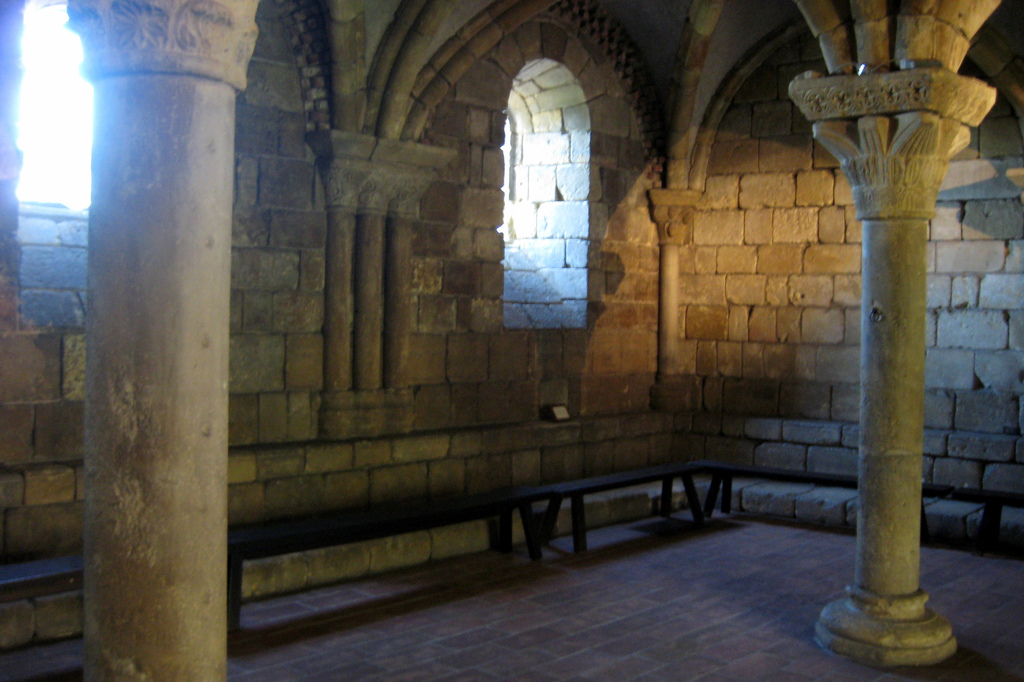
When you are thinking of bicycles, you see bicycles everywhere. Contemplating Parabola’s latest theme, “Alone and Together,” I find fresh evidence of the interplay between solitude and community everywhere. I visited The Cloisters with my daughter Alex and her boyfriend Anthony. Set on a hilltop with sweeping views of the Hudson River, The Cloisters is not just a museum of medieval art, it actually is a medieval cloister transported here from France.
Merton writes of it in The Seven Storey Mountain, the iconic memoir of his spiritual journey. Merton opens the book by saying that he was born in the shadow of some French mountains. “There were many ruined monasteries in those mountains,” he writes “My mind goes back with great reverence to the thought of those clean, ancient stone cloisters, those low and mighty rounded arches hewn and set in place by monks who have perhaps prayed me where I now am…”
And many momentous years later, after he lost his father and mother, after he went to private school and Cambridge University, and then on to Columbia University in New York, Merton encountered one of those ancient cloisters again…in the upper reaches of Manhattan. Can you imagine? He found himself at Columbia, in what I’ve heard called upstate Manhattan. Under his friendliness and activity, he was lonely and searching. And as he began to turn towards the contemplative path, as he began to turn towards the inner path—he found a monastery from the innermost layers of memory—literally relocated in time and place. Can you imagine the proverbial mountain coming for you?
“One of [the cloisters], stone by stone, followed me across the Atlantic a score of years later, and got itself set up within convenient reach of me when I most needed to see what a cloister looked like, and what kind of place a man might live in, to live according to his rational nature, and not like a stray dog. St. Michel-de-Cuxa is all fixed up in a special and considerably tidy little museum in an uptown park in New York, overlooking the Hudson River, in such a way that you don’t recall what kind of city you are in. It is called The Cloisters. Synthetic as it is, it still preserves enough of its own reality to be a reproach to everything else around it, except the trees and the Palisades (the lofty steep cliffs along the Hudson).”
I sat in the cool depths of the Chapter House. With Alex’s firm encouragement (understandably, she and Anthony wanted to drift through the garden and among the treasures without Mom on their heels), I sat for a long while in a twelfth-century enclosure where monks gathered for daily readings of the Rule of St. Bendict, the rules of their order—the most famous of which is about welcoming guests as if they were a manifesting divine. I felt welcomed, and more. The stones communicated something to me on a “preverbal”—possibly even a “post-verbal” level.
“True communication on the deepest level is more than a simple sharing of ideas, of conceptual knowledge, or formulated truth,” writes Merton in a talk he once planned. “The kind of communication that is necessary on this level must also be ‘communion’ beyond the level of words….”
For a little while, sitting in the Chapter Room, I experienced The Cloisters not as a tourist but as a pilgrim. I felt a presence or vibration in the stones around me. It felt like I was being helped by the efforts of others in the past who tried to cultivate an awareness beyond ordinary words and knowledge—who tried to open to what is new, to welcome whomever and whatever arrives as a manifestation of the divine.
Eventually, Alex and Anthony arrived. I described my sense that the stones communicated something. Alex is used to this sort statement from me. But Anthony, who studies theoretical physics and math in graduate school at Princeton, looked doubtful. No matter. I know that he understands that nothing is solid and separate in his own way. I know that we are made up of energies that too quick and subtle to perceive.
Except, I find that we can sense this great mystery with these very bodies, hearts, and minds. Sometimes when we are very still, there can be a subtle movement of availability and we can receive something extraordinary that is being offered, radiated. Sitting at The Cloisters the other day, I glimpsed that reality—a finer level reality—is not something chilly and abstract. It really does come “clothed in the friendly communion of silence.”