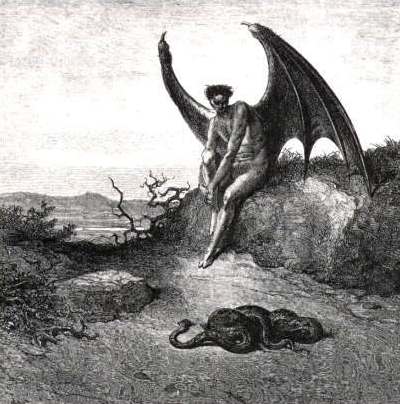
 “Better to reign in hell than serve in heaven.” In Paradise Lost, Milton gives Lucifer great lines. But after all, he is the most beautiful and brilliant of all the angels—in Hebrew his name means “to shine” or “to bear light;” in Latin it means “morning star.”
One January in college, I elected to read Paradise Lost (yes, as an elective course). As snow and cold blanketed the campus, a thick, wintery depression descended on me. I discovered I couldn’t read the epic in any analytical literary way, just picture some of it, feel the consequence of it, the possibility of doom. Lucifer was like the glamorous college roommate off drinking wine in sunny Italy, challenging my puritanical belief in the power of hard work and good intentions, seemingly revealing that being gorgeous and having a fabulous life had more to do with a sense of personal entitlement than with any boring old objective truth—who could say what that was anyway?
Lucifer was bursting with pride and vanity, just like my rich roommate. But he was also heroic, struggling to overcome his doubts and weaknesses to wage revolution against what he presents as the tyranny of God. Milton draws us to him, making evil seem attractive (at least at first). Lucifer s just so damned bold and confident, more dazzling than the coolest person you ever met, completely unafraid of being damned eternally.
Milton’s great epic poem has two narrative arcs (and thank you to Wiki for the help): the journey of Lucifer and the comparatively plodding progress of Adam and Eve. It begins after Lucifer and other rebel angels have been defeated and banished to Hell (Milton also uses the term for Hell used in the Greek myths, Tartarus). Employing dazzling rhetorical skill to rally his troops, Lucifer personally volunteers to poison the newly-created Earth and God’s new creation, Mankind. He braves great dangers alone, arduously traversing the Chaos outside Hell to enter God’s new material World, and later the Garden of Eden—his journey has been compared to Odysseus or Aeneas.
At several points in the poem, a great Angelic War over Heaven is recounted from different perspectives. The battles between the faithful angels and Lucifer’s forces take place over three days. The final battle involves the Son of God single-handedly defeating the entire legion of angelic rebels and banishing them from Heaven. Following the purging of Heaven, God creates the World, culminating in his creation of Adam and Eve. The rest, as they say, is history. God gave Adam and Eve total freedom, but one explicit command: do not eat from the Tree of the knowledge of good and evil. They will meet Lucifer again in the Garden of Good and Evil, this time as Satan.
Here is my chance to clear up a common misconception: Lucifer and Satan are not actually the same. Lucifer is a fallen angel—he has a form. He falls to hell because he is completely unwilling to be subjugated by God and his Son, claiming that angels are “self-begot, self-raised.” Lucifer is dazzling, charismatic, able to rally other angels, arguing that God rules as a tyrant and that all the angels ought to rule as gods. Lucifer is pure ego, but not the opposite of God, rather a split off, fallen piece of Him.
Satan is a spirit of evil that has lived in the world for thousands of years. He promises that one day he will make himself visible. He will be the Beast but proclaim himself God. He is the opposing resistance to God, the murderer and “father of lies” from the beginning. Lucifer was perfect until he succumbed…to Satan.
There are certain truths that take a long, long time to unfold—the length of a book, decades of life. Lucifer was cool, gorgeous, like a rock star or your rich and decadent college roommate. How can the seemingly humble Son of God—or even the admittedly human Buddha compete with such glamour and charisma? Buddha grew old and sick, according to the legend he was poisoned, in what sense did overcome death and suffering—the tyranny of creation?
This is how: Lucifer degenerates, becomes incoherent, confused, finally slithering off. The spirit that is Satan has always been portrayed as a serpent, a snake, a dragon—and in the end Lucifer is completely identified with Satan.
This is the fate of addicts. They don’t age well. Rock stars usually don’t age well. Entitled people don’t usually age well. Lucifer was addicted to his own raging ego, his own pride. He wanted to be the center of his own self-begot world, to rule rather than serve as part of a greater Whole. He waged war, volunteered to poison the Earth, proved willing to do anything to keep the domain of the self safe, to shore up his bottomless feeling of lack. The rest, as they say, is history. The spirit of evil took over. Lucifer became Satan. He wasn’t pretty and brilliant anymore.
Years later, working in the first of several Dickensian jobs in publishing, my literary agent boss gave me a ticket to a special show at the New York Public Library. Among the first editions on display was a tiny threadbare copy of Paradise Lost. Blind and about 60 years old when it was published, Milton made a whopped twelve British pounds on it in his life time (maybe twenty-four, I forget), but very little money. He hoped for a few but fit readers. I was not among them.


 Tracy Cochran
Leave a reply to James Cancel reply