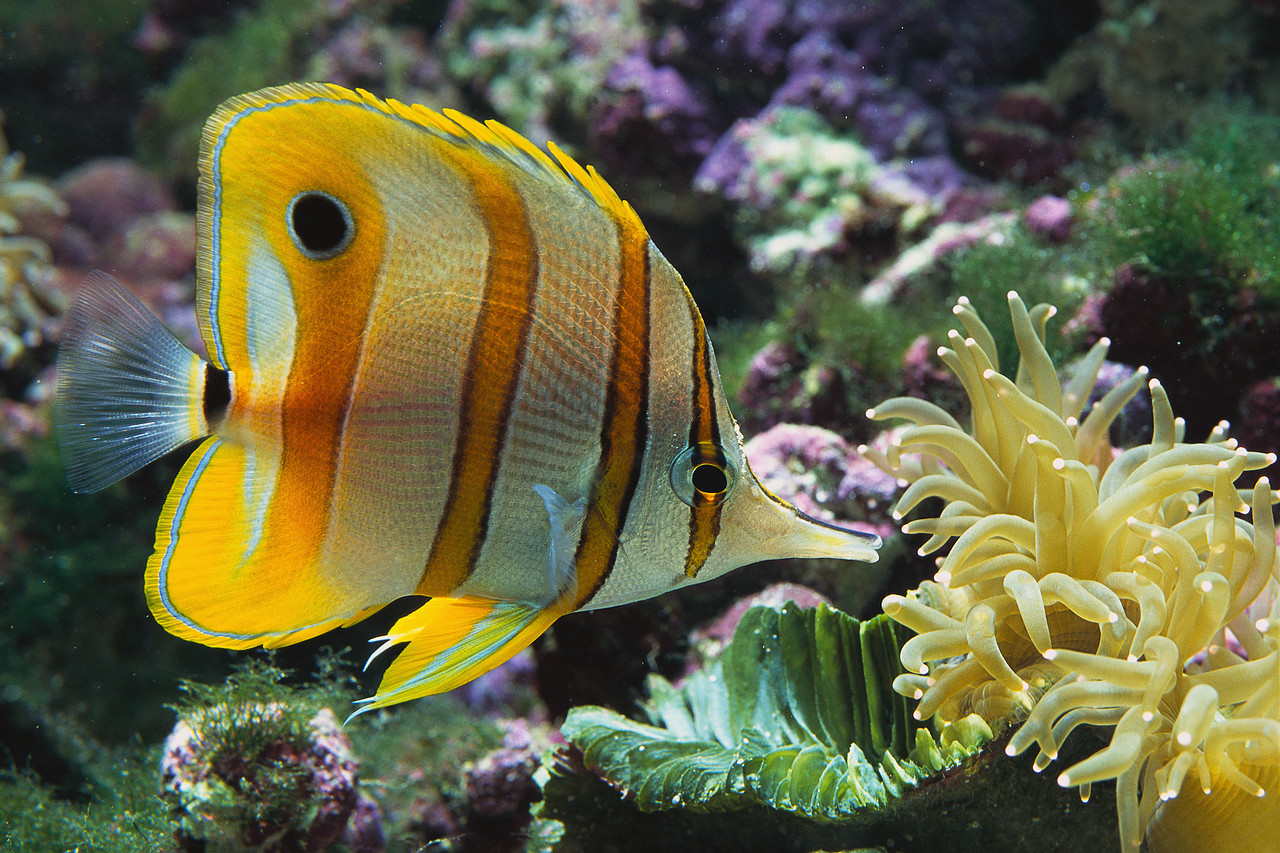
 “There are these two young fish swimming along, and they happen to meet an older fish swimming the other way, who nods at them and says, ‘Morning, boys, how’s the water?’ And the two young fish swim on for a bit, and then eventually one of them looks over at the other and goes, ‘What the hell is water?’”
David Foster Wallace kicked off his commencement speech to the 2005 graduating class at Kenyon College with this story. The brilliant author went on to describe how it is often the most important reality that we overlook or get flat wrong: “Here’s one example of the utter wrongness of something I tend to be automatically sure of: Everything in my own immediate experience supports my deep belief that I am the absolute center of the universe, the realest, most vivid and important person in existence….It is our default-setting, hard-wired into our boards at birth. Think about it: There is no experience you’ve had that you were not at the absolute center of.”
We humans are all wired the same way, and the most sensitive and aware among us come to know this. Thousands of years ago, the Buddha described how our unconscious desires and inclinations limit our perceptions, which in turn narrow and twist our cognition. In the upcoming issue of Parabola, “The Unknown,” philosopher and author Jacob Needleman affirms that the great Western philosopher Kant (among others) spelled out a similar situation—that the structures of our mind limit our perception, that everything we take in through our sense doors is organized and limited below the level of consciousness, that we cannot know reality in itself.
Most of us swim along our whole lives in our little bubble of self-centered delusion. The ocean that supports us—that provides the very oxygen we breathe since we are fish in this metaphor—remains unknown to us, even unsuspected. And yet some people seem to find a way out of this claustrophobic and unhappy situation, not just in the Buddha’s time but now. How? In our own age, this is not just a question for the philosophical or spiritual few. The fate of the real ocean and the real earth depends upon a significant number of us finding a way—or at least asking the question.
Wallace, a very brilliant and hyper-self-conscious person, knew the way had to do with “somehow altering or getting free of my natural, hard-wired default-setting, which is to be deeply and literally self-centered…” He knew that real freedom had to do with cultivating an ability to think clearly and to pay attention, which depended on aligning yourself with something more reliable than money or power or the beauty of your own body.
“In the day-to-day trenches of adult life, there is actually no such thing as atheism,” Wallace told the graduating class. “There is no such thing as not worshipping. Everybody worships. The only choice we get is what to worship. And an outstanding reason for choosing some sort of God or spiritual-type thing to worship — be it J.C. or Allah, be it Yahweh or the Wiccan mother-goddess or the Four Noble Truths or some infrangible set of ethical principles — is that pretty much anything else you worship will eat you alive. If you worship money and things — if they are where you tap real meaning in life — then you will never have enough. Never feel you have enough. It’s the truth. Worship your own body and beauty and sexual allure and you will always feel ugly, and when time and age start showing, you will die a million deaths before they finally plant you. On one level, we all know this stuff already — it’s been codified as myths, proverbs, clichés, bromides, epigrams, parables: the skeleton of every great story. The trick is keeping the truth up-front in daily consciousness. Worship power — you will feel weak and afraid, and you will need ever more power over others to keep the fear at bay. Worship your intellect, being seen as smart — you will end up feeling stupid, a fraud, always on the verge of being found out. And so on.”
Wallace glimpsed this truth and shared it: “The really important kind of freedom involves attention, and awareness, and discipline, and effort, and being able truly to care about other people and to sacrifice for them, over and over, in myriad petty little unsexy ways, every day. That is real freedom. The alternative is unconsciousness, the default-setting, the ‘rat race’ — the constant gnawing sense of having had and lost some infinite thing.”
Sadly, Wallace, who committed suicide at 46, was too afflicted by depression to be able to have this impression sink from his head to his heart—and into his feet. In “The Unknown,” we will feature another commencement address, delivered at the University of Pennsylvania this past spring, by a young man who not only came to see the way out but to actually, literally, to walk it. (Stay tuned, friends. It’s going to be a great issue).
Opening ourselves up to the reality of the unknown can be terrifying, but honestly what is the alternative? In my own case, at least, the evidence is mounting up that change is just inexorable. No matter how much I want to hold on, there is loss, aging, change. In my better moments, there is a new quality of equanimity—a willingness to being in the middle of what is happening, to drop the self-absorption and be another pair of hands in the bucket brigade. My questions are changing, maybe because it gets lonely living in self-centered isolation, boring and extremely repetive being the star of my own limited little drama.
In my more open and balanced moments (have you noticed that your balance is better when you aren’t leaning forward, chasing something?) a different kind of question is bubbling up–and from my heart, not my head. “How will I (or Parabola) survive and thrive?” shifts to “How can I (or we) serve?” In these better moments, I guess you could compare me to the old fish in Wallace’s story. I never could have guessed this at other times, but these are the best moments–being an old fish among other fish, swimming in a vast unknown ocean.


 Tracy Cochran
Leave a reply to Tracy Cancel reply