“The solitary life, being silent, clears away the smoke-screen of words that man has laid down between his mind and things,” writes Thomas Merton in Thoughts in Solitude. “In solitude we remain face to face with the naked being of things. And yet we find that the nakedness of reality which we have feared, is neither a matter of terror nor for shame. It is clothed in the friendly communion of silence, and this silence is related to love. The world our words have attempted to classify, to control and even to despise (because they could not contain it) comes close to us, for silence teaches us to know reality by respecting it where words have defiled it.”
When you are thinking of bicycles, you see bicycles everywhere. Contemplating Parabola’s latest theme, “Alone and Together,” I find fresh evidence of the interplay between solitude and community everywhere. I visited The Cloisters with my daughter Alex and her boyfriend Anthony. Set on a hilltop with sweeping views of the Hudson River, The Cloisters is not just a museum of medieval art, it actually is a medieval cloister transported here from France.
Merton writes of it in The Seven Storey Mountain, the iconic memoir of his spiritual journey. Merton opens the book by saying that he was born in the shadow of some French mountains. “There were many ruined monasteries in those mountains,” he writes “My mind goes back with great reverence to the thought of those clean, ancient stone cloisters, those low and mighty rounded arches hewn and set in place by monks who have perhaps prayed me where I now am…”
And many momentous years later, after he lost his father and mother, after he went to private school and Cambridge University, and then on to Columbia University in New York, Merton encountered one of those ancient cloisters again…in the upper reaches of Manhattan. Can you imagine? He found himself at Columbia, in what I’ve heard called upstate Manhattan. Under his friendliness and activity, he was lonely and searching. And as he began to turn towards the contemplative path, as he began to turn towards the inner path—he found a monastery from the innermost layers of memory—literally relocated in time and place. Can you imagine the proverbial mountain coming for you?
“One of [the cloisters], stone by stone, followed me across the Atlantic a score of years later, and got itself set up within convenient reach of me when I most needed to see what a cloister looked like, and what kind of place a man might live in, to live according to his rational nature, and not like a stray dog. St. Michel-de-Cuxa is all fixed up in a special and considerably tidy little museum in an uptown park in New York, overlooking the Hudson River, in such a way that you don’t recall what kind of city you are in. It is called The Cloisters. Synthetic as it is, it still preserves enough of its own reality to be a reproach to everything else around it, except the trees and the Palisades (the lofty steep cliffs along the Hudson).”
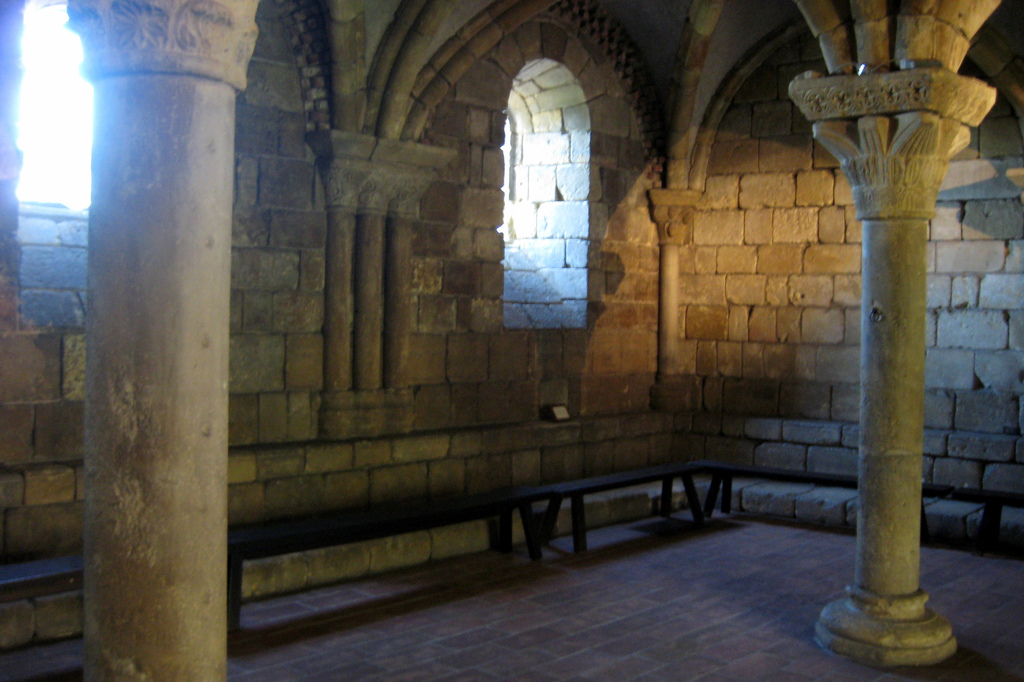
I sat in the cool depths of the Chapter House. With Alex’s firm encouragement (understandably, she and Anthony wanted to drift through the garden and among the treasures without Mom on their heels), I sat for a long while in a twelfth-century enclosure where monks gathered for daily readings of the Rule of St. Bendict, the rules of their order—the most famous of which is about welcoming guests as if they were a manifesting divine. I felt welcomed, and more. The stones communicated something to me on a “preverbal”—possibly even a “post-verbal” level.
“True communication on the deepest level is more than a simple sharing of ideas, of conceptual knowledge, or formulated truth,” writes Merton in a talk he once planned. “The kind of communication that is necessary on this level must also be ‘communion’ beyond the level of words….”
For a little while, sitting in the Chapter Room, I experienced The Cloisters not as a tourist but as a pilgrim. I felt a presence or vibration in the stones around me. It felt like I was being helped by the efforts of others in the past who tried to cultivate an awareness beyond ordinary words and knowledge—who tried to open to what is new, to welcome whomever and whatever arrives as a manifestation of the divine.
Eventually, Alex and Anthony arrived. I described my sense that the stones communicated something. Alex is used to this sort statement from me. But Anthony, who studies theoretical physics and math in graduate school at Princeton, looked doubtful. No matter. I know that he understands that nothing is solid and separate in his own way. I know that we are made up of energies that too quick and subtle to perceive.
Except, I find that we can sense this great mystery with these very bodies, hearts, and minds. Sometimes when we are very still, there can be a subtle movement of availability and we can receive something extraordinary that is being offered, radiated. Sitting at The Cloisters the other day, I glimpsed that reality—a finer level reality—is not something chilly and abstract. It really does come “clothed in the friendly communion of silence.”
 Tracy Cochran