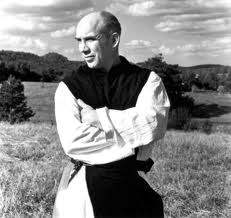
 Our luminous “Alone and Together” issue is now appearing everywhere like a beautiful new spring bird. And not surprisingly, I have been reflecting about the connection between solitude and community. At times, it feels like THE theme—the very key to life. There is a fascinating article in the issue, on the poet Rilke, who longed for solitude so he could draw close to the source of things. Exhausted from my editorial labors, I streamed “Merton: A Film Biography,” the other evening. I was struck by scenes that depicted how communal the life is in the Trappist monastery Gethsemani. Young Thomas Merton entered the monastery seeking a place apart “to entertain silence in the heart and listen for the voice of God – to pray for (my) own discovery.” And yet for years, he was rarely alone.
In pictures from his ordination, Merton glows with youth and happiness–in spite of an extremely Spartan life and striking lack of privacy. The monks sleep in little cubicles and otherwise seem to do everything collectively and under the watch of the abbott. And this seems to be the source of the freedom and simplicity and radiates from Merton. In the community of the monastery, he sheds a skin of separation.
It reminded me of what can happen briefly on retreat. There is a wearing down of the ego and its relentless insistence on making us special (if only by being especially bad at kitchen work). There comes a point when we let go of the story of ourselves, when we let go of our fear of what others think and of being no one and all the rest. Seeking solitude, we find ourselves in community. Letting go of ourselves, we may find our way to deeper feeling of connection with life.
Living apart from ordinary society as a monk, Merton found his way to the heart of life. In bustling downtown Louisviille, Kentucky, Merton had an epiphany. He saw himself in every passing stranger’s face. He was not separate from them, nor they from him. Merton went on seeking solitude. He was the first Trappist monk to be given permission to live in a little hermitage, away from the communal life of his brothers. And yet from that place of solitude, Merton reflected and wrote on the burning issues of the day. He travelled the world from that place, and he never lost that recognition of our common humanity.
There is a stillness under the noise of the world and our own thoughts. There is a kind of solitude that not a flight from others but a way of being with ourselves—the whole of our experience, excluding nothing. How precious it is in this pressured age to unplug and drop out and tune in to the experience of being fully present for a time—if only for the space of a prayer or a meditation or a walk. Retreating for a time, we may find our way home to our humanity.
Seemingly worldly people can harbor a secret monasticism. In Merton’s case, certainly being a writer is a monastic calling—even his famous excess, the girls and parties and time spent in the bars around Columbia University were ways of sending up flares: find me, God. And most adolescents are seekers. Most hide pure hearts under what they hope are tough and worldly exteriors. Most are seeking a way to be alone among others. Last time, I alluded to a high school boyfriend who liked to dress in black and act all dark and mysterious. There was actually a group of us who tried to give off a whiff of outlaw or underground—who tried to be psychedelic seekers. We would gather often in the attic room of a boy who liked to call himself “Shiva Gonzo” (which gives you some indication of his major influences). We would sit there by the light of candles shaped like dripping skulls, listening to Led Zepplin and Spirit and similar music, trying to find our way to the source.
A dozen years ago, I interviewed Ram Dass for a magazine. We warmed to each other and wound up spending hours laughing and talking. I told him I felt I had bonded with him—specifically with his book Be Here Now– years before. I described being in an attic room in a house in Northern New York with a crowd of psychedelic seekers that included a boy named Shiva Gonzo. But all the while, I felt a connection to his purifying pilgrimage to India and his meeting with the extraordinary guru who saw through his social exterior—who showed him his true self. “If I had a nickel for everyone who has said that to me,” Ram Dass laughed, banging his hand on the arm of his wheel chair (a little more on this encounter to come).
It strikes me now that I was a lamb in protective wolf’s clothing. The dripping skull candles were really votive candles. I was looking for a place of solitude—a place (in Merton’s words) “to entertain silence in the heart and listen for the voice of God – to pray for your own discovery.”
 Tracy Cochran