30
Jul 12

Lesson from an Angel

Meditating on the Mountain


In honor of “The Unknown” (and because a few loyal readers asked me), I delve deeper into my encounter with the unknown, begun last time….


One night, after I graduated my college and just before I moved to New York, I woke up in the middle of the night to see an apparition of a lovely young woman.  Her features were very delicate and she seemed to be made entirely of white mist—picture an ice sculpture, except in dry ice.  I had the impression that she was fair, or had been fair in life. She wore a long, exquisitely detailed lace dress (to this day, I can see the eyelets in the lace) and her hair was long and wavy. She smiled kindly and told me her name was Elizabeth.

And she delivered this chilling warning: “I came to tell you that if you don’t want your body, there are others who do.”  She told me that she didn’t live in that ominous house, but that she was nearby and I could find her if I needed her.  At the time, I took it as a warning that she was after me—along with unseen others.  For years, I found her appearance and message so terrifying I never spoke of it—as if to speak of it was to open a door to the unknown.

Now, I see Elizabeth as a benevolent spirit, a guardian.  Years in Manhattan, a purported “channel” asked me who Elizabeth was because when he sensed or heard that name all around me.  Perhaps that was what she meant when she told me she didn’t live in the ominous old house where she appeared but nearby.  But that night I thought she was warning me that she might take over my body—along with “others” who were dark.  Don’t ask me how I knew they were dark, but that was my sense.  They were dark spirits, hunting for bodies.

To see an apparition was terrifying enough. But that message!  It presented a reality that was unlike anything I had ever read or considered in my life.  I had been given a glimpse of something I could barely take in—that you can lose your life before you die.  It planted questions in me that were just dreamy speculations before:  Why are we given these human bodies?  What does it even mean to be embodied?  What is it all for?  Is it all for pleasure and avoidance of pain?  What are we meant to do while we are here?

But those questions came later.  That night, I dug down deep into the earth of my existence.  If the experience changed my view of reality, it also changed my view of myself.   It turned out there was more to me than I thought—that my thoughts and dreams, were just the tiniest part of me, a wisp of fog on a mountain top.  The mountain was life.

“No!” welled up from the depths of my being.  I don’t know if I actually shouted it, but it lit me up inside like lightening.  There was a surge of energy.  It wasn’t anger.  It was a wild animal certainty and fierceness.  When I was a little girl, I pretended I was friends with a super strong and super intelligent invisible black panther named Striker. There are situations that are so grave and critical, we plug straight into instinct. That night, Striker woke up in me.

Instinct isn’t in the highest human faculty.  It links us with the animal, not the angel.  But it has is an animal strength and purity, and we need be connected with it if we are to thrive in this precious life—especially if we want to know the truth.  There is a Buddhist sutra in which the Buddha is described as sitting in the center of courtyard or a house, guarding every entrance.  This is the posture we are to take to achieve awakening.   I’m not sure the commentaries mention this, but that is the stance a warrior.  Instinctively, I assumed that posture. I knew that night that if wasn’t vigilant, guarding every window and door, I could be lost.  I could be replaced by some disembodied and possibly dark force and no one would ever know.

These days, some scientists are researching the circumstantial, changeable nature of self. They are discovering that who we experience ourselves to be is constantly updating narrative, determined by the myriad influences around us.  But that night, I discovered that we are much larger than these little selves. In the grip of instinct, I discovered our common connection to the vast, submerged mountain range of great nature.  And I sensed (however distantly) that we may be meant to play a role in a greater drama than our endless personal dramas.

Before the Buddha achieved enlightenment, the demon Mara tried to distract him with beautiful women and temptations of all kinds.  When that didn’t work, he unleashed fearsome armies. But the Buddha would not be moved.  He reached down and touched the earth, asking it to bear witness to his right to be there. In the traditional teachings, this gesture affirms the Buddha’s many life times of seeking.  But I think it was a gesture of connection with his larger nature—the awakening of the animal of the body.  He needed to come down out of his thoughts and connect with the whole of himself to stand against Mara.

In Buddhist cosmology, Mara is not just an external demon but also all those impulses in us which distract us and pull us away from the spiritual path. But the Buddha would not be overtaken by desire or fear or hatred or any other dark force. The Buddha needed to be fully awake, in mind, heart, and body.  Many great spiritual traditions speak of man’s unique position between the angels and the animals.  On the night of his awakening, the Buddha discovered the Eightfold Path, which is not about accumulating facts, but literally about clearing a path inside.

Although it would take decades and many mishaps and adventures to fully realize, that night Elizabeth showed me that we may be a channel for different forces.  The greater truth doesn’t just dwell “out there” in some abstract cosmic realm.  It finds expression in the microcosm of our own life.  What we are open and willing to receive…that is an open question.


15
Jul 12

A Midsummer Night’s Ghost Story

The summer after I graduated from college, days before I moved to New York to start a real adult life, I saw a ghost.  Or maybe it was an angel, or a rare subset, a guardian ghost.  Decades later, I’m still not sure.  I am sure that it was not a dream or hallucination.  After all these years, I can see her and hear her as if she appeared last night.

I am aware that many of the details sound like classic ghost story tropes:  It happened in the spooky old house my family moved to when I was 14 years old, after my mother decided that our first house, a cozy brick ranch house designed by a uncle and largely built by my father, was no longer big enough. The house was a steal because the previous owners were highly motivated to sell.

There was something gloomy and oppressive about the place.  The kitchen was modernized but the rest of the house was full of dark wainscoting, and the diagonal placement of the fireplace and the angles felt off-kilter. The doors didn’t shut tight. I left my bedroom door ajar because it often creaked open in the middle of the night. Even my father, the most pragmatic and cheerful of men, admitted that the dark and narrow upstairs hallway felt “ominous.”

The front room upstairs, the former master bedroom, became my room.  It had three huge windows that overlooked the street, so it should have been cheerful but it was the gloomiest room of all.  As in many old houses, it had no closets, just a big cherry wardrobe, and it was dominated by n wooden bedstead with an elaborately carved headboard that touched the ceiling and a footboard about five feet high.  Brackets had been added in the frame to fit a modern mattress, but no one very tall could sleep in it.  It was the family joke that the master bedroom was mine because I was the only one who fit the bed.

The antique dealer who eventually bought the piece called it the “Shakespeare bed” because  the grain of the wood in headboard was split in such a way that it looked a little like a shadow outline of William Shakespeare, with his pointed beard and ruffled collar.  It also had big carved urns on top of the bedpost finials, and was in every way the perfect bed for a teenage girl with a moody and dramatic cast of mind.

To heighten the gothic effect of the room, I covered my walls with black light posters of Jim Morrison and psychedelic images and prevailed on my father to bolt a three foot black light to the ceiling that illuminated everything in stark purple way.  Like many adolescents, I sensed that I secretly might be capable of a deeper, greater life and felt that this—and many of my finer feelings and observations—were best kept hidden under a protective layer of darkness.

By the time I graduated from college, most traces of my dark hippie or proto-“goth” style were gone.  Still, the sense of being cut off from real life—big life–persisted.  Soon after  graduation, I took a trip out West in a VW van with my boyfriend of the time.  It was an archetypal American road trip, no real plan or route, just a powerful impulse to be in wide open spaces—to have a spacious view.  Like many recent graduates, I feared than I might miss this big potential life, that I might wander forever in the samsara of my crummy little life.  I felt I had to do something or find something or someone.  I just didn’t know what or who.

I had vague plan to drive to Boulder, Colorado, to meet the great Buddhist teacher Trungpa.  But once I made there, we sat drinking coffee in a place called the New York Bagel Cafe, full with the desolate feeling that I was going the wrong way.  Influenced by many voices, including my parents but especially a college friend (who turned out not to be a friend, but that’s another story) who worked at the New York Times, I decided that studying Buddhism in the Rockies would be dropping out of life.  The adult thing would be to do something hard.  I decided to move to New York and find a job in journalism or publishing.

Back home, I was full of misgivings, certain only that I was uncertain.  The ancient Celts spoke of the “thin places”—times and states when the boundaries between worlds, between day and night, sleep and waking, what is seen and unseen, is more porous.  Maybe I was in a thin place.  Certainly I was closer to recognizing the basic insecurity of life.

Days before I was to move to New York to begin what I hoped would be my real adult life, I woke in the night with a start to see the ghostly apparition of a young woman standing at the foot of my bed.  Although she and her dress were white, I could see every detail. She had long wavy hair and was dressed in a lacy Victorian dress. She looked like she was in her late teens and I had the impression that in life she had been very fair.

She smiled at me.

I remember gasping for breath as if I was running for my life.  My heart raced and my lungs burned, yet I was paralyzed with fright.  Years later, I wrote a story for a magazine about ghosts and I learned that being paralyzed is a standard “symptom” in true ghost stories.  And so is this:  I didn’t see her feet.  Even without being blocked by a five-foot headboard, ghosts never show their feet.

She told me her name was Elizabeth, and added that she didn’t live in this house but nearby.  She indicated that she could be reached if needed— and I had the impression that she meant she lived in the house next door.  This proved wrong, but I don’t want to get ahead of myself.

“I came to tell you something,” she said.  “If you don’t want your body, there are others who do.”

I have never been shocked by an electric cattle prod, but I imagine it feels something like I felt then.  A tremendous, affirming “No!” welled up from the depths of my being.  I squeezed my eyes shut and saw white.  I willed myself to grip the sides of the bed.  “I want this body.  I want to live!”

It was as if I woke up from a dream into a nightmare.  I was being told—by someone who was clearly not alive—that a person could lose this precious human life by not wanting it enough, by being inattentive or uncaring.  I was being told a person could just disappear, and their body could be taken over by another force, another who-knows-what.  And I found out how much will and determination I had to live.

Still smiling, Elizabeth backed away, reminding me that I could find her if I needed her.  With a great effort, I peeled my frozen limbs off the bed and ran down the hall to wake up my mother.  Still gasping, heart pounding, I choked out what happened:  “You might think I’m crazy, but I’ve just seen a ghost.”

“I don’t think you’re crazy,” she said in a solemn voice. She told me that she had been awakened by a feeling of tremendous cold one night.  She saw a column of white mist in the doorway and approached it.  “I felt so cold and sad as I walked towards it,” she said. This fog grew colder and denser as she neared it, then it disappeared.

In the days that followed, I heard other stories.  A houseguest, a friend of my brother, was alone in the house one afternoon.  He reported hearing footsteps in the upstairs hall and a heavy scraping sound like a trunk being dragged across the attic floor.  The my parents came home from a month-long vacation and felt a presence in the house. “It was the strangest thing,” said my father.  “It was as if someone wearing violet cologne, a very old-fashioned scent, had just left the room. Your mother and I looked at each other without saying a word, each of us sensing that someone was there.”

I was the only one who saw—and received a warning from—an apparition.  But as the haunted house evidence accumulated, I began to sense that the apparition I had see was something else.   After my parents sold the house (for a song), they told me more stories of sadness and losses that befell the people who moved in after us.  But I began to feel that Elizabeth had come to help.

A decade later, I was a struggling freelance writer, living in New York. New York Magazine gave me an assignment to cover a séance in a chic neighborhood on the Upper West Side.  I was to write a tongue-in-cheek piece about well-off people seeking guidance from a man who went into a trance state and purportedly channeled a great wise being.  I was convinced the man was a fraud and I asked all kinds of silly questions to try to prove it.

“I have a question for you,” said the man, when he came out of his trance.  “Who is Elizabeth?  All around you I heard the name Elizabeth.”

I never published that story. It took me years to find the courage to tell this story, and decades—now—before I wrote it down.  But over the years, it has come to seem a powerful teaching, even a kind one.

Over the years I have come to see there is trustworthy guidance in this world.  The Noble Eightfold Path and the Beatitudes and other ideas come down to us from a higher level of awareness.  They are thrown down like guide ropes, given to us like the gift of fire, so we won’t be doomed to wander aimlessly through life the way I tried to cross the country, guided only by our own changeable and self-centered desires.  But I also know we can be lost…and there may be help.


07
Jul 12

Interdependence Day

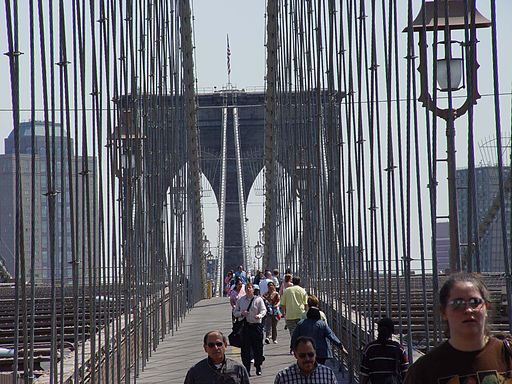
On Independence Day, I walked across the Brooklyn Bridge. We didn’t plan to do this.  My daughter, my friends, and I were headed downtown to walk around revolutionary sites.  But we emerged from the subway right where the walkway starts, and those iconic arches looming above us, inviting us to cross over to the Great Holy Land of Brooklyn.  Like many unplanned things, it turned out to be rich with meaning.

I call it Great Holy Land of Brooklyn because walking around the Heights and Cobble Hill used to fill my now-22-year-old daughter with nostalgia—a fierce longing for her what she regards to be her true home, the place of her first and happiest decade of life.  Yet, as a recent college graduate she now also understands what it is like to long for the future, to have a sense of anticipation about finding her true place in the world.

We dwell in the midst of the unknown.  We know this, or rather the body senses it. The physicist Stephen Hawkings defines “synchronicity” as nostalgia for the future.  This makes sense because synchronicity is shot through with the uncanny sense of being given a clue from another level, of following a trail of cosmic breadcrumbs towards a deeper meaning.  Even if our rational mind has talked us out of it, the body feels that there is a greater truth to be revealed, a greater pattern or whole.  Synchronicity delivers the little shock that reality is alive.

Walking in Brooklyn was charged with synchronicity for me.  I didn’t long for the future in the way that a 22-year-old longs for the future.  A middle-aged person just can’t get as excited about what life will be like in twenty years—we naturally start focusing on the journey rather than the ultimate destination.  The synchronicity I felt was a longing to find a path or a way to be part of a larger life.

My body knew the way through the brownstone streets, remembered the old haunts, the bookstore, the park, the cafe. I felt the ghosts of old experiences, old loves and sorrows and certainties.  And that was just it: they were ghosts, no longer alive.  I had lived in Brooklyn cocooned in my own little bubble of experience–and my experience had flowed on.

It was as if I had been drawn to Brooklyn to find clues about what the Buddha (or his early followers) called “the three marks of existence”– that everything in our lives is characterized by emptiness, impermanence, and the suffering or unsatisfactory feeling that comes as we experience how everything and everyone slips through our fingers.

My friend told me she thought I seemed to be walking around Brooklyn in a trance of memory, but I was actually experiencing the feeling of longing to wake from a trance. The trance-like look I may have had to do with realizing the insubstantial and fleeting nature my experience–even formerly intense experience.  I realized I had been independent those ten years there, and now I longed to know my interdependence–to really feel and know a connection with a larger world.

In an upcoming book An Unknown Earth, which will be excerpted in the new issue of Parabola, philosopher and author Jacob Needleman describes discovering (or rediscovering) a feeling for the Earth and the Sun: “Such feelings are quite prior to, earlier than, feelings for one’s mother or father.  They are written into the being of man.”  Needleman does not stint on portraying the scale of the world that science is discovering—“not only the infinity of stars, but the infinity of galaxies and clusters of galaxies…Levels and levels of worlds—worlds within worlds within worlds.”

We dwell in midst of the unknown.  Some among us in all cultures and times, from shamans to the Buddha to Socrates to the great modern philosopher Immanuel Kant, have seen and explained how the structures of the mind shape our experience of reality.  How we, ourselves, are the deepest unknown.  Below the level of consciousness, in the body, we feel this.  Our popular culture reflects and projects our fears and wonder at this knowledge.

Can we break out of the bubble of our own experience and come to know a greater reality?  All the contributors in the upcoming issue of Parabola encourage us to deepen our awareness of just this question.  Nipun Mehta describes a pilgrimage to India:  “our goal was simply to be in a space larger than our egos, and to allow that compassion to guide us in unscripted acts of service along the way.”

Can a feeling or a wish to see beyond the known be a guide?  In the course of their pilgrimage into the unknown, Mehta and his wife find a way to see life in a new way–as a gift, not a means to an end. Contributor Barbara Berger describes suddenly seeing the magic and possibility in the negative space of a great painting.  Her recognition is full of that primal feeling that Needleman describes: “My own un-knowing wasn’t a weakness after all, not a symptom of something wrong, something to fix or solve.  It was part of a greater mystery….”

Mystery awaits.