23
Oct 12

Just Breathe

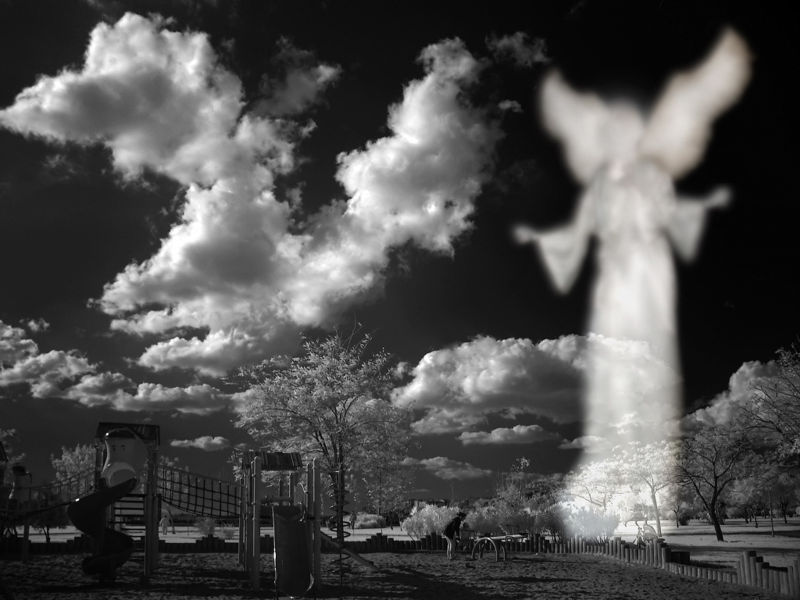
On the cover of the latest issue of Parabola, “Science and Spirit,” there is a beautiful angel, gazing down at the world with grave compassion.  While the publisher says the angel is a he, I am more than certain this particular angel is a she.  She looks so much like the apparition I describe in my story “Elizabeth” that I find myself freezing every time I pass the table where the brand new copies of Parabola are stacked.

I am not saying that I wrote about personally encountering an angel (a tradition-breaking female angel) in venerable old Parabola.  What I’m moved to say today—what I know from ordinary everyday experience as well as from the reminders in “Science and Spirit”– is that the universe is alive, radiantly and responsively alive.   We see and touch and influence and reflect each other.  To paraphrase Whitman, we are so interconnected we each contain multitudes, molecules, memories, the stuff of stars–and maybe the gentle impact of angels.   The hardest scientific heads among us—those who would scoff at any talk of love being a real force like gravity cannot deny the evidence of generosity.  On every level this is true: the more we open, the more we receive.

Sometimes, as in the act of really seeing someone or something—really taking them instead of looking at them—we can realize that giving and receiving are aspects of the same organic action, like breathing in and breathing out.  In such moments, we realize that we are made to live in such a way—that we do not need to remake ourselves after all.  We just need to patiently note all that distracts us from our natural capacity to give and receive, from our natural capacity to give attention with heart and mind, to breath with life, to come out of the isolation of our thoughts and participate in the moving, luminous, moving, living whole.

I’m just back from the Catskills, where I spent four days as a guest at a conference that included venerable teachers from the Gurdjieff foundations in London, Paris, New York, and Caracas—along with many people from many places, new friends and old friends.  The gathering reminded me of the extraordinary power of what the Buddhists call sangha, spiritual community.  It gave me an inkling of why the Buddha insisted that noble friends (or fellow seekers) are not just part but the whole of the spiritual life.   In spite of the predictable human comedy—i.e. problems with the sound system, so that one meditation leader who wouldn’t give any instructions ended up giving us just his amplified breathing (which I tried to reframe as an instruction but it sounded too much like Darth Vadar to my sleep-deprived ears).  Another leader, the English-born Paris-based theater director Peter Brook, didn’t have his sound system switched on, so that he sounded a little like Hamlet’s ghost—I mean, you would hear a grand and elderly Shakespearean accent intoning “this solid flesh…” then fade away (I have enormous respect for both these leaders, dear readers.  My subjective experience takes nothing from their brilliance).  But in spite of this and the 10,000 other sorrows and discomforts this flesh must endure, the group of us held and reflected to each other a very special kind of silence.  We formed a human satellite dish, helping each of us receive an energy that usually seems as far away as the most distant stars (but as I said, we have star stuff in us, like calls to like).

On the way home yesterday, I drove around Bear Mountain and across the Bear Mountain Bridge.  It was a blue sky day and the leaves blazed orange and red and yellow.  I spontaneously thanked God for creation, for my life, for Noble friends like you.  Now I am visiting my 93-year-old father, who recently entered hospice.  I realize there is nothing really to do, under all the busyness, just accompanying each other, just allowing ourselves to give and receive, to breathe.



16
Oct 12

Leap of Wisdom

There is a Zen koan that poses this tricky situation:  You are at the top of a 100-foot pole.  How will you take a step further?  The earliest Buddhist teachings don’t offer koans.  But it turns out that the Eightfold Path, the ancient way the Buddha offered to end suffering, does include a leap.   It turns out that attaining and perfecting each of these steps—wise view, wise intention, wise speech, wise action, wise livelihood, wise effort, wise mindfulness, wise concentration—is not enough.   The attainment of the final step, concentration, makes the mind still and steady, unifying all our ways of sensing and knowing.  It is said that fully developed concentration can open us to vast vistas of bliss, serenity, and power—there are descriptions of psychic powers in the suttas that surpass anything possessed by any the Avengers.  But it turns out that attaining the vision of a Hubble Space Telescope is still not enough.  In fact, such powers can leave one stranded on top of a very tall pole.

The next step off the top of that pole is wisdom, a penetrating view into the nature of life.   It turns out that all the other skills we need to bring ourselves into alignment with our own inner lives and the outer world are just tools and skills, just practice for the main event.  These skills are crucial—they help us transform or lesson the damage of what bubbles up in life—all the nasty or at least unskillful thoughts and words and deeds that knock us out of inner alignment and make us feel miserable.  But only wisdom can release us from all that is unseen.  Only wisdom can free us from the sleeping dragon of ignorance.  he Buddhist scholar monk Bhikkhu Bodhi explains that ignorance is not just an absence of knowledge:  “It is an insidious and volatile mental factor incessantly at work inserting itself into every compartment of our inner life.  It distorts cognition, dominates volition, and determines the entire tone of our existence.”

Ignorance colors our experience, creating the claustrophobic and stressful delusion that the world is solid and stable, and that we ourselves are solid and self-contained from the world around us.  Wisdom is a leap beyond all this—a leap into the heart of our own lives.   It is not a brilliant or philosophical thought but a moment of deep seeing—of seeing into or insight (vipasssana) into the deepest truth of our existence.  Normally we are so identified with our experience that we don’t see or feel it for what it is.  But sometimes we do.

Last week, I was standing in a shiny new Shell station-7-11 complex in Westchester, New York.  As I watched my dirty little Prius move through a sudsy car wash, I was thinking about what I would eat for dinner (one of my favorite reflections).  My cell phone rang.   I learned that my 93-year-old father was once again in the ER, that his days are numbered, and he knows it.  I was invited to come visit as soon as possible, to talk with him about his death, his life, our life.   Right there, facing a Slurpee machine and a magazine rack bristling with celebrity news, I had a cosmic moment.  There was a quiet moment of abdicating my position at the center of the world.  Even though I wasn’t bare foot in the forest, I remembered that I was standing on the earth. I was aware that I am made of different parts, that I am more a buzzing mind, a mental iPhone.  I was aware of coming from somewhere–that this life has come to me from my father and my father’s father and from the earth and stars—and that I am also made for a purpose I may never imagine.

This moment passed.  But something lingers, a wish to be present with my father, to show up—not with a head full of ideas, but with an open heart, a willingness to accompany, to bear witness.  I was sharing this at our Sunday night sangha (at Yoga Shivaya in Tarrytown, New York– each and every one of you is invited).  A friend said:  Isn’t it interesting that everywhere and in all times wisdom is the same?  Isn’t that interesting to reflect on?  Wisdom doesn’t depend on knowledge, which can change but on our unchanging common human situation, and on the ability of the heart and mind to hold it.


10
Oct 12

Free Energy


As we prepare for the birth of a new issue, I share one of my favorite quotes from The Unknown:  “Those who are willing to be vulnerable move among mysteries,” Theodore Roethke.

The spiritual path leads to vulnerability, to opening to mystery.  It is not clinging for dear life to a set of propositions or stories about who we are or who others are or how life is supposed to be.  But before we can be vulnerable to mystery we must be vulnerable to ourselves.  As I blogged about awhile back, life dealt me a shock recently, forcing me to come face to the raw power of my emotional defenses, my capacity for fear, hurt, and rage against loss.  I like to forget about this and imagine I’m wise, but it’s like imagining a volcano is dead when it is just dormant.  Just when I thought awakening may really be possible, it turns out there are enormous underground sources of emotional energy just waiting to serve the dark lord.

Watching myself freak out from time to time in the past month, I came to understand a little more deeply the meaning of the Buddha facing the terrifying armies sent by the demon Mara to unseat him.  To awaken, to penetrate the truth beyond selfish illusion, the Buddha had to face his own fear and hurt and rage.  It dawned on me that the Buddha had very powerful emotional reactions to move through.  After all, he was human—and the greater the potential, the greater the resistance.

Time and again, the Buddha stressed the need for energy (viriya), the crucial ingredient behind wise effort.   The very same energy that pours out of us (or me) when we are hurt—that fuels our sometimes violent reactions to the threat of loss is the very same energy that can go into generosity, compassion—into being free from suffering.  Awakening requires the liberation of our energy.   Awakening may actually be a process of liberating our energy.   Instead of being tossed this way and that by our dark and stormy reactions to life, our lives may slowly become instruments of truth.

The other day, I took a long walk and gently asked myself why I was still so upset about what I took to be a betrayal by a trusted friend.  I like to imagine myself a woman of the world, a student of human nature.  Why did the revelation of a deception upset me so?    As I walked along, looking at the beautiful changing leaves, not repressing the upset, not expressing it, just holding it in accepting awareness, a deeper truth bubbled up:  a powerful human tendency to cling:  “It’s not impermanence per se, or even knowing we’re going to die, that is the cause of our suffering, the Buddha taught. Rather, it’s our resistance to the fundamental uncertainty of our situation. Our discomfort arises from all of our effort to put ground under our feet, to realize our dream of constant okayness.”

- Pema Chödrön, “The Fundamental Ambiguity of Being Human”


The illusion of certainty was pulled out from under me.  And out came the troops in their scarred and dented armor of old hurts, old disappointments.  But as the dust settles, I see that we may use our energy, our precious life force in a new way, we may become brides married to amazement, to mystery:


When death comes
like the hungry bear in autumn;
when death comes and takes all the bright coins from his purse

to buy me, and snaps the purse shut;
when death comes
like the measle-pox

when death comes
like an iceberg between the shoulder blades,

I want to step through the door full of curiosity, wondering:
what is it going to be like, that cottage of darkness?

And therefore I look upon everything
as a brotherhood and a sisterhood,
and I look upon time as no more than an idea,
and I consider eternity as another possibility,

and I think of each life as a flower, as common
as a field daisy, and as singular,

and each name a comfortable music in the mouth,
tending, as all music does, toward silence,

and each body a lion of courage, and something
precious to the earth.

When it’s over, I want to say all my life
I was a bride married to amazement.
I was the bridegroom, taking the world into my arms.

When it’s over, I don’t want to wonder
if I have made of my life something particular, and real.

I don’t want to find myself sighing and frightened,
or full of argument.

I don’t want to end up simply having visited this world.

- Mary Oliver