30
Aug 12

Dare to Be Lost


Life is a mystery to be lived, not a problem to be solved,” writes Soren Kierkegaard.

All during college and long after I graduated, I often felt lost—and after many decades I have come to realize this was a good thing.   Drop by drop, the sensation of being a stranger in a strange land—of being small and poor in the way of resources and surrounded by unknown forces– accumulated like water in an inner well.  Do you know the feeling of waking up in a new place?  There can be such a vivid feeling of being alive in body in a world that is also alive—and that feeling can come to sustain you.

Being lost can be an extraordinary gift because it reminds us of our embodiment.  It returns us to the basics of our life—that we are vulnerable and very dependent on others. It can open our eyes and our minds.  It can open a door in our heart and usher us through to a new kind of knowledge, a new way of knowing and relating to the world.

“Those who are willing to be vulnerable move among mysteries,” writes Theodore Roethke.  It turns out that feeling lost in college, like a fish out of water, and afterwards blundering around in New York City without a clue or a marketable skill was a blessing.  Very, very slowly, I came to appreciate values and qualities that are often overlooked in our culture, qualities like compassion and kindness and a capacity to feel joy when things go right for others.

The Buddhists call these qualities the “Paramitas” (from a word that means “perfection” or “completeness.”) The greatness of Christianity (to paraphrase Simone Weil) is to show us the use of being lost, vulnerable, suffering, that it can be a doorway.  The Beatitudes are a testament and a contemplation and guide to the way these experiences can lead us to living waters, to that well that gives meaning and life.

This week, a dear friend of mine took her daughter, another wonderful young friend, to start college.  My own daughter and I dropped by to give our friend a fuzzy blanket for studying and a journal. In addition to being a future engineer who may help save this wounded planet Sarah is a talented writer and a very sensitive being.  We left happy and proud of all the hard work that had taken her to Columbia University, and all that is to come.  A few days ago, I heard the terrible news that a girl in Sarah’s dorm jumped to her death before classes started.  The newspapers said she was afraid of disappointing her parents.

I don’t wish to exploit or minimize the private torment of that young person, but it strikes with new force that our culture is out of balance—emphasizing intellectual achievement over inner heart qualities like compassion and wisdom.  Sarah and her Mom are definitely not in this category—nor are the readers of Parabola and this blog.  But the time has definitely come to make a stand for another way of life, another way of knowing—a way that may start with valuing what many people judge to be useless.

For now, I will leave with this: In an upcoming issue, “Science and Spirt,” we are thinking of including a piece about what helps when science (in this case medicine) fails.

Here is an excerpt from a posthumously published book by the famous Dutch priest Henri J.M. Nouwen.  After nearly two decades of teaching at the Menninger Foundation, at the University of Notre Dame, Yale University, and Harvard University, he went to work with mentally challenged people at the L’Arche community of Daybreak in Toronto, Canada.

Founded by Nouwen’s friend Jean Vanier in France in 1964,  L’Arche Daybreak now has over 140 communities around the world where men and women with intellectual disabilities live, work and learn with assistants who seek a different way of life.  In a world that usually sees people with intellectual disabilities as less than productive, useful, whole,  L’Arche celebrates their creativity, transparency and great capacity for joy.  These communities take the Beatitudes seriously.

Nouwen wrote about his relationship with Adam, a core member at L’Arche Daybreak with profound developmental disabilities, in a book titled Adam: God’s Beloved:

“My daily time with him had created a bond between us that was much deeper than I had originally realized.  Adam was the one who was helping me to become rooted not just in Daybreak but in my own self.  My closeness to him and to his body [Nouwen was charged with bathing and dressing Adam] was bringing me closer to myself and my own body.  It was as if Adam kept pulling me back to earth, to the ground of being, to the source of life.  My many words, spoken or written, always tempted me to go up into lofty ideas and perspectives without keeping in touch with the dailiness and beauty of ordinary life.  Adam didn’t allow this.  It was as if he said to me, ‘Not only do you have a body like I do, Henri, but you are your body.  Don’t let your words become separated from your flesh.  Your words must become and remain flesh.’”

The learned priest found the meaning of the Incarnation in Adam.  When I read his words—and so many other stories in Parabola—I remember there is another life to be found in the midst of this life.  I remember that failing can feel like dying but so does awakening.  I respectfully ask you to dare to be lost.  You may find a better way.


24
Aug 12

The Night of the Hessian Soldiers

There is a wee bit more to be said about my investigation into ghosts.  After my article on modern day ghost hunters was published, I was invited to participate in an experiment in a famous haunted location—an experiment that was later re-enacted in the television show “Unsolved Mysteries.”  In the interests of scientific purity, I was told nothing about where I was going or what exactly I was going to be doing, only that a group of us would be leaving after dark and spending the night.

I remember standing outside my apartment in the East Village in downtown Manhattan, alive with uncertainty and anticipation.  I wondered if this was being an investigative reporter–except that I didn’t know what I was doing.  As I watched the punk kids and the artists and all the other members of the nightly East Village carnival pass, I registered that I didn’t know what I what I was meant to do here on earth, when it got right down to it.  But I wondered if it might have something to do with bearing witness to the life I was given to live, with really digging into it and learning what there was to learn.

In the van, I learned that I was to be a control in an experiment that involved leading of psychics through an old inn that was legendary for haunting activity.   This was ironic, since I was the only person in the van who had been spoken to by an apparition, and I told the paranormal researcher this. But I had written a long piece of journalism that came to a skeptical conclusion and I didn’t have psychic powers—at least not that I knew about.  One of the psychics was the woman who saw the ghost on Washington Square.  She had been tested and scored very high for psychic sensitivity after the fact.

We were driven to the General Wayne Inn in Merion, Pennsylvania. Established in 1704, it was legendary for being haunted by numerous ghosts, including a handful of Hessian soldiers. George Washington slept there, as did Benjamin Franklin.  Edgar Allen Poe was a frequent visitor of the inn and carved his initials in one of the window sills in 1843.  A dozen years after my overnight stay, a subsequent owner of the inn was found murdered in his office.  It turned out to be his business partner.

My job was to sit for hours in the dark basement of the inn.  One by one, the psychics were led through the building like blood hounds.  The basement was last stop. Several psychics gasped and otherwise indicated that they sensed that this was a haunted place.  One, the most celebrated of the group, said later that she glimpsed soldiers in green coats crouching in the wine cellar and that she felt their terrible fear.   When I heard that, I felt sad for them, trapped in their own suffering.  But strangely, the whole time I sat there I didn’t feel any fear, just wonderment.

A new kind of questioning and knowing began to take shape that would take years and years to break the surface of consciousness.  I marveled at finding myself there, and unable to sense the presence of the unknown forces around me. It was as if I was alive, yet not fully alive, there but not all there.  It dawned on me that maybe that there was another kind of investigative reporting to be done—not seeking the extraordinary outside in far flung places, but seeking to be fully present.  I didn’t necessarily want to see or sense the ghosts of Hessian soldiers, but I wanted to know I was alive.

There began a very slow-dawning awareness that we can lose our bodies and minds in very ordinary circumstances—that this may not be the exception but the rule of ordinary life.  We can be taken over by desire or anger or just drift away in dreams.  People can want to leave our own lives and invade the lives of others, to be carried along like a virus.

I once heard the Indians thought that all the invading European settlers were possessed by the wendigo,  a malevolent, flesh-eating spirit that drove them to consume the lives of others.   I began to see that it is very easy to be both victim and victimizer. Especially now, in our heavily mediated age, when we are in danger of being both bored and amused to death—when we are in danger of passing years, even a life time, without really inhabiting our lives at all.

I began to see that maybe I would be the kind of writer who was meant to dig down into the simple experience of being alive—that maybe there was adventure to be found in paying attention and having good intentions and being alive moment by moment.  I began to discover that attention itself could be magic, and that it could cure Jane Eyre Syndrome.  Very slowly, with much backsliding, I established the habit of spending a little bit of each day paying attention with my whole body and mind.  I learned to welcome in all the orphans of my consciousness, and I began to feel at home in the world.

“The cosmos is our home, and we can touch it by being aware of our body,” taught Thich Nhat Hanh.  “Our home is available right here and now.”

“You can’t seem to stop your mind from racing around everywhere seeking something. That’s why the Patriach said, “Hopeless fellows–using their heads to look for their heads!” You must right now turn your light around and shine it on yourselves, not go seeking somewhere else. Then you will understand that in body and mind you are no different than the patriarchs and Buddhas, and that there is nothing to do.
–Zen master Lin-Chi


20
Aug 12

The Invitation

My daughter is packing to move to England at the end of the week.  As I sit here by the picture window typing, she comes in from time to time to tell me some new detail about her graduate program or the location of a possible flat or the friends she will be sharing it with.  For some reason, I find little packing details particularly wrenching:  coats, dresses, and shoes leaving this home for a bright unknown. She is bubbling over with happy plans for her future and I am very happy for her.  I am also deeply relieved that she is not moving to London the way I moved to New York—which was under the spell what I now call Jane Eyre syndrome.

I travelled to New York and set about getting some kind of job with a blend of determination and timidity, as if I was an unwanted visitor, an unloved orphan in the world.  I longed to draw closer to the great fire, to be invited to feel the real the warmth and vibrancy of life.  But I had no idea how to go about it.  It took many years for me to learn that the invitation is always being offered…and that it is issued on the inside.

The invitation to the great party of life comes when we let go.  This is a lesson that must be relearned again and again, because it is human nature to try to be in control.   Counting down to my daughter’s departure, my moods are very changeable.  At some moments, I am serene and expansive, full of wisdom and sympathetic joy.  In these moments it seems that after all these years as a spiritual seeker, I am finally getting somewhere!  At other moments, and when I least expect it, I will feel like crying like a big baby. All that seeming wisdom, and sympathetic joy just vanishes like smoke, and I am left with the knowledge that nothing is turning out to be the way I thought it was going to be.

In such a moment, I wonder why nobody ever told me that this earthly life of ours was going to turn out to be so impermanent, so subject to change and loss.  It seems like we are like snow people, capable of just melting away.  I can feel a bit like Dante, in the middle of the journey of my life and lost in a dark wood—the first half of my life seems like a blissful illusion while what is yet to come is truly unknown.

Lately, the reality of impermanence is so powerful it wakes me up in the middle of the night.  Sometimes, I get up and meditate.  Recently, in a marvelous a weekly newsletter called Brain Pickings, I read a list of rules for students and teachers, the creation of the artist and educator Sister Corita Kent. Sitting down to meditate is my way of following Sister Kent’s first rule:  “Find a place you trust, and then try trusting it for awhile.”

Sitting in silence I remember that knowing what I don’t know and what I can’t control is an important way of knowing.  I remember that when all else fails, when life breaks your heart, there is another kind of truth that is always waiting to embrace you.  Sometimes when I sit, especially in the face of such a momentous change, I realize the truth—the real truth—cannot be thought, just seen, just live. I realize there is a fork in the path—and not just in the middle of our lives but the middle of any given moment.  We can lament our fate or plot to change it—or we can seek to speak and live and be in accord with the nature of the way things are.

As the countdown to England approaches, Alex comes in to admit that she is also scared.  The future is unknown.  I tell her that this is what I have learned after many mishaps and many years of just plain living: the invitation is always being offered.  When your heart is broken, when you all else fails, when you don’t know what to do, don’t do anything.  Let go.  Sit down and be still.  Don’t know. The truth that cannot be thought.  The truth of what is always waiting to receive you.


13
Aug 12

The Space Between


My journalistic investigation of the way scientists attempt to investigate the phenomenon of ghosts led me nowhere.  My article became a cover story and even inspired an episode or two of the television series “Unsolved Mysteries.” But the mystery of my own experience remained untouched by the whole adventure, like a stone glinting up from the bottom of stream.   The researchers I asked told me what I already knew—that it was most unusual to be addressed in such a way by a ghost.  To be seen.

One day, there came a hint.  I visited Karlis Osis at the American Society for Psychical Research, in an old brownstone on the Upper West Side of Manhattan (where Dan Ackroyd did much of his research for the movie “Ghost Busters.”)   Born in Riga, Latvia in 1917, Osis is one of the first psychologists to receive a doctorate degree with a thesis that dealt with ESP, from the University of Munich, in 1950.  Tall and ascetic looking, with a soft voice and a Latvian accent that made his words sound like spooky echoes rolling out of a cave, Osis told me that spending his youth surrounded by the devastation of World War I helped him develop “a taste of the mysterious and sublime.”

And there was this:  As an adolescent lying in bed with tuberculosis, Osis suddenly saw his room fill with a “joyful white light.”  He later learned that at precisely that moment, his aunt had died.   Osis went on to conduct ESP research at the parapsychology laboratory at Duke University, as a colleague of one of the famous figures of parapsychology, Dr. J. B. Rhine.  But Osis never forgot that experience and he began to feel sure that the great discoveries were to be found in the experiences themselves, not merely by research in the lab.

Osis left the lab to conduct a major survey of the deathbed observations of physicians and nurses in India and the United States, which resulted in a book he co-authored, At the Hour of Death.   It also turned up a smattering of evidence for the reality of ghosts.  Osis called them “transit disasters,”  Near Death Experiences in which there is no joyous burst of light that seem bound for somewhere, but “exceedingly self-centered individuals cruise in a void with no one to meet, instruct, or rescue them.”

This was not my Elizabeth.  I was certain of the reality of my experience—and yet I also came away siding with the skeptics.  As Ray Hyman, professor of psychology at the University of Oregon explained to me, even the most rigorous of these investigations “are historical investigations, not true scientific investigations at all.”   It all comes down to testimony, stories.  No researcher has ever been able to capture a ghost by way of an experiment that could be repeated in a lab.  I came away from my ghost investigation knowing that I was on my own—left to discover the meaning of what to others could only be a story.

“Not till we are lost, in other words, not till we have lost the world, do we begin to find ourselves, and realize where we are and the infinite extent of our relations,” wrote Henry David Thoreau in Walden.

There are times in life, usually after a significant ending–college or a job or a marriage or the life of a loved one, when we really realize where we are—when we shocked into realizing the depth and mystery of our experience.  This often comes at the moment when we feel lost in a dark wood, off the path, our connection to the divine cut off.  When all of the exits are blocked,  you have no choice but to go inward, to leave your head entirely and sink down into your own experience, into the body.  There we may discover our roots–“the infinite extent of our relations,”  the depth and fineness of our capacity to just be here, alive on the earth.

In the end, spiritual work is about being willing to be naked and vulnerable, about letting go of the armor of answers to live to be open and defenseless (I once heard that the word “lost” came from a Norse word that means to disband an army).   Real spiritual work depends on an awareness that can embrace contradiction and brokenness—that can bear not knowing, being in between.

The Buddha called the path he found the middle way (majjhima patipada) because it steers clear of two extremes.  One extreme is totally going for it, totally indulging every sense pleasures.   The other way is total denial, painful self-mortification.  The usual explanation of this way between extremes is that body needs to be healthy and in balance to undertake the cultivation of awareness.  But it can also be taken to mean being willing to be in the space between certainties.

“We are not ‘everything,’ but neither are we ‘nothing,’” write Ernest Kurtz and Katherine Ketcham in The Spirituality of Imperfection. “Spirituality is discovered in that space between paradox’s extremes, for there we confront our helplessness and powerlessness, our woundedness. In seeking to understand our limitations, we seek not only an easing of our pain but an understanding of what it means to hurt and what it means to be healed. Spirituality begins with the acceptance that our fractured being, our imperfection, simply is: There is no one to ‘blame’ for our errors — neither ourselves nor anyone nor anything else. Spirituality helps us first to see, and then to understand, and eventually to accept the imperfection that lies at the very core of our human be-ing. Spirituality accepts that ‘If a thing is worth doing, it is worth doing badly.’

Very slowly, it dawned on me that I could learn to be with my experience just as it is, in all its weirdness and imperfection.  If I could learn to be in my experience—to really inhabit the experience of being in this body– its meaning might slowly open over time like a story or a myth.

“Read the myths,” said Joseph Campbell once said in an interview with Bill Moyers. “They teach you that you can turn inward, and you begin to get the message of the symbols. Read other people’s myths, not those of your own religion, because you tend to interpret your own religion in terms of facts – but if you read the other ones, you begin to get the message. Myth helps you to put your mind in touch with this experience of being alive. It tells you what it is. “


08
Aug 12

Mysterious Messengers

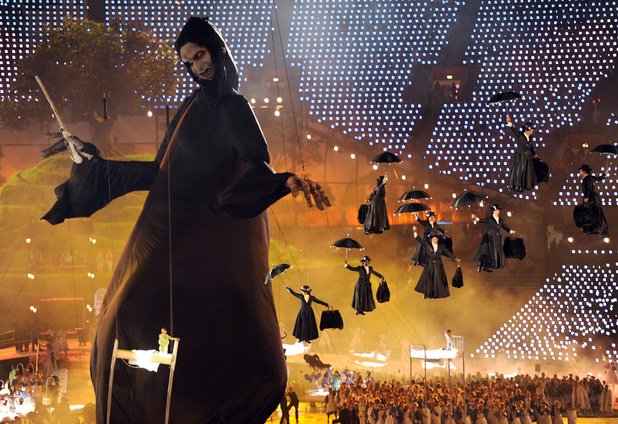
Voldemort battling Mary Poppins at the London Olympics

As Jacob Needleman states in our new issue, the greatest unknown is us, ourselves.   We fear the unknown and we try to run from it, even as we try to tame by making it a thing we can name.  We make it the punch line in every equation we can’t solve or else sanctify it and pray for it to be on our side.  But we really can’t run from ourselves.  The unknown will surface.


After I saw Elizabeth (see my old post, “A Midsummer Night’s Ghost Story”), I was understandably ambivalent about ghosts and guardian spirits.  I couldn’t move to New York fast enough.  I couldn’t bury the experience deep enough.  I didn’t speak of the experience or even think of it.  I worked hard to build a full life.  But the experience and that strange and terrifying message trailed after me, a prophetic riddle I hadn’t understood.


From the distance of all these years, it seems inevitable that I would run blindly into the kinds of situations I was being warned against—situations that would invite me to give up my place in the universe, to lose the awareness that is acceptable for me to be just as I am.  But there are truths that can be learned only by living through them.  As P.L Travers, the creator of Mary Poppins and a founding editor of Parabola, wrote in an early issue the word “understanding” means to stand under, to have the truth rain down on us.   Some truths take a long time to soak in.


Years after the experience, I received an assignment from the late, great science and science fiction magazine Omni, to write about how researchers try to use the methods of science to track down ghosts.   The assignment was exciting to me because it allowed me to explore ghosts and related paranormal events under the protective label of work.  I thought that becoming a journalist meant leading a more adventurous life—a more inhabited life—than working in the cubicle of a giant corporation.  The isolation of the writing life dawned on me over time.  And so did another truth.  I discovered that meaning of what I had seen and what I had heard that night in that spooky old house might be found by opening my heart and mind in a new way.


In addition to interviewing paranormal researchers and skeptics and doing research, I visited the scene of a few hauntings and paranormal investigations.   One was a rambling apartment on Washington Square.  As I sat at a kitchen table drinking coffee, “Kathleen” (not her real name) described how her sense of reality vastly expanded one night in October in 1973.  She thought she heard the front door slam.  Thinking it was her sister, and thinking ahead to the dinner party that was planned, she rushed happily towards the door.  In the dusty rose-colored hallway she froze and all the bright images in her mind went dark.


“There was a hunched over figure in a black robe,” said Kathleen (I quote from my 1988 Omni article).  “I thought it was a robber, though it seemed very sick or old.”  She turned on the light and watched the gigure creep toward the bathroom down the hall. She called to her mother who was in her bedroom up the hall, asking her who just entered the apartment. “Nobody,” her mother answered. “It was almost as if the figure was absorbing light instead of reflecting it,” Kathleen, who happened to be a talented photographer, told me.  “But even then, I never thought of a ghost.”


The following night Kathleen looked up from the sofa to see her mother standing in the doorway shaking.  She told Kathleen she had heard a whooshing sound in hall and looked up to see a “transparent blackness” passing down the hallway towards the bathroom.  She yelled “Kathleen! Kathleen!” and ran after the shadow, only to find nothing there.  Eventually a family friend, Michaeleen Maher, who had a Ph.D. in parapsychology from City College in New York, heard about these incidents.  Equipped with a Geiger counter, infrared photography and other equipment, and a team of volunteers, Maher attempted to use the tools and techniques of science to investigate. The results were suggestive but maddeningly elusive in scientific terms.  There a “parabola of fog” in an infrared photo of the hallway; a flurry of Geiger clicks in a particular spot, but nothing that could not be ruled out by ordinary explanations.  But Kathleen couldn’t rule it out.


I sat with her and Michaeleen Maher in the freshly renovated kitchen of that apartment on Washington Square. In the years after the haunting, Kathleen became an accomplished photographer and her smoky, evocative photos lined the walls.  I watched Maher and Kathleen study the infrared photo with the parabolic arc of fog.  They also notice a strange dark circle that looked to me a little like the interlocking black and white tear drops of the yin-yang symbol.


“To me it looks like a face, a black face up close to the camera,” said Kathleen.  Mayer said that one of the psychics she brought in to read the space reported seeing the figure of an African American as well.   Kathleen and Maher acted out how the mysterious figure moved up the hall.  The tour ended in her late mother’s room and a window overlooking Washington Square Park.  Although I didn’t know it until much later, what Kathleen explained next changed my perspective on such things for good.


Directly across the street stood a massive old elm tree.  Kathleen said that according to her research, the last person to be hanged in New York City was hanged in that tree.  She was an African American woman who worked as a servant in one of the grand buildings lining the square.  The conversation rushed on:  Kathleen saying that ghosts open up a world of forces and influences science can’t understand; Maher suggesting that someday science may have tools fine enough to collect physical evidence for such phenomenon.


I kept thinking of that servant, hanged for stealing.  I wondered if there might be situations so grave and critical they have to be impressed on us by extraordinary means.  I wondered if we were asking the wrong questions, looking at things in the wrong way.  Maybe where the ghostly messenger came from was less important than the message she brought.


To be continued….