30
Jun 12

Frozen

When I was 12 or 13-years-old, I had a recurring nightmare in which I was trapped in a grid or maze.  I was not alone in the maze. Other people, including friends, were visible and in shouting distance, but we couldn’t move to really face one another.  We were all frozen in assigned positions, some on one level, some on another, some vertical, some horizontal, some upside down.  There were grooved pathways in the maze, suggesting the possibility of movement, but we could not budge.  The worst part of the dream, the truly hellish part, was the heavy message that this situation could never change.

We were like butterflies pinned to a board by a giant hand.  There was no hope.  The dream conveyed that all hope is at bottom the hope of change.  Our lives move from hope to hope—and ultimately, the hope is to move towards greater freedom, greater happiness– towards a larger, more vibrant, more real life. But in this dream I was completely thwarted—forever.  I would be desperate to find a way to connect with my friends.  I would shout to them that together we could find away to break through to life outside the box.  But they had all given up.

We were all crushed into a miserable isolation, all consigned to living a flattened little life with all the spaciousness and possibility and hope sucked out of it.  I kept trying to twist and turn and break free.  I kept trying to shout to them that maybe if we all tried we could find a way.  But they were just spacing out, dreaming, suffering in mute silence, telling me not to stir things up.

I couldn’t believe it when the exact same dream repeated!  I knew I was dreaming but I couldn’t wake up!  It was as if I was being shown the warning light blazing red on the dashboard of life.  I was being shown the flaw in the mechanism, the way to hell.  I couldn’t convey to my mother or anyone how horrible it was.  They treated it like a consolation that I was there with others.  I didn’t have the words to express how horrible it was that we were all frozen.

Later, this dream morphed into a fear of being buried alive. This was more understandably horrible to people because there was a coffin involved, and the prospect of being eaten by bugs and worms. But under the physical difference between a coffin and a maze there was the same hellish feeling of utter stagnation and hopelessness.  No hope of being able to move and connect with others, with life, with God.  I think that must be the essence of true despair—and why despair was considered to be a grave sin in the Christian tradition, so that suicides were not buried in sacred ground: it is loss of hope, the loss of the sense of space and movement and possibility.

I wasn’t at all surprised to learn that in Dante’s Inferno, Satan, denizen of the deepest hell, is found frozen in a block of ice, utterly unable to move. Buddhism offers similar hells.

The Buddha taught that all living beings bound by ignorance and craving (in other words, almost all of us) are subject to rebirth. In Buddhism, there is no soul to transmigrate from one life to the next, but there is an ongoing stream of consciousness which seeks a life appropriate to the desires and tendencies that dominate.  In other words, our habits, including our habits of thought, live on.

According to Buddhism, you can be reborn in a number of hells, or the animal kingdom, or as a “hungry ghost” (petavisaya), a shadowy being afflicted with strong desires you can never satisfy. These three realms of rebirth —together with the asuras, titanic beings obsessed by jealously and amibition–are called the “evil destinations” (duggati) or “plane of misery” (apayabhumi). This is because of the unbroken suffering found in them. The human world, which holds a mix of happiness and misery, and the heavenly worlds of the devas, or demi-gods, are called, in contrast, the “happy destinations” (sugati) since they contain  happiness—and also, more importantly the possibility of freedom.

Once you have landed in an evil destination, you can end up in a vicious circle of suffering that is very difficult to break. According to Bhikkh Bodhi (who is responsible for all the Buddhist scholarship in this and previous entries): “The Buddha says that if a yoke with a single hole was floating at random on the sea, and a blind turtle living in the sea were to surface once every hundred years — the likelihood of the turtle pushing his neck through the hole in the yoke would be greater than that of a being in the evil destinations regaining human status.”   The rat race squared.

The way to a fortunate rebirth—and the way out of ignorance and misery in this life–depends on a shift in awareness and thought and action. In Buddhism, this is called karma (or kamma, in the early Buddhist dialect of Pali).  Liberating karma are actions motivated by detachment, kindness, and understanding, the latter actions motivated by greed, hatred and delusion. It is important to note that detachment in Buddhism does not mean being cold—it means seeing beyond your own self-interest.  To avoid rebirth in the plains of misery, we must learn to keep watch over ourselves.  We must learn to be aware of our thoughts, our automatic emotional reactions, our words and deeds.  Can we come to understand that we are not the center of the universe—even though we are hardwired to think so?  Can we learn to live another way?

We need help to find our way out of the maze of self-centeredness.  We need ideas and guidance from another level, whether it’s J.C. or Buddha or some other time-tested wisdom. And we need each other.  The summer after college, I remember going out West in a VW bus.  I went searching for the kind of education I hadn’t found in college. My travelling companion was Rip Westmoreland, who happened to be the son of General Westmoreland, who commanded the U.S. forces in Vietnam.  In college, Rip had a band called General Malaise, a very apt term for the times, including my personal times.  The war in had ended some time before, but the karmic ripples continued to spread. I thought that maybe we should go to Naropa Institute in Colorado—that perhaps there we would find a path or a way.

The engine of the VW bus blew up in a cornfield in Iowa.  We were stranded in a little town.  While we waited for a new engine, we hung around with some of the young locals we met at a bar café.  I remember one night driving around and around and around in someone’s convertible, a six pack of beer on the seat beside us.  The young driver indicated that this is what they did most nights, drove around in circles.

All around us was the vastness of the prairies. Above us, the vastness of stars, the worlds within world.  I wondered what it took to feel a connection with that.  Later the trip, I spoke to a few farmers and ranchers.  They gave me the impression—which I later forgot—that the way to this feeling of connection with a bigger life might be found through the body and the heart and through kinds of work that remind us we are alive on the earth.  Decades later, I have had the extraordinary good fortune to work at Parabola, where I get to ask these questions with others.


28
Jun 12

A Fish In Water

“There are these two young fish swimming along, and they happen to meet an older fish swimming the other way, who nods at them and says, ‘Morning, boys, how’s the water?’ And the two young fish swim on for a bit, and then eventually one of them looks over at the other and goes, ‘What the hell is water?’”

David Foster Wallace kicked off his commencement speech to the 2005 graduating class at Kenyon College with this story. The brilliant author went on to describe how it is often the most  important reality that we overlook or get flat wrong: “Here’s one example of the utter wrongness of something I tend to be automatically sure of: Everything in my own immediate experience supports my deep belief that I am the absolute center of the universe, the realest, most vivid and important person in existence….It is our default-setting, hard-wired into our boards at birth. Think about it: There is no experience you’ve had that you were not at the absolute center of.”

We humans are all wired the same way, and the most sensitive and aware among us come to know this. Thousands of years ago, the Buddha described how our unconscious desires and inclinations limit our perceptions, which in turn narrow and twist our cognition. In the upcoming issue of Parabola, “The Unknown,” philosopher and author Jacob Needleman affirms that the great Western philosopher Kant (among others) spelled out a similar situation—that the structures of our mind limit our perception, that everything we take in through our sense doors is organized and limited below the level of consciousness, that we cannot know reality in itself.

Most of us swim along our whole lives in our little bubble of self-centered delusion. The ocean that supports us—that provides the very oxygen we breathe since we are fish in this metaphor—remains unknown to us, even unsuspected.   And yet some people seem to find a way out of this claustrophobic and unhappy situation, not just in the Buddha’s time but now.  How?  In our own age, this is not just a question for the philosophical or spiritual few.  The fate of the real ocean and the real earth depends upon a significant number of us finding a way—or at least asking the question.

Wallace, a very brilliant and hyper-self-conscious person, knew the way had to do with “somehow altering or getting free of my natural, hard-wired default-setting, which is to be deeply and literally self-centered…”  He knew that real freedom had to do with cultivating an ability to think clearly and to pay attention, which depended on aligning yourself with something more reliable than money or power or the beauty of your own body.

“In the day-to-day trenches of adult life, there is actually no such thing as atheism,” Wallace told the graduating class. “There is no such thing as not worshipping. Everybody worships. The only choice we get is what to worship. And an outstanding reason for choosing some sort of God or spiritual-type thing to worship — be it J.C. or Allah, be it Yahweh or the Wiccan mother-goddess or the Four Noble Truths or some infrangible set of ethical principles — is that pretty much anything else you worship will eat you alive. If you worship money and things — if they are where you tap real meaning in life — then you will never have enough. Never feel you have enough. It’s the truth. Worship your own body and beauty and sexual allure and you will always feel ugly, and when time and age start showing, you will die a million deaths before they finally plant you. On one level, we all know this stuff already — it’s been codified as myths, proverbs, clichés, bromides, epigrams, parables: the skeleton of every great story. The trick is keeping the truth up-front in daily consciousness. Worship power — you will feel weak and afraid, and you will need ever more power over others to keep the fear at bay. Worship your intellect, being seen as smart — you will end up feeling stupid, a fraud, always on the verge of being found out. And so on.”

Wallace glimpsed this truth and shared it: “The really important kind of freedom involves attention, and awareness, and discipline, and effort, and being able truly to care about other people and to sacrifice for them, over and over, in myriad petty little unsexy ways, every day. That is real freedom. The alternative is unconsciousness, the default-setting, the ‘rat race’ — the constant gnawing sense of having had and lost some infinite thing.”

Sadly, Wallace, who committed suicide at 46, was too afflicted by depression to be able to have this impression sink from his head to his heart—and into his feet.  In “The Unknown,” we will feature another commencement address, delivered at the University of Pennsylvania this past spring, by a young man who not only came to see the way out but to actually, literally, to walk it. (Stay tuned, friends.  It’s going to be a great issue).

Opening ourselves up to the reality of the unknown can be terrifying, but honestly what is the alternative?  In my own case, at least, the evidence is mounting up that change is just inexorable.  No matter how much I want to hold on, there is loss, aging, change.  In my better moments, there is a new quality of equanimity—a willingness to being in the middle of what is happening, to drop the self-absorption and be another pair of hands in the bucket brigade.  My questions are changing, maybe because it gets lonely living in self-centered isolation, boring and extremely repetive being the star of my own limited little drama.

In my more open and balanced moments (have you noticed that your balance is better when you aren’t leaning forward, chasing something?) a different kind of question is bubbling up–and from my heart, not my head.  “How will I (or Parabola) survive and thrive?” shifts to “How can I (or we) serve?”   In these better moments, I guess you could compare me to the old fish in Wallace’s story.  I never could have guessed this at other times, but these are the best moments–being an old fish among other fish, swimming in a vast unknown ocean.
25
Jun 12

Shelter from the Storm

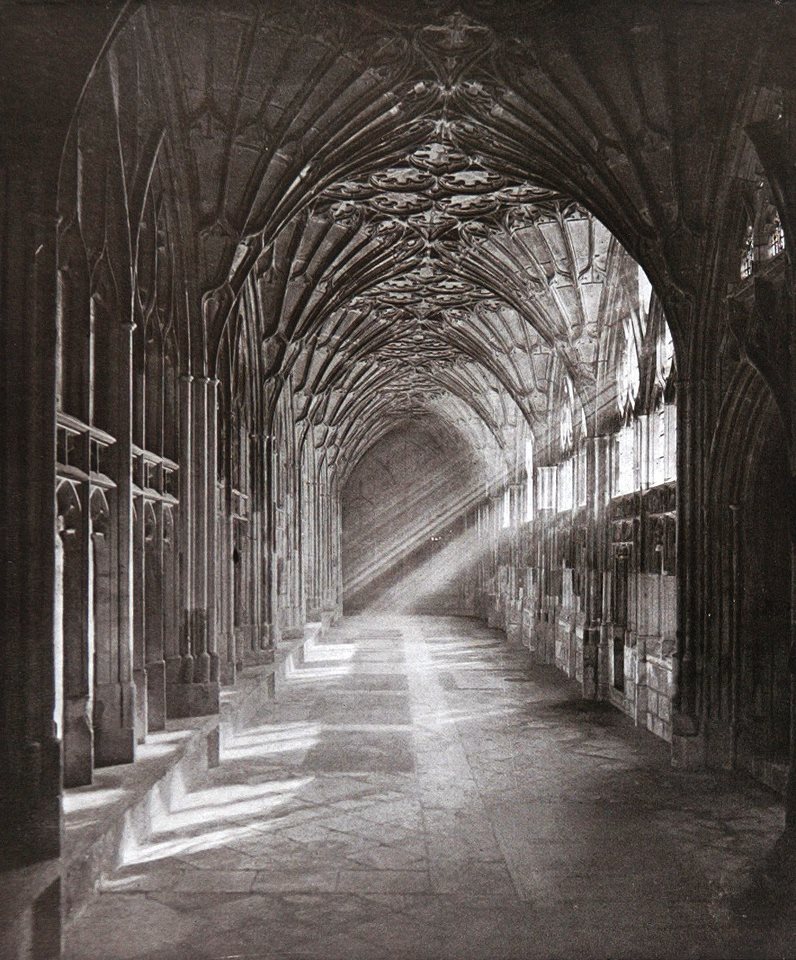
S.G. Kimber, "A Sunlit Cloister"

Buddham saranam gacchami
I go for refuge to the Buddha;

Dhammam saranam gacchami
I go for refuge to the Dhamma;

Sangham saranam gacchami
I go for refuge to the Sangha.

Lately, it has occured to me that we have lost our sense of danger and our need for refuge.  We love movies and books about vampires, zombies, aliens, and many forms of apocalypse (I know I’m generalizing.  I personally am very easily frightened and avoid such entertainments).  We love them because they indulge yet project away our underlying fears.

Yet in earlier times, people understood that there really were such things as vampires, zombies, and ghosts–people that feasted on the lives of others or haunted the world instead of really living in it.  They understood that they could lose their human status and descend into these realms–not just in a future life but right now.  They understood that bad thought habits are actually dangerous, a kind of gateway drug that could lead to being trapped in a subhuman hell. For thousands of years, Buddhists went for refuge to the Triple Gem of the Buddha, the Dharma (or Dhamma, in Pali), and the Sangha.  As I wrote last week, the scholar monk Bhikkhu Bodhi compares the ritual of going for refuge to passing through a great doorway—and I don’t think it would be mixing traditions too much to call it the doorway to a vast cathedral.  Going for refuge is an expression of faith that there is a way out of the wilderness of me, me, me—embattled me alone against the world.  Going for refuge is seeking the shelter and guidance of a higher order of ideas and values, an affirmation that there is perspective beyond my own.

Thousands of years ago, long before the current research on the brain, the Buddha taught that cognition is subservient to wish. Submerged from us, our desires condition our perceptions, narrowing them to fit the view they want to impose. We take note of those things agreeable to our pre-conceptions; we blot out or distort those that threaten or throw them into disarray.  In recent years studies have been conducted that show that when subjects are handed a hot cup of coffee, they have a warmer attitude towards a stranger than if they are handed a cold drink.  This reaction happens below the level of conscious awareness.  It would be the same for any human.  We are at the mercy of the vast and intricate workings of our human nature.

In order to widen our vision, we need to find help that comes from another level. We need help even to see into the depths of our true nature and possibilities. According to Bhikkhu Bodhi: “In the words of the Buddha we are like a traveler passing through a thick forest bordered by a swamp and precipice; like a man swept away by a stream seeking safety by clutching at reeds; like a sailor crossing a turbulent ocean; or like a man pursued by venomous snakes and murderous enemies.”  This dramatic language makes sense.  In the time of the Buddha, people didn’t just worry about wasting their one precious life or not achieving their full potential.  Physical suffering and death lived nearby, even for the young and beautiful—and they worried about their future lives.  They were haunted by the possibility of wandering lost forever, drifting from torment to torment without hope of finding refuge.

Yet even in our relatively secure age, illness, loss, and death come. And in each of us, there is an inner unease that flares up into out-right anxiety and fear when just the right button is pushed. Deep down, we know that we are in an untenable situation. When something unexpected happens, we instantly realize that we have been seeing the world through a haze of expectations, projections, and demands.  In fact, a good portion of the pain we experience in life comes from the disappointment and disillusionment we feel, when the world does not conform to our will. (Please, don’t take my word for it, or even the Buddha’s word for it.  See for yourself).  In Buddhism, the first reason for going for refuge is the need for protection from our own negative reactions to life, our own endlessly and perfectly natural tendency to take it all personally, the good, the bad, and the neutral.  (A friend of mine once asked me what I thought the most common question in every language was.  He guessed it was “Why me?”)

Or, the words I learned in childhood, the words that drift back to me in times of uncertainty because they are known on a deep down cellular level: “Thy Will Be Done On Earth As It Is in Heaven.”  At moments, we let life be.  We allow events to unfold as they will with equanimity.  And peace flowers in us.  For a moment or two we receive the endlessly fluctuating flow of events as if we are watching a passing storm from the shelter a vast refuge.

There is a great deal more to be explored about taking refuge.  For now, it is interesting to reflect on this: The quality of equanimity, that state of being poised beyond the play of worldly opposites, is prized above all other states in Buddhism not because it is a way of numbing ourselves to life.  It is a way of affirming that there is a larger perspective and a greater will than our own little will. It reflects the shift in attitude that takes place when we realize that we are in great danger left to our own devices and we go for refuge in a place of safety and guidance.  Equanimity reflects the faith that there are laws and forces and guidance that come from another level.  It affirms that we are not alone in this world but with others, and part of a larger mystery.


22
Jun 12

Taking Refuge

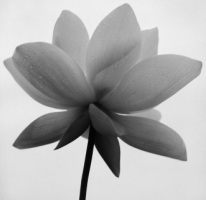
Lotus by Brian English

All week, I was aware of a loud buzzing sound when I opened my car door and at regular intervals.  It filled my consciousness.  I was sure my Toyota Prius didn’t make this sound before it was repaired–before the accident I was in about a month ago.  Really, did it buzz that loudly before?   My mind kept returning to it, magnifying the sound, questioning my experience.  Could it be metal grinding on metal, a cable fraying and getting ready to snap?

So back I went to the Toyota body shop to have a Toyota technician listen to the sound and assure me that it was the normal sound of the electric motor kicking in.  “You’re listening to every little sound,” he said. It was oppressively hot in the body shop.  I worried about the technicians.  Liberated from worrying about the buzz, my consciousness was now free to be captured by other worries.  I worried about everyone who was working in the scorching heat.  I worried about climate change and—managing to bring my worries back to myself in a spectacularly petty way—I wondered if the bird droppings on the hood of the car were going to take the paint off in these record-breaking temperatures.   I remembered that a friend from Texas once told me that can happen.   Was there a car wash nearby?

Is it any wonder that people in all times and all traditions have sought liberation from the tyranny of self?  In Buddhism, lay people and monastics “go for refuge” (sarana gamana)  in the Triple Gem — the Buddha, the Dhamma, and the Sangha.   The word refuge comes from the Latin refugium, from re, back, and fugere, flee.

According to Bhikkhu Bodhi:  “The Buddha’s teaching can be thought of as a kind of building with its own distinct foundation, stories, stairs, and roof. Like any other building the teaching also has a door, and in order to enter it we have to enter through this door. The door of entrance to the teaching of the Buddha is the going for refuge to the Triple Gem — that is, to the Buddha as the fully enlightened teacher, to the Dhamma as the truth taught by him, and to the Sangha as the community of his noble disciples. From ancient times to the present the going for refuge has functioned as the entranceway to the dispensation of the Buddha, giving admission to the rest of the teaching from its lowermost story to its top. All those who embrace the Buddha’s teaching do so by passing through the door of taking refuge, while those already committed regularly reaffirm their conviction by making the same threefold profession:

Buddham saranam gacchami
I go for refuge to the Buddha;

Dhammam saranam gacchami
I go for refuge to the Dhamma;

Sangham saranam gacchami
I go for refuge to the Sangha.”

I confess that I used to have a condescending attitude about this ritual. It seemed like a polite nod to the past, something to get through before I could get on with the practice of mindfulness meditation.   Now I see that the seemingly minute action of going for refuge is really huge.  This shift in attitude—from self to self in relation to a larger whole–can change the direction and momentum of a whole life.   Our lives open and flower when we “flee back” from our own smallness, our own preoccupation with our likes and dislikes and what relates to little me, me, me.    As in prayer, taking refuge is really moving from the known to the unknown.

In the next issue of Parabola, there will run a marvelous interview with Jacob Needleman, about how we relate to the vast unknown.  Here is a quote: “In a word, we cannot be ourselves without, as the same time, rooting ourselves in God.  We cannot be independent beings without depending entirely on a higher force that penetrates our specifically human consciousness….Otherwise our entire life is self-deception.” Otherwise our entire life, or at least mine, is pretty small and repetitive.

And who am I to write about taking refuge, or about rooting myself in God?   I ask myself that quite often.  But there comes a moment—often in sheer exhaustion from tossing and turning in bed worrying about something related to me—when I let go.  In such a moment, I realize that I am only human and that this seems to be accepted by the surrounding stillness.   My own common human experience opens into mystery—what is this life I am part of?  In the end, I take refuge in a willingness to be vulnerable to mystery.  I take refuge in knowing that I am only human and part of something much greater than I can know.

“Come, come, whoever you are. Wanderer, worshiper, lover of leaving. It doesn’t matter. Ours is not a caravan of despair. Come, even if you have broken your vows a thousand times. Come, yet again , come , come.”
― Rumi

Welcome all of your experience—even all the times you fall out of grace in your own eyes.  Take refuge in what we cannot know.


17
Jun 12

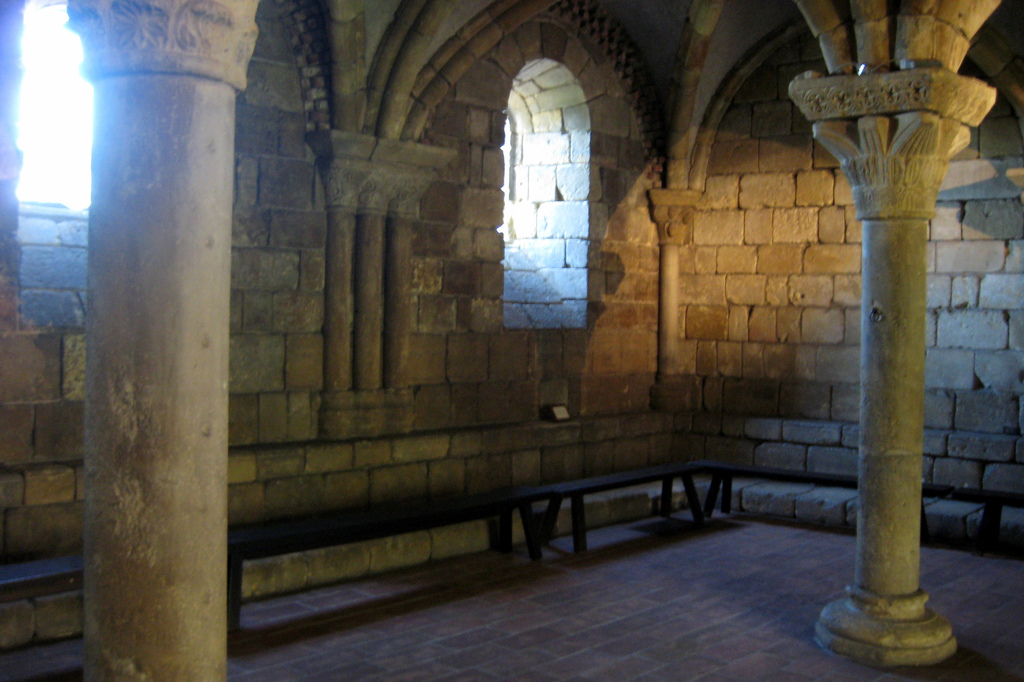
In the Chapter Room

photo by wallyg

“The solitary life, being silent, clears away the smoke-screen of words that man has laid down between his mind and things,” writes Thomas Merton in Thoughts in Solitude.  “In solitude we remain face to face with the naked being of things. And yet we find that the nakedness of reality which we have feared, is neither a matter of terror nor for shame. It is clothed in the friendly communion of silence, and this silence is related to love. The world our words have attempted to classify, to control and even to despise (because they could not contain it) comes close to us, for silence teaches us to know reality by respecting it where words have defiled it.”

When you are thinking of bicycles, you see bicycles everywhere.  Contemplating Parabola’s latest theme, “Alone and Together,” I find fresh evidence of the interplay between solitude and community everywhere.  I visited The Cloisters with my daughter Alex and her boyfriend Anthony.  Set on a hilltop with sweeping views of the Hudson River, The Cloisters is not just a museum of medieval art, it actually is a medieval cloister transported here from France.

Merton writes of it in The Seven Storey Mountain, the iconic memoir of his spiritual journey. Merton opens the book by saying that he was born in the shadow of some French mountains. “There were many ruined monasteries in those mountains,” he writes “My mind goes back with great reverence to the thought of those clean, ancient stone cloisters, those low and mighty rounded arches hewn and set in place by monks who have perhaps prayed me where I now am…”

And many momentous years later, after he lost his father and mother, after he went to private school and Cambridge University, and then on to Columbia University in New York, Merton encountered one of those ancient cloisters again…in the upper reaches of Manhattan.  Can you imagine?  He found himself at Columbia, in what I’ve heard called upstate Manhattan.  Under his friendliness and activity, he was lonely and searching.  And as he began to turn towards the contemplative path, as he began to turn towards the inner path—he found a monastery from the innermost layers of memory—literally relocated in time and place.  Can you imagine the proverbial mountain coming for you?

“One of [the cloisters], stone by stone, followed me across the Atlantic a score of years later, and got itself set up within convenient reach of me when I most needed to see what a cloister looked like, and what kind of place a man might live in, to live according to his rational nature, and not like a stray dog.  St. Michel-de-Cuxa is all fixed up in a special and considerably tidy little museum in an uptown park in New York, overlooking the Hudson River, in such a way that you don’t recall what kind of city you are in.  It is called The Cloisters.  Synthetic as it is, it still preserves enough of its own reality to be a reproach to everything else around it, except the trees and the Palisades (the lofty steep cliffs along the Hudson).”

I sat in the cool depths of the Chapter House. With Alex’s firm encouragement (understandably, she and Anthony wanted to drift through the garden and among the treasures without Mom on their heels), I sat for a long while in a twelfth-century enclosure where monks gathered for daily readings of the Rule of St. Bendict, the rules of their order—the most famous of which is about welcoming guests as if they were a manifesting divine.  I felt welcomed, and more.  The stones communicated something to me on a “preverbal”—possibly even a “post-verbal” level.

“True communication on the deepest level is more than a simple sharing of ideas, of conceptual knowledge, or formulated truth,” writes Merton in a talk he once planned.  “The kind of communication that is necessary on this level must also be ‘communion’ beyond the level of words….”

For a little while, sitting in the Chapter Room, I experienced The Cloisters not as a tourist but as a pilgrim.  I felt a presence or vibration in the stones around me.  It felt like I was being helped by the efforts of others in the past who tried to cultivate an awareness beyond ordinary words and knowledge—who tried to open to what is new, to welcome whomever and whatever arrives as a manifestation of the divine.

Eventually, Alex and Anthony arrived. I described my sense that the stones communicated something.  Alex is used to this sort statement from me.  But Anthony, who studies theoretical physics and math in graduate school at Princeton, looked doubtful.  No matter.  I know that he understands that nothing is solid and separate in his own way.  I know that we are made up of energies that too quick and subtle to perceive.

Except, I find that we can sense this great mystery with these very bodies, hearts, and minds. Sometimes when we are very still, there can be a subtle movement of availability and we can receive something extraordinary that is being offered, radiated.  Sitting at The Cloisters the other day, I glimpsed that reality—a finer level reality—is not something chilly and abstract.  It really does come “clothed in the friendly communion of silence.”


12
Jun 12

Entering the Temple

Photo by Br. Paul Quenon

Most Sunday evenings, I sit and conspire with others.   I mean this in the sense of the Latin roots of the word con, with, and spirare, to breathe .  A group of monks sit quietly in a second floor yoga studio and breathe together.   As the French-born Buddhist monk Matthieu Ricard explains in the current issue of Parabola, intelligence in our culture is usually associated with the acquisition of information or posited as a faculty of reasoning.  But real intelligence means understanding—and Ricard means seeing through the appearance of things, to the underlying nature of reality.  And you don’t have to travel to Tibet or Nepal to uncover the truth.  If you dig down to the roots of the English word, you come up with the Latin verb intellegere, which means to understand.

The yoga studio where we sit and conspire is on a busy block, just around the corner from the Tarrytown Music Hall.  But even when there is no famous old rock act playing, people fill the restaurants and cafes below us. The town is carved into a hill that runs down to a breathtaking view of the Hudson and the illuminated span of the Tappan Zee Bridge.   This is a place that flows.   Especially on warm nights, the sounds of laughter, shouts, talking, cars with radios blasting ebb and flow below us.

Yet for about an hour, we just let it be.  We sit in stillness and walk in stillness, and after about an hour we listen and talk in a new way, grounded in understanding.   If I leave you with nothing else in this post, let it be that the search for truth and meaning can be very, very local.  It doesn’t mean uprooting ourselves, but just the opposite: digging down into our experience right here and right now.   Words get a bad rap for being labels that we cling to rather than opening to the living experience of the moment.

But if we dig down to their roots, we often find that words—even plain old, seemingly uncool English words–are records of the experience in being here in the most basic human way.   Understanding comes from the Old English understandan, which probably literally meant stand in the midst of, from under + standan, to stand.  In other words, to stand under, to let the truth of what it is really like to be here to rain down on you.

Thomas Merton writes:  “We betray ourselves and one another in the No Man’s Land which exists between human beings, and into which they go out to meet one another disguised in words.  And yet without words we cannot find ourselves, without communication with men we do not know God: fides ex auditu [faith comes from hearing]….”

What if instead of trying to escape or nullify our experience with words, we could sink down into our most basic human experience and gently bear witness to it—breathing, the sensation of being present, alone or with others   Without going anywhere, right here and right now, wherever you are you can allow ourselves to be vulnerable to the truth, to go without the disguise of words, to be inspired, filled with life and spirit.

What we practice together when we sit and conspire in the yoga studio is the same as Parabola’s aspiration (there’s that Latin root spirare yet again, this time related to breathing into or infusing):  we seek to contact and communicate a deeper truth.   We cannot reach the truth without grounding ourselves in our own experience, literally humbling ourselves (from a root shared with humus or earth and human).   When we are grounded, even for a moment, we can listen in a new way.   And when we communicate with each other from that experience, the words can resonate like bells, sounding all the way back to their roots.

Mind you, I do not know Latin or Old English, and my daughter, who has studied both,  reminds me that what I’m sharing is really just someone’s opinion.  To that I say, Mea Culpa—my bad.  And yet, thanks to my long experience with English and with living and Phil Cousineau’s clever book Word Catcher, I have confidence (which comes from the Latin con, with, and fidere, “to believe in” or “have faith in,” that I have found something worth sharing.   Faith can start with what we can experience here and now.  Let yourself be vulnerable to  your  ignorance and inner emptiness or poverty.

The word “contemplate” does not mean to escape into grand cosmic thoughts.  It comes from the 13th-century contemplationem, the act of looking at, and contemplari, to observe.  From con, with, and templum, originally an open space reserved for observation of augurs.  When we meditate or engage in contemplative prayer , we have stepped inside a temple,  we enter an a special empty space where we may consider the signs, the underlying laws or reality of our lives.  Traditionally, this templum was marked off with a line drawn in the ground by the augur, and was later demarcated with stones, gates, and doors.   As most of us know, the temple later entered English as a place for the holy, from an Old English haelen, for heal  (which my daughter can pronounce in a wonderfully hale and hearty Old English way) and PIE kailo or whole or uninjured.  To enter the stillness and emptiness of the temple is to be healed, to be made whole…to be in accord with the deepest laws of reality (which the augus sought, throwing bones or sticks or whatever…and Merton found in solitude, in God).

I don’t mean to take it too far, but it strikes me as amazing that our words contain these depths.   Words like “contemplate” and “inspire” actually signify our deepest human capacity for observation and experience.  Of course words are just points on a map, and the map is not the territory. May we all come to know the ground for ourselves.  May we all enter the temple and conspire.  May we all be be healed and made whole.


08
Jun 12

New Subscription Service

Dear Friends,

Please subscribe for email updates through our new service, located both here as a link and on the side bar of the site:

Subscribe by Email!

Note: If you were already an email subscriber, you must resubscribe through the new service to receive updates. All problems have been resolved and we look forward to delivering Tracy’s posts to your inbox!

Best wishes,

The Support Team


08
Jun 12

A Happy Man

“Stuff your eyes with wonder,” wrote the late, great author Ray Bradbury. “Live as if you’d drop dead in ten seconds. See the world. It’s more fantastic than any dream made or paid for in factories.”

The very insightful Gurdjieff once said (and this is a very rough paraphrase) that a man (or woman) who knows how to do anything well, even if it is making coffee well, comes to understand something about reality.  Bradbury, who died this week at 91-years-old, knew how to observe the world as if he would drop dead in ten seconds.   He grew up during the Great Depression, like my own 92-year-old father, and he went to libraries instead of going to college.

“Ask no guarantees, ask for no security, there never was such an animal. And if there were, it would be related to the great sloth which hangs upside down in a tree all day every day, sleeping its life away. To hell with that,” he said, “shake the tree and knock the great sloth down on his ass.”

He learned how to stuff his eyes–and without asking or receiving any guarantees in the way of college or connections, he learned how to share what he saw by telling a good story.  He once explained that his novel Farenheit 451 was science fiction, which it meant it could and probably would happen in some form.   He once observed a woman with headphones on, “sleep walking” through the world–this was Farenheit coming true.  Bradbury said The Martian Chronicles was more like myth.  I once thought of interviewing him for Parabola, as a lively source of insight on the mythic themes and questions bubble up in contemporary lives.

Bradbury said two things in particular sparked the habit of writing every day. This first is not surprising: he was taken to see Lon Chaney in The Hunchback of Notre Dame—the 3-year-old who would be a writer was galvanized by a character and story.  But the second event was literally electrifying:  In 1932, a carnival entertainer called “Mr. Electrico” touched the then 12-year-old on the nose with an electrified sword, made his hair stand on end, and shouted, “Live forever!”

Bradbury said, “I felt that something strange and wonderful had happened to me because of my encounter…[he] gave me a future.”  I can’t help thinking that in the shock gave Bradbury a sense of how extraordinary life really is—it lifted the poor impressionable boy out of the sleep- walking of the ordinary, charging him with sense that life means something beyond survival, that it is shot through with energy and wonder.

It was a bit of a shock for me to learn this week that Bradbury helped design and conceive the storyline for “Spaceship Earth,” the iconic and symbolic structure of the Epcot part of the Disney World Resort. I was just there!  As I mentioned in a long-ago post here called “The Happiest Place on Earth,” my daughter loves Disney World, and here we were on her college graduation visit.  As I have explained in some detail, I can’t take the big rides anymore–the rides that simulate hurtling up Mt. Everest, then plunging to your death.   So off we went to Epcot, my daughter, her English boyfriend, my sister, her boyfriend, and I.  I was hoping for a civilized stroll around the “World Showcase,” a trip through Norway, Germany, and England—all my daughter’s favorite countries—only in balmy weather, with palm trees all around.

But it rained torrentially the day we went, especially in the morning.  There are no guarantees, as Bradbury said.  “This will be perfect for England,” said Alex’s English boyfriend, Anthony.  Soaked to the skin, we took refuge inside “Spaceship Earth.”  Named after Buckminster Fuller, this is not just a landmark but an 18-story geodesic sphere that takes guests on a time machine trip from the origins of prehistoric man to the 21st century, showing us the evolution of human communication (from the caves at Lascaux to Steve Jobs at work on the first Apple in a California garage).  Narrated by Judi Dench, the ride was soothing yet amazing.  For me, it was a high tech version of Mr. Electrico, shocking me into an awareness that time does indeed fly, and that we are all interconnected here on Spaceship Earth–and that all humans throughout time all alike in our quest to know and participate in the deeper truth.”

In the current issue of Parabola, the Buddhist monk and author Matthieu Ricard explains that to be truly constructive, intelligence needs to be accompanied by an insight into the deeper nature of reality:  “So a larger perspective means actually understanding things as they are.  It does not mean fabricating a sort of wishy-washy cosmic consciousness.  It’s understanding that the real fabric of reality is interdependence—for phenomena, for living beings, and for the environment. “

Really seeing our interdependence and our common wish for happiness and connection can lead to wisdom and loving-kindness, according to Ricard.  But you don’t have to be a Buddhist monk or a spiritual seeker to learn this. You just have observe long enough to really see.  I glimpsed this last week in Florida, in my 92-year-old father.  While staying in a guest room at his house, where he lives alone (thanks to the daily help and support of my sister) he awakened me at 3 a.m.  Quite courteously under the circumstances, he asked me to call 911 because he couldn’t breathe and felt too weak to have me take him to the hospital.  He was admitted for pneumonia, where stayed there for several days, making friends by being cooperative, uncomplaining, friendly, funny.

“I’m hooked up to so many tubes and monitors, I’m not going anywhere,” he told me. I told him about my latest trip to Disney:  “I’d go back there,” he said.  “If they paid me enough.”  Even the gentle terrain of Epcot is too rough for my father these days.  I told him to rest.  “All there is to do here is rest. I want to get back to being nosy about the neighbors. “ According to my sister, there were quite a few on hand to welcome him home.   The happiest old people (and not so old people) understand that happiness happens with and through others—and comes by way of an electrifying interest in life.

“I know I can’t go on forever, “ he told me. “But I want to keep going, to just flow along with it as long as I can.  I love to see how things unfold.”   Or as his contemporary Ray Bradbury said, “to stuff his eyes with wonder.”