28
May 12

Finding the Source

Most people associate the creative with the lush, the prolific, the fertile, the rich.  Contemplation or meditation as the Trappist Monk Brother Paul Quenon describes it in “Alone and Together” sounds like the opposite:   It “is too poor, too empty, and obscure.  It is mostly an entrance to and abiding in the emptiness of Christ.  And that largely without being aware that it is Christ’s emptiness.  Gradually one ceases to think of it as one’s own as well. “

It sounds bleak.  Trappist monk, who received his novitiate training under Thomas Merton, makes his calling and his mentor Merton’s calling sound like an exile in the desert—going beyond comfort and hope,  in which “the self and its sense of well-being, or lack thereof, is incidental.”  The strange thing is that Brother Paul is a prolific writer and by many accounts a wonderful, happy, engaged human being—and so was his famous mentor.

Brother Paul, who wake up at 2:40 in the morning to start his meditation in Vigils at 3:00 a.m. , asks what he is doing.  This is a good question–especially because this good kind human being senses that what he needs is something “too pure and brief for me to dwell on.”  What he really needs—what we all really need—is a connection with life that is intimate and true.  We need to know that we are accepted by God and by life as we are.  As Brother Paul puts in a journal entry included in his essay: “the truth of my name is already spoken in the silence….”

Or as I have thought of it far more folksy, slangy terms:  “sometimes God likes to get us alone.”   I have been in a few deserts in the course of my life, most of us have—stretches of life not going according to plan, times of not knowing what would come.   These stretches can lead to a very intimate contact with your life–this naked contact is essential to a truly creative life.

Did you ever wonder why a soul like Merton–overflowing with creativity and a wish to serve—would enter a Trappist monastery?   Into the desert Brother Paul goes—and finds that the detachment and freedom that opens the flood gates of creativity.  He quotes a spare little poem by his mentor Merton called “Song for Nobody” –“A yellow flower/(light and spirit)/sings by itself/For nobody.”

Merton might have been describing a scraggly flower on the gravel path to his hermitage, according to Brother Paul, yet its song contains “the grandeur and the poverty of interior prayer.”    Brother Paul makes the point that true creativity begins when we stop caring in an ordinary way—when we stop caring about being a success in the eyes of the world.  Brother Paul offers the example of Emily Dickinson, who lived like a nun and didn’t care at all about success or publication.  For Dickinson, poetry was a way of meditating or contemplating: “Thought belongs to Him who gave it.”

The word contemplation comes from the Latin word contemplatio. Its root is also that of the Latin word templum, a piece of ground consecrated for the taking of auspices, or a building for worship, derived either from Proto-Indo-European base *tem- “to cut”, and so a “place reserved or cut out” or from the Proto-Indo-European base *temp- “to stretch”, and thus referring to a cleared space in front of an altar.  The Latin word contemplatio was used to translate the Greek  word θεωρία (theoria).

To contemplate or meditate is enter an empty space (the root of the word sacred means to set apart).  As Merton famously said real prayer is learned in the hour when easy wordy prayers are impossible).  I have been writing in this space about the importance of letting go and letting be.  Now I am adding the importance of daring to enter the desert, of daring to be poor and obscure and maybe even a little crazy in the eyes of the world.   Dare to be useless and incoherent.  As Thomas Merton said:  “If you have learned only how to be a success, your life has probably been wasted.”

Life can be like this:  Just when we’ve given up hope of finding a way out of the desert we may come upon a spring.   Just when you have accepted that scorn of the world or your parents or mentors—just when you are too parched and tired to care about anybody’s judgments, you may find a deep well.   It happens at the point when you go beyond all the noise—let them call you a lunatic, a bum, an extra and thoroughly unwanted human who doesn’t pull her weight,  someone too impractical, artistic, mystical, unrealistic (you may add your favorite salt to the wound of being you).   It happens when you stop needing assurances and praise.  You will sink into a stillness below the words, and remember the simple vibrant, naked sense of being alive.   And then you may find the source, the wellspring.  No one knew to tell you it was there—no one knew.  No one but God, and now you.

24
May 12

White Water

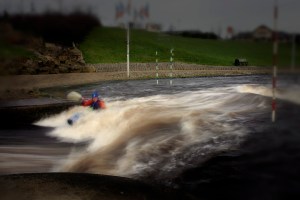
photo by James.

“For some, collaboration is not a deliberate choice,” writes architect Barry Svigals in Parabola’s current issue, Alone and Together.  “It is a way of solving problems that is deeply interwoven into the communal experience.”  He is writing of aboriginal people who couldn’t help but work together to solve puzzles in an intelligence test (and accomplished them in record time) in spite of the anthropologists’ efforts to have them work as individuals. Svigals (and his collaborators) contrast this to our culture’s celebration of the “lone genius, the myth of the hero leader….”

Yet as I was alone in the yard this morning planting flowers, it struck me that all our efforts in this world are really collaborative.  I went outside to be alone and found I was in intimate contact with life.  I was collaborating with the flowers, the soil, the soft morning air, the water from the hose, the ants that swarmed up and helped me turn the soil.  I went outside early because there were trailing petunias to plant–but also because I was grieving.  I was grieving exactly the same thing that I was just celebrating: my daughter’s college graduation, her successful launch into the world.

She is moving to London at the end of the summer to pursue graduate school, a loving relationship with an English boyfriend, a happy social life with friends there.  I am thrilled for her, really.   She has worked hard for this—and so have I.  Yet, inevitably, I am deeply aware of the impermanence of life just now. Wasn’t she just in high school?  In preschool? In Brooklyn? Where did the time go?

Around midnight last night, I concluded that the only thing to do is to let go—or its more gentle English variant, let it be.  Letting go, letting be, may be the last word—or perhaps the first and last—the exhale of the Big Band and, well, the next Big Bang (or the Great Sigh of Relief, whatever the next cycle will be called).  In the end, there is the act of seeing, which is not separate from accepting—which is not separate from knowing—or from loving.

This morning while gardening, I realized that there is a kind of complete seeing—the kind we associate with Near Death Experience—that happens when we let go of our insistence on ourselves, when we forget ourselves and collaborate with life.  As the Zen sage says, forget yourself and find yourself in the 10,000 things.  And if he was less poetic and concise, he might have added:  see and experience yourself in a new way, not as an idea or label or story but taking your part (which is itself changing) in the whole of life.

I woke up early and went outside and gave myself  over to life—to the red petunias, the soft air, soil, water, and ants.  I felt better, and I saw glimpsed something that doesn’t boil down to words.  The spiritual teacher Gurdjieff  emphasized self-observation, and so does his foremost pupil, Madame de Salzmann, who discovered on her own that “seeing is not an idea.”

Now more than ever, I am touched by De Salzmann’s efforts to attain realization after Gurdjieff died. And by all accounts, she found it. She taught that self-observation “is one complete act, an experience that can take place only if there is no separation between what sees and what is seen….”  When  the act of seeing is more important than what is seen, a special feeling can arise—“an affection that embraces everything that I see and is indifferent to nothing.  I need to see.  When I begin to see, I begin to love what I see.  No longer separate, I am in contact with it, intensely, completely.  I know, and this knowing is the result of this new condition.  I wake up to what I am and touch the source of true love, a quality of being.”

I once interviewed a Taoist master for Parabola.  He spoke of being taken to meet Madame de Salzmann.  I asked him what she was like, his first impression, and he drew on his love of white water rafting.   The white water is at the edges, he told me. The fastest water looks as smooth as glass.  It looks still.  Yet, if you put the raft down there, it shoots off because the water is so fast. That is the quality that Madame de Salzmann had, said the Taoist master.  She was very still, yet very fast.  She took in everything.

When we let go and open to life, there can be a kind of seeing that, in Madame de Salzmann’s words–“is like following a fast current, a torrent, anticipating the rushing water with one’s look, seeing the movement of each little wave.  There is not time to formulate, to name and to judge.  There is no more thinking.  My mind becomes quiet and sensitive—very alive but quiet.”

This kind of seeing allows us to be in disorder (in our judgment) yet to see in a new, much more expansive way—to be part of a new order. May we all let go and accept and become part of what is.


22
May 12

Graduation Sutra

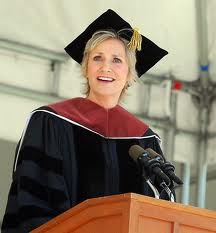
What a week.  Days after my car accident, I attended my daughter Alex’s graduation from college.  And as I sat on a lawn at a beautiful college under a blue sky, watching my daughter process across the stage, I suddenly realized a college graduation is not unlike a car accident.  It is another kind of heightened moment that invites us to see what we don’t usually see—including the impression that we usually don’t like to empty ourselves of ego and take life in.  We want things to unfold the way our ego wants them to unfold.   The commencement speaker Jane Lynch, the star of Glee, supported this realization, urging the graduation class to see that life is always a surprise and that the best way to receive it is the way an actor does improvisation.  She gave the graduates this mantra: “Yes, and….”

Lynch moved in the same direction that Alan Arkin does in his marvelous interview in “Alone and Together.” She encouraged these hardworking, high principled, fresh-faced young people not to plan and try to control what is going to happen to them because many of the biggest events in our lives take a form and happen in a way we could never predict.  In spite of all our long preparation and hard work, what happens—the creative or scientific breakthrough, the true love—comes as a surprise.  Usually, these surprises come to us when we abandon all hope of pleasing others or otherwise controlling events.

Most of us can provide our own examples of this truth—about the time we almost didn’t go here or there and yet we did, only to meet the person we married or step on a path that led to destiny.  It was the last thing we wanted to happen—the car accident, the lost job—and yet it opened up something unexpected.  Out of work, out of hope that our lives would ever be or look like we wanted them to, despairing that we would ever win our parents’ or society’s approval, we threw up our hands and embraced life.  We said: “Yes, and….” Embracing and then adding our own presence and intelligence to what life was serving up.  As the spiritual teacher Gurdjieff once said, playing a role can be the highest undertaking a human can engage in—provided we can empty ourselves of ego (oh, that little detail again).

Sometime during the graduation weekend, I began to associate this truth, this “Yes, and” with St. Benedict and hospitality.   This had something to do with my sister and brother-in-law (whom I associate with St. Benedict by way of their scholarly and religious pursuits) hosting a whole crew of us for dinner.  Also, my sister and her partner, who were among the guests, volunteer at a church-run homeless shelter called “Room at the Inn.”  Every great tradition includes this wisdom about letting life in, welcoming every being and every happening as a divine guest.

Benedict of Nursia abandoned his studies in Rome and found his way to a cave in the hills of Subiaco.  This cave would become his sacro speco (sacred space).  For three years, Benedict listened deeply, searching for God.  Our of  this deep listening in this cave of solitude came this Rule of St. Benedict.”  The Rule opens with St. Benedict setting forth the main principles of the religious life — the renunciation of one’s own will and arming oneself “with the strong and noble weapons of obedience”  under the banner of “the true King, Christ the Lord.” He proposed to establish a “school for the Lord’s service.”

I sat in a folding chair taking in the rich impression of my daughter’s college graduation—finding myself there, in a situation I had long pictured only to find it completely different and surprising because I, my daughter, and everything else in the picture is completely different than I could ever have predicted.  It struck me then that Jane Lynch was right, the only sane way to treat life is as a school—and a school of improvisation.  Yet I feel that St. Benedict found something that is deeply and enduringly right—and not just for monks but for all of us. How liberating it would be to live life as a school for service—to welcome everything that happens to be a teacher sent to deepen and open us so we can hold more life, respond more swiftly, love more.  There is an article from Scientific American currently being passed around on the internet exploring the concept that depression may serve an evolutionary function, that it may invite a person to shut out distractions and analyze.  I’m not inclined to agree that major depression is the most reflective state to be in.  And yet I have known dark and difficult times that became sacred spaces, places to “be still and know” that there was a majesty and wholeness to life beyond my wildest imaginings.  And that I was welcome to take part, to add my presence, to play my role.

What a week: a car accident, a graduation.  I come away a bit frazzled and tear-streaked but wishing to welcome life—not just the good times but the difficult times.  May I remember that even the most unlikely messenger may be divine.


15
May 12

Car Crash Sutra

The accident happened at the worst possible moment, yet even as it happened I realized there is probably never a good moment a good moment for a car accident. I was driving home through the rain, thinking about how much I have to do before I leave for my daughter’s college graduation this week.  I was thinking about what a difficult week it has been and that I just might triumph over it when the crash  came.  I was driving through an intersection, almost home, when an elderly man turned left and smashed into me, demolishing the front of my car.

Time slows down in an accident, as they say.  A crystalline clarity comes.  I was aware of my thoughts. Didn’t I have the right of way?  Was the driver impaired?  But the thoughts seemed slow and overly simple, like a headline news stream, compared to the full feeling the impact.  There was the sensation of the collision and the sound of crunching metal and breaking glass.  And there was a deeper seeing.  I watched myself try to refuse to take in what was happening.   My mind tried to push it away with objections:   Why did it have to be happening on the week of Alex’s graduation?  It wasn’t my fault.  And why did I have to be in that place at that time?   And at the same time, a deeper awareness watched all this and more, watched how in every cell of my being I DID NOT WANT THIS TO BE HAPPENING.

All my thinking could not undo it. I sat stunned in the rain in my crushed little hybrid car.  The other driver, an elderly man, got out of the big van that hit me and loudly protested that it wasn’t his fault.  He yelled at me to call the police because he did not have a phone.  His bullying manner took me by surprise and I burst into tears.  A nice fireman appeared out of nowhere and asked me if I was hurt.  I told him that I was not although it was clear that my feelings were very hurt.  I told him, absurdly, that my daughter was graduating from college that week.  I told him that I loved my little certified Prius, and that I just bought it a few months ago.  I told him it had been a very difficult week.  These things happen, he told me kindly.  A very similar thing happened to him not long ago, he told me.  Someone was texting and ran into him.  Accidents happen. The important thing is that no one is hurt.

People should pay attention, I told him, realizing even in my shocked state that this was deeply true.  We waited in the rain a long time for the police to come.  The press of errands and tasks just stopped, the flow of traffic proceeded around us, and I realized I would never have life under control.   It struck me as very strange then, that I would choose to live my life this way, taking the counsel of these ordinary thoughts, these fears, this grasping need to, well, get a grip on things.  I have heard that death can find us like this—unprepared, too far behind.  But I saw that we also refuse life, drowning it out with our re, every shutting it out.   Even as the tears flowed, I realized there is another way to live—not to like or dislike but to be receptive, to be interested, open to receiving the truth that is always being offered.  What inner conditions or qualities need to be present to meet life as it is?

A friend recently wrote of the importance of equanimity.  It brings a special kind of insight, he wrote.  We have to build up an inner reliance to external circumstances.  I thought of this as the policeman made a report, as I waited for the tow truck.  What he said struck a deep chord.  For years, I wondered why the Buddha placed equanimity above rapture, made it the ultimate factor in the 7 Factors of Awakening—made it one of the Divine Abodes or Dwelling Places.  During the accident, I realized that this quality allows us to take life in, to literally receive it as a kind of food or guide for the creation of an inner presence.   Suddenly, it seemed just completely insupportable to try to base a sense of happiness or well being—or a sense of life–on how things were going in relation to my own ego.  Is there not a finer happiness or wisdom that can accompany us no matter what? It dawned on me that I might choose to be open to the whole of life, that I could have a different relationship with it–rather than protecting myself from it, I might be in a position to witess and to serve. The spiritual teacher Gurdjieff once said, the worse the outer conditions, the better for inner life—provided one is interested in cultivating an inner life.   Based on what just happened to me—on this fresh reminder of the turns life can take—I am definitely interested.

Take care out there.


13
May 12

Let it Be

When I find myself in times of trouble, Mother Mary comes to me
Speaking words of wisdom, let it be
And in my hour of darkness she is standing right in front of me
Speaking words of wisdom, let it be
–Paul McCartney

McCartney was singing of his own mother, who died when he was young.   That a sense of her presence comes to him in his hour of darkness is very poignant.  And yet what she tells him to do is profound and universal.   For thousands of years, people have sought the same wisdom from Mother Mary.  There is a deeper awareness in us that Knows what we need in times of trouble.   In our hour of darkness, we know what to seek.  It isn’t stern and fatherly counsel.  It is a mother’s caring and nonjudgmental awareness.   And I agree with McCartney that this is the kind of intelligence that everyone in the world, however far apart in culture, beliefs, economic status, most needs right now.

After meditation one evening, a friend (who happens to be English and sounds a little like McCartney) once said that he prefers the phrase “let it be” to “let it go” because letting go can feel like too much doing–inviting the ego to take over, ending the sense of being with life that can appear in the quiet of meditation.   Let it be conveys what I’ve heard described as a “movement of availability.”  Letting be is that very quiet movement of allowing life to be what it is.  If we are to awaken, we must welcome in all the orphans of our being and consciousness.  If there is to be an answer to the mystery of our lives, if there is to be healing to the heartbreak, it is in this movement of quiet, attentive letting be.

The Buddha urged his followers to adopt the attitude of a mother caring for her only child.  Jesus urged people to be like children, to make themselves available to the embrace of his love.  I once heard the Zen master Thich Nhat Hahn say that understanding is acceptance, and acceptance is love.  Acceptance is not passivity or weakness, not giving up—it is just the opposite.  It is the courageous movement of allowing what is to be what it is—understanding that what will be will be, that children and all manner of things inside and outside will unfold in a lawful way.  It is embracing that unfolding with love.  It is mercy.

And when the broken hearted people living in the world agree
There will be an answer, let it be…..

The greatest wisdom is letting be.  Letting be is a movement of availability, of acceptance—and ultimately of love.  How can we achieve such an extraordinary capacity—to love consciously?   I suspect it is not what we think.  It is not straining beyond ourselves—it is just the opposite.  It is going down, practicing love and acceptance on animals—including the animal of the body.  The wise Buddhist teacher Ajahn Chah urged people to be humble—to be like earth worms, digging down into the earth of themselves.  When I sit sometimes, I reflect that this body I have been given links me to the distant past.  I marvel that this body came to me from a great chain of humanity—reaching back to our common mothers.  In meditation, this body is revealed to be a vast cave of wonders, like Lascaux. Who knows what wonders might be discovered if I can shine the light of attention? I have heard and read that we contain worlds, universes.  I might glimpse this and hear this. If I can let it be.

May all beings know the love of a mother.  Happy Mother’s Day.


11
May 12

Being Lost Together

“Not until we are lost do we begin to understand ourselves,” wrote Thoreau.  I think Thoreau was speaking of that descent from our heads into the center of our beings.  At the first shock of loss, we are bereft, shipwrecked.  We search for something of value to guide us or to hold on to and come up nothing but shabby and broken things–shards of memory, old wounds may come alive and old selves come wafting out of their graves like ghosts.  But as we dive down into the wreck, down through layers of habitual postures, lost cultures and worlds, we may find our way to a stillness that is also a listening and a seeing.

Slowly we remember that we secretly knew there was more to life than thought and habit. Slowly we realize that what we need is not a striving but a quieting and letting.  An attention appears that does not take sides or make demands—that is not eager to possess anything, just wishing to know.  “Prayer and love are learned in the hour when prayer is impossible and your heart has turned to stone,” wrote Thomas Merton (who was an orphan in an English boarding school, who knew what it is to be lost).

We understand who we really are when we descend center of ourselves—when we don’t rush to  identify with any habitual attitude or posture, just see and listen in the calm eye in the center of storm of our lives:  “The question we need to ask ourselves is whether there is any place we can stand in ourselves where we can look at all that’s happening around us without freaking out, where we can be quiet enough to hear our predicament, and where we can begin to find ways of acting that are at least not contributing to further destabilization,” writes Ram Dass.

In my last post, I wrote about meeting Ram Dass.  He told me that the stroke—and his times of being lost—acted on him like sandpaper.  “Coarse or fine sandpaper?” I asked. He laughed and said both kinds.  I realized that he meant that life wears you down, scratches the paint off, but it can also polish and refine you, taking away what is false, leaving something real.  Ram Dass had to deal with being lost. Along the way, he was dismissed as a failure and a fool and a fraud (he was called “Rum Dum” in the press).  But all the while there was another process going on (at times—in all of us, this happens in moments)—a descent into the center of himself.  The ambitious academic gave way to a kind of holy child who wished to penetrate to that still place in the center of our being.

I asked him if he had any inkling when he was young that he would have such a life. “Years ago, I had a dream,” he told me.  “I was in a huge amphitheater full of people all in white.  There was a woman on the dais.  I was standing in the back and somebody was guiding me by the elbow.  The woman saw me and said, ‘Take him out, he isn’t ready.’”

“This stroke is an ego drag,” he told me. “But for soul, it got me into that room.”

We all meet in that still place.

If you happen to be in the area, consider joining me at Yoga Shivaya, in Tarrytown, New York, this Sunday, May 13, from 7 to 9 pm.  We will practice the stillness of meditation together, then listen (and see!) the harmonic chant of singer, composer, and new Parabola music editor David Hykes, which renowned violinist and conductor Yehudi Menuhin has called “the music of the spheres.”   For directions contact Yogashivaya.com.  (This event is offered without charge to all mothers and those who have or had mothers, and offerings are happily accepted).


09
May 12

Being Here Together

“My guru told me ‘Be like Gandhi,’” Ram Dass told me during an interview that took place about a decade ago.  “Gandhi said, ‘My life is my message.’” The words came haltingly, short phrases followed by long pauses.  The former Dr. Richard Alpert, the once eloquent spiritual seeker and psychedelic rebel, sat in a wheelchair, hunting for words, often coming up with nothing except a soft “yea.”  “Before the stroke it was words, words, words,” he told me.  “After the stroke it was silence, silence, silence.”

My encounter with Ram Dass proved to be one of those quiet, tiny, yet inwardly momentous events that lead to real wisdom—to opening to reality.  He spoke of before the stroke and after, and I received a lesson in the difference between having a concept (and a projection) about a person and what is actually meeting in silence.  There is the thought and the reality, there is being alone and being together, in which there is a meeting and exchange of presence and awareness, of worlds of experience.

Ram Dass and I sat together near a window of a room in a hotel that was then called “the New York Marriott Financial Center,” a grand edifice of glass and steel that was a short and impressive stroll from the World Trade Center.  The hotel itself turned out to be a lesson in before and after.  About a year and a half after our meeting, much of that glass would be shattered, and when the hotel finally re-opened years later it was renamed the “New York Marriot Downtown.”  Those were different times.  The day I visited Ram Dass, there was a big bustling conference going on.  There were signs in the lobby saying something about “Asset-backed Commercial Paper.”

“Acid-backed paper?” said Ram Dass, when I described the scene. “What are we waiting for?  Let’s go!” He laughed, banging his hand on the arm of his wheelchair.  Just for a moment, if I squinted my eyes, he looked a little bit like the psychedelic crusader who had ingested at least three hundred bits of acid-backed paper over the years, before he went off to India to find a guru and learn to meditate.  He and the classic story of his journey Be Here Now had been iconic to me when I was young—proof that there was another way.  The formerly ambitious young assistant professor of psychology at Harvard took psilocybin mushrooms with Timothy Leary and glimpsed an abiding awareness, a witnessing “I.”  And from that time he sought not just know things but to “Know.”  And now here we were.

The formerly irrepressible, unstoppably eloquent Ram Dass sat and waited patiently for words to float up to the surface (or not) and this inspired patience in me.  There was nothing else to be done but just hang out and be. We sat together and watched ferries and tugboats criss-cross New York Harbor.  The famous seeker was there to attend a conference on dying organized by Buddhist scholar Robert Thurman, and I was there to interview him about his latest book.  But I couldn’t do my job the way it is usually done.  I couldn’t press on, trying to pry something new and original out of him.  I had to let go of my questions and just sit back and wait.  I remember relishing the way the tugboats rode low in the choppy grey water.  And I realized that being him felt like being with any old person.

Concepts hide as much as they help reveal.  Once I thought of Ram Dass as a glamorous psychedelic outlaw (and I tried ridiculously to come across as an outlaw myself.  It was a protective stance, quills to protect the tender belly of my being).  But what I was really seeking was an outlier, a figure less or more than the usual sum.  But that day I realized that we all contain outlier particles or numbers and life activates them.  I realized that we don’t have to go to great extremes because life will bring us extremes, and the awareness that “Knows” may find us anywhere because it is already in us, waiting patiently.

Ram Dass told me a little about the stroke that hit one evening in 1997, as he lay in bed wondering how to improve a book he was writing about the wisdom potential of aging.  Over the months and years of his rehabilitation, wisdom came:  “We think life is like one of these buildings, big and solid,” said, gesturing at the hotel around us and out the window towards the towers.  “But age is like an earthquake.  Everything goes.”

Twelve years later, those mighty skyscrapers are gone or vastly altered, and Ram Dass himself is still here.  But the real irony was this.  I shared with this famous seeker, this disciple of the Indian guru Neem Karoli Baba, some wisdom from my mother who suffered a stroke and recovered her vocabulary and other faculties, well beyond predictions:  “You tell Ram Dass not to listen to anybody tell him what he can’t do.  Tell him to just keep going because nobody knows what can happen.”

Ram Dass listened closely. He knew she knew something real. My mother never tripped or went to India.  She never lost her Nebraska accent, just added a layer of Northern New York, so that his name came out like Dodge Ram (and Dass like Ass).  But she understood the impermanent nature of life because she had lived through it.  She was a mother (and a daughter) and she knew that forces like love and compassion are stronger and more enduring than buildings. She had lived through enough to be an outlier–she had faced death and the loss that comes with age.  Without ever putting it into words, she understood that reality is always different our thoughts and words about it, and that nobody can nail it down.  She probably would have agreed with Ram Dass that about the best we can do is accompany each other in this mystery, give each other the gift of our presence and attention.  I think she would have agreed with Ram Dass who said:  “We’re all just walking each other home.”


07
May 12

Alone With Others

Our luminous “Alone and Together” issue is now appearing everywhere like a beautiful new spring bird.  And not surprisingly, I have been reflecting about the connection between solitude and community. At times, it feels like THE theme—the very key to life.  There is a fascinating article in the issue, on the poet Rilke, who longed for solitude so he could draw close to the source of things.   Exhausted from my editorial labors, I streamed “Merton: A Film Biography,” the other evening. I was struck by scenes that depicted how communal the life is in the Trappist monastery Gethsemani.   Young Thomas Merton entered the monastery seeking a place apart “to entertain silence in the heart and listen for the voice of God – to pray for (my) own discovery.”  And yet for years, he was rarely alone.

In pictures from his ordination, Merton glows with youth and happiness–in spite of an extremely Spartan life and striking lack of privacy.  The monks sleep in little cubicles and otherwise seem to do everything collectively and under the watch of the abbott.  And this seems to be the source of the freedom and simplicity and radiates from Merton.  In the community of the monastery, he sheds a skin of separation.

It reminded me of what can happen briefly on retreat.  There is a wearing down of the ego and its relentless insistence on making us special (if only by being especially bad at kitchen work).  There comes a point when we let go of the story of ourselves, when we let go of our fear of what others think and of being no one and all the rest.  Seeking solitude, we find ourselves in community.  Letting go of ourselves, we may find our way to deeper feeling of connection with life.

Living apart from ordinary society as a monk, Merton found his way to the heart of life. In bustling downtown Louisviille, Kentucky, Merton had an epiphany.  He saw himself in every passing stranger’s face.  He was not separate from them, nor they from him.  Merton went on seeking solitude. He was the first Trappist monk to be given permission to live in a little hermitage, away from the communal life of his brothers.  And yet from that place of solitude, Merton reflected and wrote on the burning issues of the day.  He travelled the world from that place, and he never lost that recognition of our common humanity.

There is a stillness under the noise of the world and our own thoughts.  There is a kind of solitude that not a flight from others but a way of being with ourselves—the whole of our experience, excluding nothing.  How precious it is in this pressured age to unplug and drop out and tune in to the experience of being fully present for a time—if only for the space of a prayer or a meditation or a walk.  Retreating for a time, we may find our way home to our humanity.

Seemingly worldly people can harbor a secret monasticism.  In Merton’s case, certainly being a writer is a monastic calling—even his famous excess, the girls and parties and time spent in the bars around Columbia University were ways of sending up flares: find me, God.  And most adolescents are seekers. Most hide pure hearts under what they hope are tough and worldly exteriors.  Most are seeking a way to be alone among others.  Last time, I alluded to a high school boyfriend who liked to dress in black and act all dark and mysterious.  There was actually a group of us who tried to give off a whiff of outlaw or underground—who tried to be psychedelic seekers. We would gather often in the attic room of a boy who liked to call himself “Shiva Gonzo” (which gives you some indication of his major influences).  We would sit there by the light of candles shaped like dripping skulls, listening to Led Zepplin and Spirit and similar music, trying to find our way to the source.

A dozen years ago, I interviewed Ram Dass for a magazine.  We warmed to each other and wound up spending hours laughing and talking.  I told him I felt I had bonded with him—specifically with his book Be Here Now– years before.  I described being in an attic room in a house in Northern New York with a crowd of psychedelic seekers that included a boy named Shiva Gonzo.  But all the while, I felt a connection to his purifying pilgrimage to India and his meeting with the extraordinary guru who saw through  his social exterior—who showed him his true self.  “If I had a nickel for everyone who has said that to me,” Ram Dass laughed, banging his hand on the arm of his wheel chair (a little more on this encounter to come).

It strikes me now that I was a lamb in protective wolf’s clothing.  The dripping skull candles were really votive candles.  I was looking for a place of solitude—a place (in Merton’s words) “to entertain silence in the heart and listen for the voice of God – to pray for your own discovery.”


03
May 12

Child’s Play

It sounds like child’s play.  In a very interesting interview in “Alone and Together,” the shiny new issue of Parabola, the actor Alan Arkin describes starting workshops by telling participants not to do anything interesting or creative.  Instead, they play with an imaginary ball or something similar, and soon people start being…creative.

“When we leave ourselves alone, when we’re flowing like we’re supposed to flow, without getting in our way and censoring ourselves and trying to please our parents or some teacher or some idea of who we would like ourselves to be,” says Arkin, “we automatically go into creative mode.”

Creativity is our true nature.  But we do get in our own way.   Over the years, we pick up ideas and biases and conditioning.  We use ideas to arm ourselves against life—defending ourselves against the unknown (in Arkin’s terms) with “Saturday Night Live, smart-ass stuff.”  Most of us have to live a bit before we can shift from grasping an idea to holding an intention.   Being really willing to be open to receive and to serve life can take living through a failure or two.

When I was in high school, I had a boyfriend who liked to wear only wore black, including a long black leather trench coat.  He liked to draw very pen and ink drawings of dead ravens.   He made delicate trees out of blown glass—which he would dramatically smash them from time to time.  These days, I’m sure he would be called Goth.  It is also clear to me that he (and probably many contemporary Goths) was living at a considerable distance from his own body, his own life.

This boyfriend’s father was a doctor, and along with a consortium of other doctors he owned a sizable tract of the Adirondacks and a big lodge.  This boy of cultivated darkness and smart-ass remarks would go there to indulge in rare pastimes like falconry.  (Even at the time, I found that over the top.)  He also liked to go there alone in the winter because–as he once told me in a dramatically hushed voice—“ the cold cauterized all sorrow.”   Towards the end of our bleak little relationship, he told me he plagiarized that phrase and that thought.

I found the admission deeply shocking, proof that I made the right decision in ending the relationship. And yet I’ve come to see that in a sense we are all plagiarists most of the time—a bundle of borrowed ideas and phrases.  My friend was in flight from real feeling.  The wish to feel intense cauterizing cold—all the intense risks that certain kinds of adolescents take—it was a reaction to the numbness that comes from living at a distance from life.  For all the talk of ultimate subjects we did in those days(discussed by the light of dripping skull candles) death didn’t mean anything—and life didn’t yet mean anything.  Being in a body in life was a terrifying prospect we hadn’t really explored.   And yet, most of us are like this, most of the time.

Yet slowly, I am learning to appreciate that we need to show up for life in a direct and simple way to have certain realizations: we find true equanimity in the midst of unquiet life, we find compassion as we suffer. There is a kind of alchemy that can happen only when we put aside all our ideas and agree to be deeply in our bodies and our lives, like children.   I’m convinced this takes certain grounding experiences.  Here J.K. Rowling addresses a Harvard graduating class on the value of failure:

“Ultimately, we all have to decide for ourselves what constitutes failure. But the world is quite eager to give you a set of criteria if you let it. Failure means a stripping away of the inessential. I stopped pretending to myself to be anything other than what I was, and began to direct all my energy into finishing the only work that mattered to me. Had I really succeeded at anything else, I might never have found the determination to succeed in the one arena where I believe I truly belonged.  Rock bottom became the solid foundation on which I built my life.”